What I Saw at TechDays 2026: The Business Central Team Showed Range They Usually Hide
A year ago I opened a session at BC TechDays by telling the room "this is a Copilot-free session." The room broke into applause. A few people stood up.
This year I sat in the Thursday morning keynote at the same conference and watched Microsoft put a slide on the wall that read "Business Central is 100% ready for agentic engineering." The room nodded along. Nobody clapped - but nobody recoiled, either. The applause line had become the assumption.
Twelve months is a short time for a community as careful as ours to make a turn that sharp. I want to spend this column on what's actually underneath the turn, because if you read the announcement headlines without context, you might think Microsoft suddenly decided to bet the platform on agents. They didn't. Their bet was already placed, as we saw from the spring Launch Event series showing the agentic investment. This week was when they revealed how they have put the pieces together.
The taxonomy that explains the year
Early in the keynote, Microsoft showed a six-box framing slide that I think is the most important slide of the whole week.
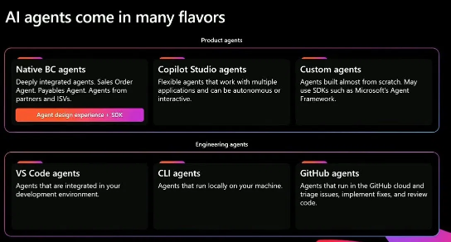
Product agents — Native BC agents (Sales Order Agent, Payables Agent, ISV/partner agents), Copilot Studio agents, custom agents built on Microsoft's Agent Framework. These run inside the Business Central application. They face end users. They post to ledgers. They have to be right.
Engineering agents — VS Code agents, CLI agents, GitHub agents. These run in your development environment, on your local machine, or in the GitHub cloud. They review code, triage issues, write tests, raise PRs. They face developers, not customers.
Microsoft just told us — explicitly, on one slide — that these agent types are operating in two different speed lanes, and they want us to think about them with that vision in mind.
The product agents live inside the BC application. They're bound by the same constraints that bind everything else in BC: accounting integrity, multi-country compliance, customer data protection, regulatory accountability. The BC application moves carefully because it has to.
The engineering agents live outside that constraint. They don't ship to anyone's production ledger. They run in your dev environment. That means Microsoft can iterate on engineering tooling at a fundamentally different pace than they can iterate on the BC application.
And that is the actual story of the week.
What got built in the speed lane
Look at what landed in the engineering-agent column across BC TechDays:
FREE Membership Required to View Full Content:
Joining MSDynamicsWorld.com gives you free, unlimited access to news, analysis, white papers, case studies, product brochures, and more. You can also receive periodic email newsletters with the latest relevant articles and content updates.
Learn more about us here