How US Financial Services Firms Are Using Predictive AI in Dynamics 365 to Win More Deals and Reduce Churn
Every insurance agency, bank, and wealth management firm in the US is sitting on a goldmine of CRM data.
The problem? Most of it just sits there.
Sales reps still rely on gut instinct to figure out which leads are worth calling back, which opportunities are likely to close, and which clients are quietly shopping around for a better rate.
That's where predictive AI in Dynamics 365 is changing the game, and firms that are adopting it now are pulling ahead fast.
Key Takeaways (TL;DR)
- Stop guessing, start predicting: Predictive AI transforms CRM data into actionable insights for smarter sales and retention decisions.
- Prioritize what matters most: Identify high-converting leads, forecast opportunities accurately, and detect churn early.
- Turn CRM into an intelligence engine: With AI-driven insights, Dynamics 365 becomes a proactive system that guides your next move.
The Real Cost of Guessing in Financial Services
Picture a mid-sized insurance brokerage in Texas with 40 sales reps.
Every morning, each rep looks at a queue of 30+ leads and decides who to call first, based on experience, intuition, and maybe a quick glance at how long a lead has been sitting in the pipeline.
That's not a system. That's a guess.
And in financial services, wrong guesses are expensive.
A misread lead costs time.
A missed churn signal costs a client.
A poorly forecasted quarter costs credibility with the board.
The firms that are winning right now aren't working harder; they're using AI predictive analytics in Dynamics 365 to know before the phone is picked up which leads are most likely to convert, and which clients are most likely to leave.
What Predictive Forecasting Actually Looks Like in Dynamics 365 CRM
Let's get concrete. Here's how this plays out across three common BFSI scenarios in the US:
1. Lead Conversion Prediction for Insurance and Banking
A loan officer at a regional bank in Ohio has 50 active leads.
Without AI, they prioritize by recency or deal size. With lead conversion prediction in Dynamics 365, each lead gets a conversion probability score, automatically calculated from historical CRM data, behavioral signals, and deal attributes.
The officer now knows that Lead A has an 82% conversion likelihood and Lead C has 14%. They spend their morning accordingly. Close rates go up. Sales cycles shrink.
This is exactly what tools like Predict4Dynamics enable, a no-code, ML-driven app built natively inside Dynamics 365 CRM that scores leads and opportunities in real time, without any data science background required.
2. Opportunity Win Forecasting for Wealth Management
A wealth advisory firm in New York is trying to forecast Q3 revenue. Traditionally, that means a manager manually reviewing every open opportunity and applying a gut-feel percentage. It's time-consuming and wildly inconsistent.
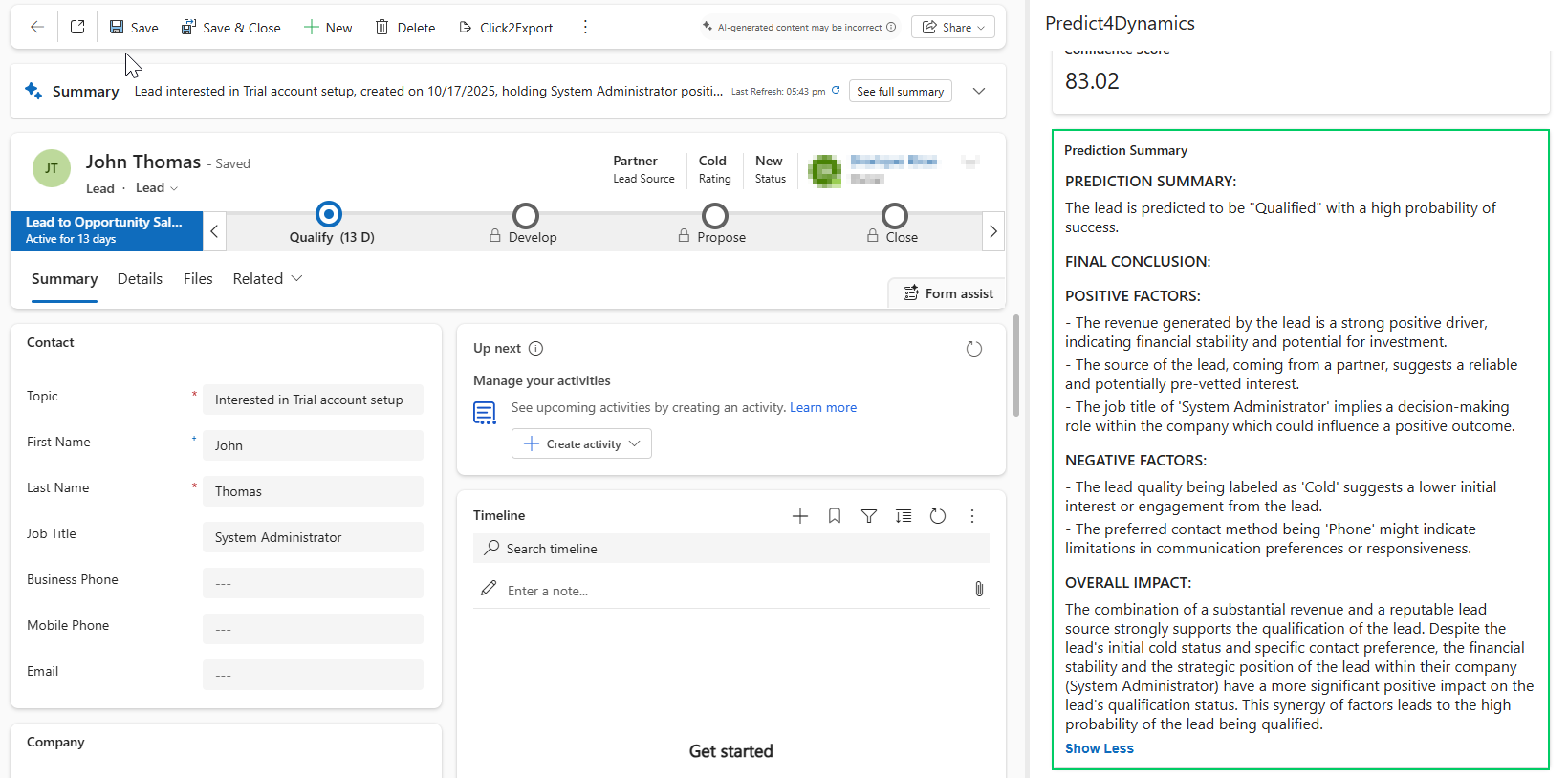
With Dynamics 365 AI forecasting tools, the CRM runs ML models on every open opportunity and surfaces a confidence score alongside a human-readable explanation:
"This opportunity is likely to close because the prospect has engaged with three proposals in the past 60 days, and deal size falls within the firm's historical win range."
That's not just a prediction, that's a reason.
And that matters enormously in financial services, where advisors and compliance teams need to understand why a system is making a recommendation, not just what it recommends.
3. Churn Prediction for Retention Teams
A regional bank in Georgia is losing commercial clients to fintechs offering better rates. The retention team only finds out a client is leaving when they call to cancel, by which point it's too late.
With predictive analytics in Dynamics 365, the CRM flags at-risk clients weeks in advance based on engagement drops, support ticket spikes, and product usage patterns. Relationship managers get an alert and a reason, so they can reach out with the right offer at the right time.
The result: proactive retention instead of reactive damage control.
Why Explainable AI Is a Big Deal for US Financial Firms
Here's something most Dynamics 365 predictive analytics tools miss entirely: in regulated industries like banking, insurance, and investment advisory, it's not enough to get a prediction. You need to explain it.
Regulators, compliance officers, and even clients increasingly want to know why a decision was made. "The AI said so" doesn't hold up in an audit.
Predict4Dynamics addresses this directly through Explainable AI powered by Azure OpenAI; every prediction comes with a plain-language explanation generated automatically. Sales reps, managers, and compliance teams can all see the reasoning behind each score without decoding a machine learning model.
What Makes This Practical (Not Just Theoretical)
A few things make predictive forecasting in Dynamics 365 genuinely usable for mid-market financial firms, not just enterprise giants:
- No code required. Admins can build, train, and deploy predictive models inside Dynamics 365 without data science expertise.
- Works on existing CRM data. No need to migrate data or build a separate data warehouse. Models train on what's already in your CRM.
- Runs inside your Azure tenant. All data stays within your organization's environment, a non-negotiable for firms with strict data governance requirements.
- Automatic triggers. Predictions update in real time whenever a record is created or updated, so reps always have current scores without manual refreshes.
Bonus: Already Know What to Predict? Now, Know What to Do Next.
Predictive scoring tells your team who to focus on. But it doesn’t always tell them what to do next.
That's where Next Best Action by Inogic comes in.
Built for Microsoft Dynamics 365, it’s an AI/ML-powered companion app that analyzes your CRM data, engagement history, and past outcomes to recommend the single most impactful next step, right on the record, in real time.
Whether it's sending a follow-up email, scheduling a call, or flagging an escalation, reps get a prioritized action card with a confidence score and a plain-language reason behind it. No guesswork, no tab-switching, no wasted touchpoints.
If Predict4Dynamics tells you a lead is hot, Next Best Action tells you exactly how to close it. Interested? Want to see how both work together inside your Dynamics 365 environment? Reach out to the Inogic team for a tailored walkthrough.
The Bottom Line
US financial services firms don't have a data problem. They have a decision-making problem. There’s too much data, and not enough clarity on what to act on.
AI predictive analytics in Dynamics 365 changes that. It transforms your CRM from a passive system of record into an active intelligence engine - one that tells your team where to focus, what’s likely to close, and which clients are at risk before the opportunity is lost..
If your firm is still forecasting by instinct instead of insight, it’s time to change that.
Explore solutions on the Inogic Website or Microsoft Marketplace to get started.
Prefer a tailored walkthrough aligned to your business goals? Reach out to the Inogic team at [email protected].
FAQs
1. What is predictive AI in Dynamics 365 CRM?
Predictive AI in Microsoft Dynamics 365 CRM uses machine learning models to analyze historical and real-time data to forecast outcomes such as lead conversion, deal closure, and customer churn. It helps sales and service teams prioritize actions based on data-driven insights rather than guesswork.
2. How does predictive AI improve lead conversion rates?
Predictive AI assigns a probability score to each lead based on past interactions, behavior signals, and deal attributes. This enables sales teams to focus on high-potential leads first, improving conversion rates while reducing time spent on low-value prospects.
3. Can Dynamics 365 predict customer churn?
Yes, Dynamics 365 can identify at-risk customers by analyzing patterns such as reduced engagement, increased support issues, or declining product usage. This allows teams to take proactive steps to retain customers before they leave.