How AI Is Quietly Changing Field Service Work
Not long ago, Artificial Intelligence was treated like a party trick. Businesses talked about it in meetings, added it to slides, and quietly wondered what it actually did. Fast forward to today, and AI has grown up. It shows up to work every day and actually helps get things done.
Today, across industries, AI is about saving time, reducing guesswork, and helping people make better decisions without staring at screens all day.
From Buzzword to Everyday Helper
AI used to live in labs and tech demos. Today, it lives inside tools people already use. Retail teams use it to predict demand.
- Manufacturing teams use it to spot faults early.
- Finance teams use it to flag risks before they become problems.
- Healthcare uses it to plan resources better.
What changed is how AI is being applied. Instead of asking users to learn new systems, AI is being built into familiar platforms and workflows. When using AI feels like part of the job instead of an extra step, adoption happens naturally.
This is also where things get interesting for field teams!
Field Work Has Always Been Hard Mode
If you have ever worked in sales, service, or field operations, you know the reality. Your job happens outside the office. While your data lives inside the systems. Somewhere between traffic, meetings, site visits, and last-minute changes, decisions still have to be made.
Field agents do not have time to dig through tables or reports while traveling. Managers do not have time to explain dashboards over calls. Everyone wants answers quickly, clearly, and preferably without logging into five different tools.
This is where AI and location intelligence meet!
Why Location Matters More Than We Admit?
Most business activity happens in the real world. Customers are in some places. Assets are in different places. Problems happen in still different places. Yet for years, businesses have been trying to manage all this through rows and columns, sheets and numbers.
The integration of maps changes that. They show locational patterns instantly. They show clusters, gaps, and priorities without explaining them. When AI is added to maps, the system helps answer questions like where to go next, who to meet first, and how to plan the day better.
This combination is quietly transforming how field teams work.
Enter MapCopilot Inside Maplytics
In this evolving world of AI, here is what Maplytics brings to the table with MapCopilot.
Maplytics already helps businesses visualize CRM data on maps inside Microsoft Dynamics 365, Dataverse, Power Pages, etc. MapCopilot takes this one step further by adding AI-based intelligence that understands users' intent.
Instead of applying filters, choosing views, and hoping the data makes sense, users can ask questions like-
- Find accounts near me
- Show leads within five miles
- Optimize my visits for today
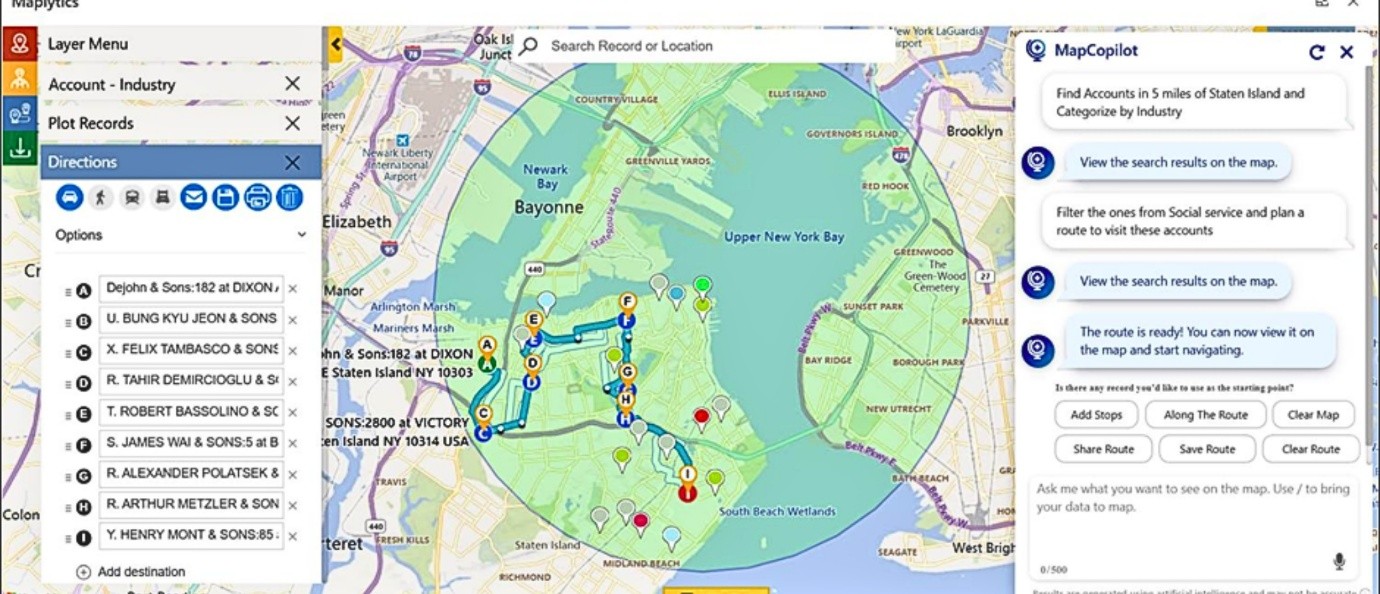
The map quickly responds like a dear friend!
How This Changes Life for Field Agents
For field agents, this feels less like using software and more like having a helpful assistant who knows the area and your clients. Instead of planning routes manually, the AI application suggests smarter paths. Instead of guessing which visit to prioritize, the map shows what makes sense based on location.
It also removes friction. No switching apps. No copying addresses into navigation tools. No second-guessing decisions while standing in a parking lot. Not using a laptop and performing all the important functions over the phone. Being hands-free and talking to the application in natural language.
The result is fewer wasted hours and less mental load. Field agents spend more time doing their actual job and less time wrestling with tools that were not designed for life on the move.
Managers Get Their Sanity Back Too
Management benefits just as much, if not more. Instead of asking for updates or exporting reports, managers can see what is happening visually, in real-time. They can understand coverage gaps, overloaded regions, and missed opportunities by simply looking at a map.
When AI is part of this picture, insights come faster. Managers do not need to be analysts. They can ask simple questions and get answers that make sense immediately.
This makes reviews more productive and planning more realistic. Decisions are based on what is actually happening on the ground, not what looks neat in a spreadsheet.
AI That Fits Into Work Instead of Disrupting It
One of the reasons why AI adoption often fails is that it asks users to change how they work. MapCopilot does the opposite. It fits into existing workflows inside Dynamics 365 and Dataverse.
Data stays secure. Permissions are respected. There is no new system to learn. This matters because businesses care about control just as much as innovation. AI works best when it feels invisible. When users forget they are using AI and simply feel that work has become easier, faster, and a little less stressful.
The Brighter Picture of AI in Business
What MapCopilot represents is not just an assistant. It reflects a larger shift in how AI is being used across industries. AI is moving away from complex setups and toward practical assistance. It is becoming less about showing intelligence and more about delivering value.
Businesses that adopt AI in this way see better results. Teams trust the tools. Adoption grows naturally. And decisions improve without dramatic change management programs.
Where This Is All Heading
AI will continue to grow, but not in flashy ways. It will quietly sit inside systems, answering questions, suggesting actions, and removing friction. Location intelligence will play a bigger role because it connects digital data to the real world.
For field teams and managers, this means fewer surprises, better planning, and more confidence in daily decisions. Maplytics with MapCopilot is also a part of this shift. Not by trying to reinvent work, but by making existing work smarter.
What’s More?
Maplytics, with its features, is available for Dynamics 365, Power Apps, Power Pages, and Dataverse. Organizations interested in adoption, 15-day free trials, or personalized demos are encouraged to contact Maplytics’ sales team at [email protected]
Happy Mapping!