Why Retail Teams Are Putting Their Entire CRM on a Map
Retail sounds simple from the outside. You make a product, find customers who want it, and get it to them. In practice, it is one of the most geographically complex operations a business can run, with raw materials moving from suppliers, goods flowing through storage units, field reps covering wholesale accounts and corporate clients, new store locations being evaluated, sample trials being coordinated with volunteers across cities, and delivery routes being planned and re-planned every single day.
Most retail businesses manage all of this from a CRM that shows them a list. Names, addresses, phone numbers, flat data with no sense of where any of it actually sits in the real world. The question that matters most in retail is-
- Where should we open next?
- Which rep covers which accounts?
- Who is the nearest wholesaler to this production facility?
We don't have answers in a list. They have answers on a map.
This is where Maplytics, the certified geo-analytical app for Microsoft Dynamics 365, Power Apps, Dataverse, and Power Pages, changes how retail teams operate.
Key Takeaways
- Visualize stores, suppliers, distributors, and customers on an interactive map instead of static CRM lists.
- Find the nearest supplier, wholesaler, or customer in seconds using proximity search.
- Help field teams save time with optimized routes, automated scheduling, and location-based check-ins.
- Use heat maps and territory management to identify growth opportunities and balance sales coverage.
- Make expansion, sourcing, and field operations more data-driven with location intelligence inside Dynamics 365.
Visualizing the Retail Network
The foundation of any retail operation is its network, suppliers, wholesalers, factory outlets, distribution points, store locations, and corporate accounts, all existing in different geographies and all needing to be managed in coordination with each other.
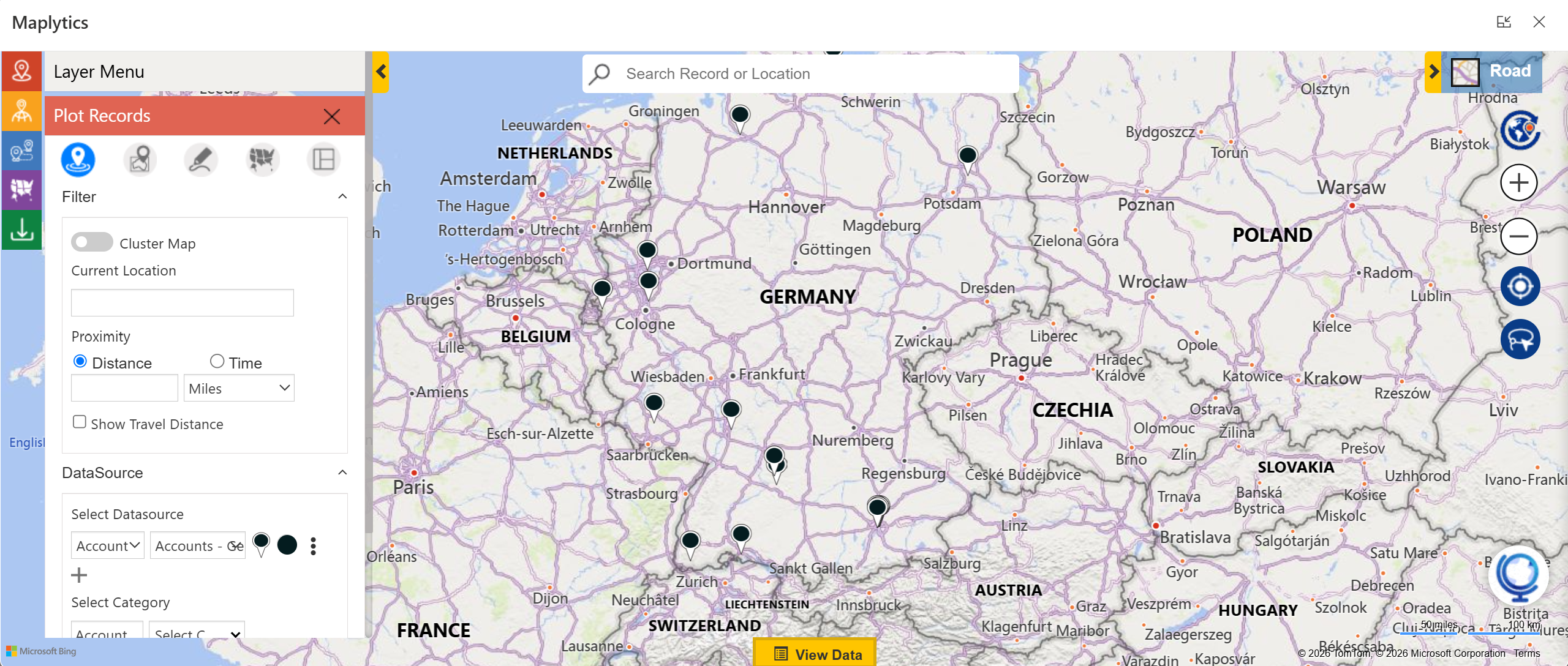
Maplytics' Map CRM Data feature plots every one of these records onto an interactive map inside Dynamics 365. A retail manager opens their CRM, and instead of scrolling through rows of supplier accounts, they see the entire supplier network geographically, color-coded by type, filterable by product category or account status, and clickable for full record details without leaving the map.
The same visualization works for identifying potential new store sites. Instead of manually cross-referencing demographic reports and location databases, retail expansion teams can plot target audience concentrations, existing store footprints, and competitor presence simultaneously, seeing the geographic case for a new location rather than building it from spreadsheets.
Custom pushpins let teams visually distinguish between a flagship store, a wholesale partner, a storage unit, and a corporate client at a glance.
No digging through filters.
No switching tabs.
The full picture, on one map.
Finding the Right Supplier or Wholesaler, Fast
Every retail operation depends on sourcing. Sourcing, at its core, is a proximity problem.
- Which approved suppliers are within a viable range of this production facility?
- Which wholesalers near this market offer the right product at the right price?
- Which factory outlets can supply samples quickly for an upcoming trial?
Maplytics' Radius or Proximity Search turns these into instant map queries. A procurement manager sets any facility as a search origin, defines a distance or travel time, layers in filters for product type or approval status, and gets a visual result in seconds. What used to require manual cross-referencing across supplier databases and mapping tools happens in one step, inside Dynamics 365, from a desktop or a phone.
For retail teams running sample trials, visiting volunteers, independent retailers, or corporate testers to collect feedback on new products, proximity search also identifies the right clusters of contacts near each other, making the logistics of a multi-stop trial run far more manageable.
Scheduling That Keeps Pace With Retail's Complexity
Retail field reps carry one of the heaviest scheduling loads of any industry. On any given day, they're visiting wholesale accounts, checking in with independent retailers, coordinating sample deliveries, conducting store audits, and handling the inevitable ad-hoc requests that retail generates constantly.
Maplytics' Auto Scheduling builds their day plans automatically, optimized by location, appointment availability, and travel time, so reps start each day with a route rather than a to-do list. New requests that come in mid-day can be slotted into an existing schedule based on proximity, instead of disrupting the entire plan.

Safety audits for storage units, maintenance visits for outlets, and compliance checks for supplier facilities can all be pre-scheduled and tracked within the same system, with Check-In and Geofencing confirming that visits actually happened at the right location and time.
Route Optimization for a Moving Operation
In retail, goods move constantly, raw materials in, finished products out, delivery carriers on the road, field reps across territories. Every unnecessary kilometer costs time and money, and in a margin-sensitive industry, that adds up quickly.
Route Optimization in Maplytics automatically sequences multi-stop routes for field reps and delivery teams, factoring in traffic, tolls, and highways to find the most efficient path. Saved routes can be reused, emailed to drivers, and printed with turn-by-turn navigation, removing the daily friction of route planning entirely.
Heat Maps and Territory Management for Growth
- Where is demand growing?
- Where is the rep coverage thin relative to account density?
- Where is a competitor gaining ground before you've noticed?
Heat Map Visualization answers all three, overlaying account concentration, revenue density, and visit frequency across geographies to surface patterns that a list view buries. Territory Management then lets regional managers draw, assign, and rebalance sales territories directly on the map, ensuring reps are distributed against actual opportunity rather than historical assumption.
For a retail business with ambitions to expand, new cities, new store formats, and new wholesale partnerships, this geographic intelligence is the difference between growing strategically and growing by gut feel.
Retail is a geographic business. The supplier is somewhere. The customer is somewhere. The next store should be somewhere specific. Maplytics makes sure every decision about where is made with the clearest possible picture of what's actually there.
What's More?
Maplytics, with its AI assistant, MapCopilot, adapts to the shape of your business. Whether your mapping needs run on Bing Maps, Azure Maps, Google Maps, Apple Maps, or ESRI ArcGIS, Maplytics makes the integration inside Dynamics 365 feel seamless, from Radius Search and Route Mapping to Territory Management and Heat Map analysis, etc. To experience it first-hand, you can have a 15-day free trial of get a personalised demo inside Microsoft Dynamics 365 CRM, Power Apps, Power Pages, or Dataverse, get in touch at [email protected], or explore more at the Website and Microsoft Marketplace.