Beyond the Item Cost: What Static Costs and Prices Are Really Costing Distributors
Most distributors know what they paid for a product. Far fewer know what it truly costs them to sell it or what their pricing is quietly losing while the market moves. Discover why formula-driven pricing is becoming essential for protecting margins in today's volatile market.
Our CEO's Perspective
"Revenue growth is important, but protecting every dollar of margin is equally critical. Organizations that eliminate pricing and rebate leakage achieve higher profitability without increasing sales revenue"
— Gajendra Pareek, CEO, Vyas Consulting
Most Distributors Know What They Paid. Fewer Know What It Actually Costs.
A distributor can tell you exactly what they paid for an item.
That's usually easy.
What's harder is answering a much more important question:
What does it actually cost to sell that item today?
For many organizations, those two numbers are not the same.
The item cost sitting in the ERP may represent what was paid weeks ago. Meanwhile, freight rates have changed. Vendor pricing has shifted. Tariffs have moved. Handling costs have increased.
Yet pricing decisions continue to be made using a number that no longer reflects reality.
That's where margin erosion begins not through bad pricing decisions, but through outdated cost assumptions.
Every distributor recognizes the day-to-day version of this.
A vendor sends a new price list. Someone opens the spreadsheet, checks which SKUs are affected, cross-references tariff codes, updates freight assumptions, and pushes changes into the ERP. Industry benchmarks put that work at 15–30 hours a week for a single pricing analyst at a mid-sized distributor (Intuilize). The typical lag between a vendor cost increase and a customer-facing price update runs about two weeks (Intuilize case study).
Two weeks of orders shipping. Priced against costs that no longer exist.
The damage is measurable. Benchmark research puts average margin erosion from delayed cost updates at 1.6% (Intuilize). On distribution operating margins that typically sit at 3–4% (Intuilize).
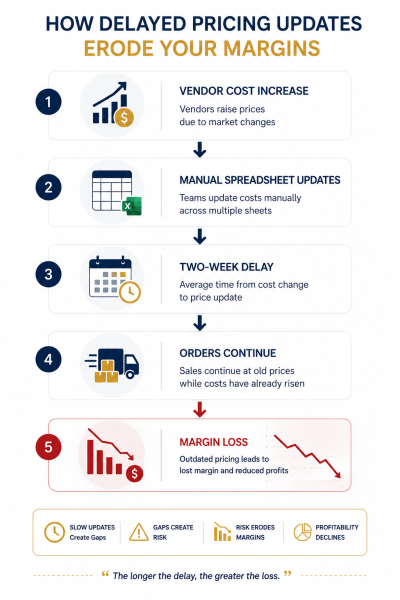
One $45M distributor documented $250,000 in annual losses from delayed cost updates on just 7% of its catalogue (Intuilize case study).
The 2026 backdrop compounds it. Diesel climbed nearly 40% to $5.40 a gallon in a matter of weeks (Transport Topics). Every change touched landed cost and everyone had to be traced back to the SKUs it affected.
And the pricing layer is worse.
Because even when the cost is finally updated, the price built on top of it usually isn't. Traditional pricing is stored as a value a rate agreed with a customer, a discount grid set for a segment, a fixed number sitting in an agreement. When the cost moves, those stored values don't move with it. Someone has to open them, revisit them, and change them one by one.
Industry research puts margin erosion from that slow reaction, the gap between a cost change and the pricing catching up at roughly 6% (Intuilize). That's on top of the 1.6% already lost on the cost side.
The pattern behind both problems is the same.
Cost and price are both being stored as final numbers snapshots frozen in a system while the world underneath keeps moving.
The alternative is to stop storing the answer and start maintaining the inputs.
If freight, duties, tariffs, and handling are held as living inputs connected to the factors that drive them cost stops being a stored value. It becomes a calculated result. When a driver moves, cost moves with it.
And if pricing is built on top of that live cost using a method rather than a stored value the price recalculates whenever the basis does.
There is nothing static in the chain left to fall out of date.
That's the shift.
Vyas Advanced Intuitive Pricing is built around that shift.
On the cost side, the line items that make up landed cost; freight, duties, tariffs, handling are maintained separately, as the components that drive it. When any one of them changes, Vyas Advanced Intuitive Pricing updates every impacted cost automatically. The two-week gap closes. The 15–30 hours a week goes back to the pricing team.
On the price side, distributors don't have to store customer prices as fixed values. Instead, they can use dynamic methods pricing logic that applies a margin percentage on top of cost or deducts a discount percentage from a list price. Several other dynamic methods are supported as well.
Nothing sits downstream as a stored, decaying value.
When the basis moves, pricing moves with it.
The Future Vision
Volatility in 2026 isn't a phase. Tariff regimes are shifting quarter to quarter. Fuel prices are moving in double-digit percentages inside a single quarter. Vendor lists are refreshing faster than most ERPs are set up to absorb.
The distributors who hold their margins through the next cycle will be the ones that stop treating cost and price as static values in a database. The ones that connect their pricing to the drivers underneath it and let the system do the propagation the market is already forcing on them.
Pricing stops being a maintenance job.
It becomes a live signal.
FAQs
How much margin do distributors actually lose to outdated costs?
Benchmark research puts average margin erosion from delayed cost updates at 1.6%, with another ~6% lost from pricing that fails to catch up after a cost change. On operating margins that typically sit at just 3–4%, that's significant.
Why does it take so long to update prices after a cost change?
Both cost and price are usually stored as fixed values. When a vendor sends a new price list, someone has to manually check affected SKUs, cross-reference tariff codes, update freight assumptions, and push changes through an estimated 15–30 hours a week for a single analyst. The typical lag between a cost increase and a customer-facing price update is about two weeks.
What is dynamic pricing?
Instead of storing a customer price as a fixed number, you define the logic for example, a set margin percentage on top of cost, or a discount percentage off a list price. When the underlying cost moves, the price moves with it automatically.
Connect With Us:
See how Vyas Advanced Intuitive Pricing keeps costs live, keeps prices moving, and takes the manual work out of both.
At Vyas Consulting, we help distributors protect revenue and scale profitably with Microsoft Dynamics 365 for wholesale distribution and our industry-specific ISV solutions.
Visit vyasconsulting.com and connect with [email protected] for a CXO-level conversation on how leading distributors are turning challenges into opportunities.