Finance Where I'm From: Electronic Invoicing and Tax Compliance in Mexico with Microsoft Dynamics 365 Business Central
If you ask finance professionals around the world to explain what an invoice is, most will describe a document you create, send to your customer, and record in your books. Ask the same question in Mexico and you'll get a different answer: an invoice is something the government approves. That difference explains much about how finance teams work here, and it's usually the first thing we have to explain to companies bringing Business Central into the country.
Mexico's electronic invoicing regime, the CFDI (Comprobante Fiscal Digital por Internet), has been mandatory for essentially all businesses for over a decade, and it has grown into one of the most sophisticated systems of its kind anywhere. Every invoice, credit note, payroll receipt, and transport document is a structured XML file that must be digitally sealed and certified before it has any legal value. In this article I want to walk through the two parts of this system that most surprise finance teams arriving from abroad: the certification cycle itself, and a uniquely Mexican document called the payment complement.
The CFDI cycle: Certification before anything else
Here's how issuing an invoice with Business Central actually works in Mexico. BC generates the CFDI as an XML file with the structure the SAT (the Mexican tax authority) defines, currently version 4.0. The file is signed with the company's digital seal certificate, and then it goes to a PAC (Proveedor Autorizado de Certificación), one of the private companies the SAT authorizes to validate and certify invoices on its behalf. The PAC checks the document, stamps it with a unique folio (the UUID), and reports it to the SAT. Only at that moment does the invoice legally exist. All of this happens in seconds, and it happens before your customer ever sees the document.
For the finance team, this standard shapes daily work. The customer's tax ID, postal code, tax regime, and the intended use of the invoice all have to be exactly right, because the validation is strict. A mismatch means the PAC rejects the document, and a rejected document means you haven't invoiced. Master data quality determines whether your team is billing today or tomorrow.
In our BC implementations, cleaning up customer records is often where a Mexico project spends its first weeks, and it pays for itself immediately.
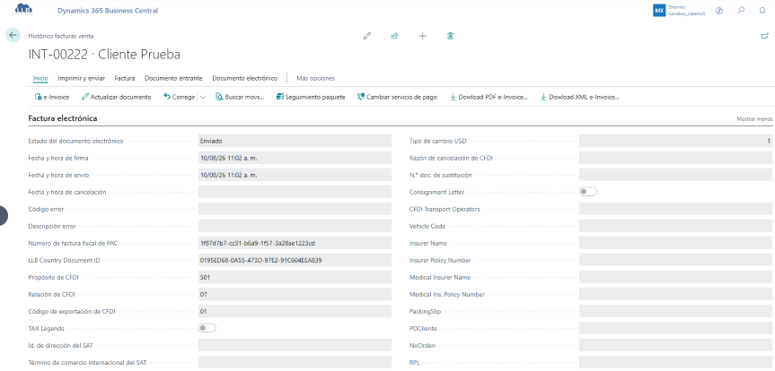
Cancelling an invoice is also different here. You don't simply void it. Since 2022, most cancellations require stating a reason code, and in many cases the customer has to formally accept the cancellation through the SAT's systems before it takes effect. The ERP needs to track that request-and-acceptance flow, because until it completes, the original invoice is still alive for tax purposes.
The payment complement: invoicing the payment itself
The second thing that surprises people is that in Mexico, collecting a payment can also require issuing a CFDI.
FREE Membership Required to View Full Content:
Joining MSDynamicsWorld.com gives you free, unlimited access to news, analysis, white papers, case studies, product brochures, and more. You can also receive periodic email newsletters with the latest relevant articles and content updates.
Learn more about us here