AMCS vs. Microsoft's New Multi-Company Financial Journals: What's the Difference?
Microsoft announced that it is rebuilding financial journals in Dynamics 365 Finance. Of course, for multi-company finance teams, that's good news, and it raises a fair question for customers running AMCS (Avantiico Multi-Company Solution): if D365 now handles multi-company journals, where does AMCS fit? The answer is the serve two different, but equally essential, jobs. Microsoft is improving the engine that creates, validates and posts journals. AMCS gets the data to that engine and automates everything around it.
Ultimately, what’s important to understand is that AMCS aligns perfectly with Microsoft’s future roadmap, and when used with this newly announced capability, it is transformative for multi-entity organizations. Here is what you need to know about how they are different and how they complement each other to achieve end-to-end optimization.
What Microsoft Announced
To better understand the game-changing potential of Microsoft’s newly announced multi-entity functionality for Dynamics 365 Finance journals, it’s important that you have some context. Here is what Microsoft announced (and what it means for you):
- Faster posting. Microsoft says the new framework processes journals 5 to 300 times faster. That's Microsoft's figure; Avantiico hasn't tested it yet.
- A simpler data model. Financial dimensions are stored as readable values (up to 20) instead of a single combination ID, which makes reporting easier.
- Multi-company entry. Vouchers for different legal entities can sit in one journal, and one problem voucher no longer holds up the rest.
- A phased rollout. Ledger account journals come first, with more journal types to follow. Existing journals are not being deprecated.
In other words, the standard Microsoft process has just gotten better.
Where AMCS Fits
Every journal imported through AMCS goes through five steps. AMCS runs the first two. The last three are standard D365 code that AMCS triggers through standard APIs, and that's exactly the part Microsoft is speeding up.
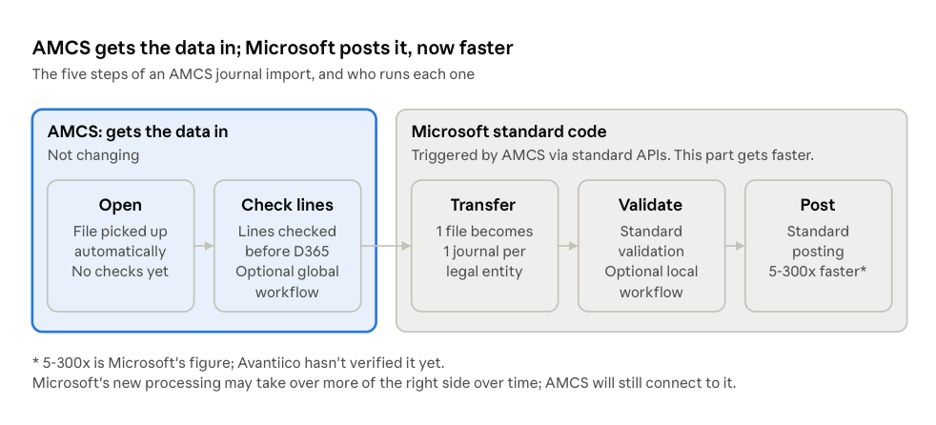
In practice, AMCS takes a single file covering many legal entities, from Excel, CSV, payroll, point of sale, expense or other systems. It maps the data to your financial dimensions and checks every line before anything reaches D365.
Approvals run in Teams or Outlook, and processing can run on a schedule. Then AMCS splits the file into one journal per legal entity and hands them to Microsoft to validate and post.
Essentially, AMCS is the front end of the process to get the data into D365 F&O, and now, Microsoft is just making it faster and easier to process that into journals.
Classic or New journals: AMCS Covers Both
For companies already live on D365, moving to the new framework changes the table structure underneath. It's still unclear how historical data and existing reports will carry over, and we expect many companies to take their time, or to never switch at all. For those:
- Staying on classic journals, nothing changes. AMCS keeps delivering the same imports, validation, approvals and automation.
- Moving to the new journals, they will enjoy the same AMCS but with faster processing. Once Microsoft's new journal features reach public preview, AMCS will support them, set with a parameter in AMCS.
On the AMCS side, the good news is that change is narrow. Only ledger Super Journals gain new-framework support. Other Super Journals, data imports, iPaaS integrations, global reports, workflows, legal entity creation, and budgeting and allocations stay as they are.
Learn How AMCS and Microsoft’s New Multi-Company Journal Capabilities Work to Transform Your Multi-Entity Org
The bottom line is that AMCS isn't competing with Microsoft, but rather, it aligns with Microsoft's roadmap: when Microsoft improves how journals are processed, AMCS adopts it as quickly as possible. Microsoft's new journals make the engine faster, but they don't solve the import and automation problems AMCS was built for. Together, they're the combined package multi-company customers will need. Try AMCS Lite for FREE today.