Warehouse Automation: Types, Technologies, Benefits, and Costs
Warehouses have changed a lot in recent years. What was once a place where employees manually received products, counted stock, picked orders, packed boxes, and moved goods is now becoming faster and more connected. Businesses are using machines, software, sensors, robots, and real-time data to complete warehouse tasks with less manual effort.
This is where Warehouse Automation comes in.
In simple terms, Warehouse Automation means using technology to perform warehouse activities automatically or with much less human intervention. It can be as simple as using barcode scanners and conveyor belts or as advanced as using autonomous mobile robots, automated storage systems, and artificial intelligence.
Businesses of all sizes are exploring warehouse automation solutions and warehouse management systems because customers expect faster deliveries, accurate orders, and real-time inventory visibility. At the same time, warehouse labor costs are increasing, product ranges are expanding, and order volumes can change quickly.
But automation is not a single machine or software product. It is a combination of technologies selected according to the needs of a warehouse.
This guide explains what warehouse automation is, the major types and technologies, its benefits, implementation considerations, and expected costs.
Need Complete Warehouse Automation at Affordable Price from Industry Experts?
What Is Warehouse Automation?
Warehouse automation is the use of equipment, software, robotics, and digital technologies to automate repetitive warehouse processes.
Imagine a customer places an online order.
In a traditional warehouse, an employee may:
- Check the order.
- Find the products.
- Walk to the storage location.
- Pick the items.
- Take them to the packing area.
- Print a shipping label.
- Move the package for dispatch.
In an automated environment, software may send the order to a warehouse control system. A robot or conveyor can move the product, while barcode scanners verify the items and software updates inventory automatically.
The level of automation can vary significantly. A company does not need a fully robotic warehouse to benefit from automation.
For example, a small warehouse might start with barcode scanning and automated inventory updates. A larger operation could use conveyors, automated storage and retrieval systems, robotic picking, and autonomous robots.
The right approach depends on order volume, warehouse size, product characteristics, labor availability, and business goals.
Warehouse Automation vs. Traditional Warehousing
Traditional warehouses depend heavily on manual work. Employees may spend hours walking, searching for products, entering information, and moving inventory.
Automation reduces the amount of manual work involved in these activities.
For example:
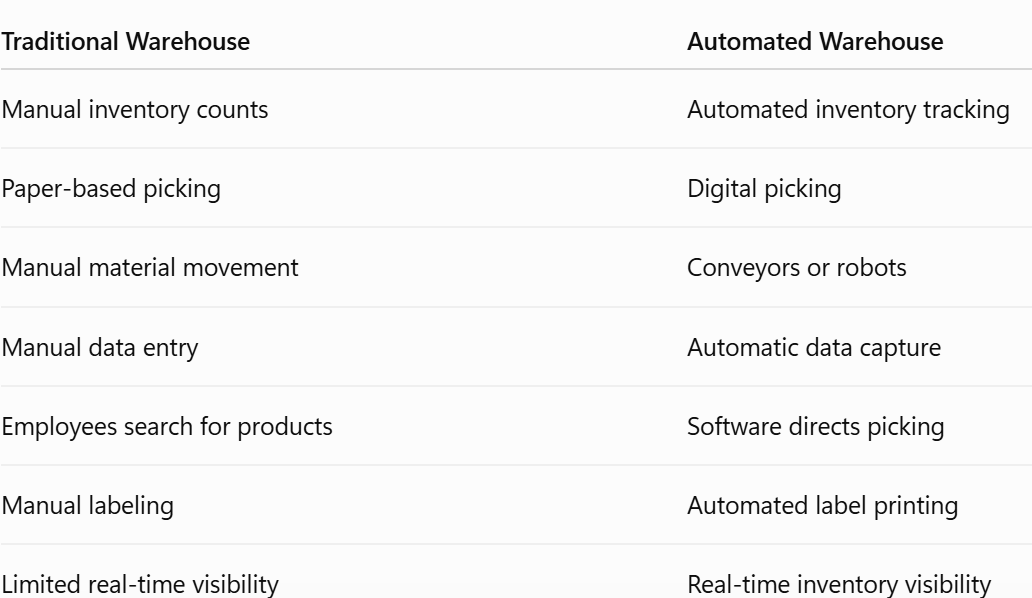
However, automation does not necessarily mean removing people from the warehouse.
In many cases, the goal is to help employees work more efficiently. People can focus on activities that require judgment, problem-solving, quality checks, customer issues, and exception handling while machines handle repetitive movements.
Good Read: 10 Top 3PL Warehouse Management Systems
Major Types of Warehouse Automation
There are several types of warehouse automation. They can be grouped into different categories depending on what task they perform.
1. Conveyor Automation
Conveyors are one of the most common forms of warehouse automation.
They move products from one location to another without requiring employees to carry them manually.
For example, a conveyor can transport picked products from the storage area to packing stations.
Different conveyor designs are available, including:
- Belt conveyors
- Roller conveyors
- Sortation conveyors
- Flexible conveyors
- Chain conveyors
Conveyors work particularly well in warehouses with predictable product movement and high order volumes.
They can also be connected with scanners and warehouse management software so products are automatically routed to the correct destination.
2. Automated Storage and Retrieval Systems
Automated Storage and Retrieval Systems, commonly called AS/RS, use automated equipment to store and retrieve inventory.
Instead of an employee walking through storage aisles and manually locating a product, a machine retrieves the required inventory.
AS/RS can be useful where:
- Storage space is expensive
- Inventory volume is high
- Accurate storage locations are important
- Fast retrieval is required
- Vertical warehouse space needs to be used
Different AS/RS systems are designed for different products, weights, and warehouse layouts.
3. Automated Guided Vehicles
Automated Guided Vehicles, or AGVs, are vehicles that move materials around a warehouse along predefined routes.
AGV warehouse automation can be used for transporting pallets, containers, carts, and other materials.
AGVs normally follow planned paths using technologies such as magnetic strips, markers, sensors, or other navigation methods.
They can reduce the need for employees to repeatedly transport materials between fixed locations.
However, AGVs generally operate differently from more flexible autonomous mobile robots because they are designed around established routes and workflows.
4. Autonomous Mobile Robots
Autonomous Mobile Robots, or AMRs, can move around warehouse environments and dynamically navigate their surroundings.
Unlike many traditional AGVs, AMRs can use cameras, sensors, maps, and navigation software to select routes.
This makes them useful for changing warehouse environments.
For example, an AMR can transport picked inventory from a storage location to a packing station. It may also assist workers by bringing shelves, bins, or products to designated locations.
Warehouse automation robots can therefore support picking, transportation, replenishment, sorting, and other warehouse processes.
5. Robotic Picking
Picking is one of the most labor-intensive warehouse activities.
Robotic picking systems use cameras, artificial intelligence, robotic arms, grippers, and software to identify and move products.
These systems can be particularly useful when warehouses handle large numbers of repetitive picking tasks.
Robotic picking can also work alongside human employees.
For example, an employee might handle complex or fragile products while a robot manages standardized items.
6. Automated Sorting
Sorting systems automatically identify and route products to the right location.
A sorting system may use barcode scanners, cameras, sensors, and conveyor systems.
For example, orders going to different shipping carriers can be automatically directed to separate lanes.
This can reduce manual sorting work and help prevent packages from going to the wrong destination.
Good Read: Top Business Central Partners in 2026
Key Warehouse Automation Technology
Modern warehouses rarely depend on a single technology. Instead, different systems communicate with one another.
Important technologies include:
Barcode and RFID
Barcodes are widely used to identify inventory.
RFID, or radio-frequency identification, allows products and containers to be identified using radio signals.
Sensors
Sensors can detect movement, location, temperature, weight, and other conditions.
Artificial Intelligence
AI can analyze warehouse data and support demand forecasting, inventory planning, route optimization, and robotic operations.
Computer Vision
Cameras and computer vision systems can recognize products, read labels, detect objects, and support robotic picking.
Internet of Things
IoT devices connect equipment and sensors to software platforms so businesses can monitor operations.
Cloud Computing
Cloud-based systems make warehouse data accessible across locations and devices.
Together, these technologies form the foundation of modern warehouse automation technology.
As warehouses become more connected, the ability to integrate machines and software becomes just as important as the individual machines themselves.
Good Read: Best Vendor Management Software
What Is Warehouse Automation Software?
Equipment alone cannot create an intelligent warehouse.
Software tells equipment what needs to happen.
Warehouse automation software can connect orders, inventory, warehouse locations, machines, scanners, and employees in one operating environment.
For example, when a customer order enters the system, software can determine:
- Which inventory should be picked
- Where that inventory is located
- Which picking method should be used
- Which robot or conveyor should move the item
- When inventory should be replenished
- Where the finished order should go
A Warehouse Management System, or WMS, often plays a central role in these processes.
The WMS maintains inventory information and coordinates warehouse activities, while specialized automation systems can control machines and equipment.
A strong integration between the WMS and automation equipment helps create a connected warehouse rather than a collection of separate technologies.
What Are the Benefits of Warehouse Automation?
The benefits of warehouse automation go beyond simply reducing manual work.
1. Improved Productivity
Machines can perform repetitive activities continuously and consistently.
Employees can spend less time walking and transporting inventory and more time handling tasks that require human judgment.
2. Better Inventory Accuracy
Manual data entry creates opportunities for mistakes.
Automated scanning and system-based inventory updates can reduce data-entry errors and give warehouse teams better visibility into available stock.
When inventory records are accurate, businesses can make better purchasing and fulfillment decisions.
3. Faster Order Fulfillment
Customers increasingly expect fast delivery.
Automation can shorten the time required to locate, pick, sort, and move products.
For high-volume warehouses, even small efficiency improvements can have a significant effect on daily throughput.
4. Reduced Physical Work
Moving heavy products repeatedly can be physically demanding.
Robots, conveyors, lifts, and automated vehicles can handle many material movement tasks.
Employees can therefore spend less time performing repetitive physical activities.
5. Better Use of Warehouse Space
Some automated storage systems can use vertical space more efficiently than traditional storage layouts.
This can be especially useful in warehouses where expanding the physical building is expensive.
6. Improved Order Accuracy
Scanning systems and automated verification can help make sure the correct product is picked and packed.
This can reduce returns, customer complaints, and the cost associated with incorrect shipments.
7. Better Scalability
Automation can help businesses handle increased order volumes without increasing manual work at the same rate.
This is particularly important for eCommerce businesses and companies dealing with seasonal demand.
8. Better Safety
Automation can reduce the amount of repetitive lifting, carrying, and movement performed by employees.
Safety still depends on proper system design, training, maintenance, and operational procedures, but automation can reduce exposure to certain repetitive physical tasks.
Warehouse Automation Trends
The industry continues to move toward more connected and intelligent systems.
Some important warehouse automation trends include greater use of AI, autonomous mobile robots, computer vision, predictive analytics, cloud platforms, and flexible automation.
Another important trend is the move toward modular automation.
Instead of investing in a complete automated warehouse immediately, businesses can automate specific processes and expand later.
This approach can make automation easier to introduce and can reduce the risk of making a very large upfront investment before the operating model is proven.
Businesses are also increasingly interested in real-time visibility. Knowing where inventory is, what is being picked, what is delayed, and what equipment is operating can help managers react faster.
How Warehouse Automation Works With a WMS
Automation becomes more valuable when connected with warehouse management software.
A WMS can act as the operational brain of the warehouse.
For example:
Customer order → WMS → Pick task → Robot/Employee → Verification → Packing → Shipping
The WMS can determine what needs to be picked and in what sequence. Automation equipment then performs the physical movement.
The system can also update inventory after an item is picked.
This creates a continuous flow of information.
For example, a business using warehouse automation robotics can connect robots with its WMS so the system knows which items need to be moved and where those items should go.
This integration is particularly important when warehouse automation is being used alongside ERP systems such as Microsoft Dynamics 365 Business Central.
Warehouse Automation Robotics
The phrase warehouse automation robotics covers a wide range of robotic technologies.
Some robots move goods. Others pick products, sort packages, transport carts, or assist employees.
Robotic systems can include:
- AMRs
- AGVs
- Robotic arms
- Picking robots
- Palletizing robots
- Depalletizing robots
- Sorting robots
The best robotic system depends heavily on the type of inventory.
A robot designed for boxes may not be suitable for fragile products, irregular items, liquids, or products with unusual shapes.
That is why businesses should first understand their processes before buying robotics equipment.
Robotic Warehouse Automation
Robotic warehouse automation is particularly useful in environments where repetitive material handling occurs throughout the day.
Consider an eCommerce fulfillment center.
Employees may need to move thousands of products from storage shelves to picking and packing areas.
Instead of employees repeatedly walking long distances, robots can transport materials.
The result can be a more efficient workflow in which people and machines each handle the tasks they are best suited for.
However, robotics does not automatically solve every warehouse problem. Poor inventory data, inefficient warehouse layouts, weak processes, and inaccurate product information can still cause problems.
Automation works best when the underlying process is well designed.
Warehouse Automation Solutions for Different Business Sizes
Not every company needs the same level of automation.
Small Warehouses
Small warehouses may begin with:
- Barcode scanners
- Mobile devices
- Inventory software
- Automated reorder alerts
- Digital picking
- Label automation
These technologies are relatively simple and can provide meaningful improvements.
Mid-Sized Warehouses
Mid-sized operations may add:
- Conveyors
- Automated sorting
- Pick-to-light systems
- Mobile robots
- Automated replenishment
- Advanced WMS functionality
Large Warehouses
Large facilities may use:
- AS/RS
- AMRs
- AGVs
- Robotic picking
- Automated sorting
- AI-based optimization
- Advanced warehouse control systems
The key principle is that automation should solve a business problem rather than being purchased simply because it is technologically advanced.
How Much Does Warehouse Automation Cost?
The cost of automation varies significantly.
There is no universal price because every warehouse has a different layout, product mix, order volume, technology requirement, and integration environment.
Some basic automation projects can cost relatively little, while highly automated facilities can require substantial investment.
Typical cost factors include:
Cost Factor
What It Includes
Equipment
Conveyors, robots, scanners, lifts, AS/RS
Software
WMS, WES, automation control software
Integration
Connecting systems and equipment
Infrastructure
Electrical work, networking, layouts
Installation
Equipment setup and commissioning
Training
Employee and administrator training
Maintenance
Repairs, service, parts, support
Consulting
Process design and implementation planning
Companies should calculate the total cost rather than looking only at the equipment purchase price.
For example, a robot may appear affordable initially but require significant integration, maintenance, infrastructure, and software costs.
On the other hand, a simple barcode-based automation project may deliver meaningful improvements with a much smaller investment.
Understanding Automation ROI
Return on investment, or ROI, is one of the most important factors when evaluating automation.
A company can compare the investment with expected savings and operational improvements.
Potential financial benefits can come from:
- Lower labor requirements for repetitive tasks
- Higher order throughput
- Fewer picking errors
- Lower inventory losses
- Better warehouse space utilization
- Reduced overtime
- Faster order processing
For example, assume a warehouse invests $200,000 in automation and expects measurable annual savings and additional contribution of $80,000.
A simple payback calculation would consider how long it takes to recover the initial investment.
However, companies should also consider less obvious benefits such as improved customer service, reduced errors, additional capacity, and the ability to handle growth without immediately expanding the workforce.
Warehouse Automation Companies: What Should You Look For?
There are many warehouse automation companies offering different technologies.
One company may specialize in mobile robots, another in conveyor systems, and another in warehouse software.
Before selecting a vendor, businesses should evaluate:
Integration
Can the technology integrate with the existing WMS, ERP, and other systems?
Scalability
Can the solution expand as order volume grows?
Product Compatibility
Can it handle the company's actual inventory?
Support
What technical and operational support is provided after implementation?
Implementation
How long will installation and integration take?
Total Cost of Ownership
What will the company pay over the entire life of the system?
The cheapest solution is not necessarily the most suitable, and the most advanced solution may be unnecessary for a smaller operation.
Warehouse Automation Consulting
Many businesses start by purchasing technology without first analyzing their processes.
This can create expensive problems.
Warehouse automation consulting can help businesses evaluate their current warehouse operations and identify suitable areas for automation.
A consulting assessment may review:
- Warehouse layout
- Order volume
- SKU count
- Picking processes
- Inventory accuracy
- Labor utilization
- Material movement
- Technology infrastructure
- WMS capabilities
- Future growth expectations
The goal is to identify where automation can create measurable value.
For example, a warehouse might discover that its biggest problem is not picking but internal material transportation. In that case, AMRs may provide greater value than expensive robotic picking systems.
Common Challenges of Warehouse Automation
Automation has many potential advantages, but it also creates challenges.
High Initial Investment
Automation equipment can require substantial capital.
This is why businesses should establish a clear ROI model before starting a project.
Integration Complexity
Connecting robots, WMS platforms, ERP systems, scanners, and other technologies can require technical expertise.
Maintenance
Machines require regular maintenance.
Unexpected downtime can affect warehouse performance, particularly when critical processes depend on automated equipment.
Employee Training
Employees must understand how to work safely with automated systems.
Training should cover both normal workflows and exception handling.
Process Changes
Automation often changes how employees perform daily tasks.
Businesses need proper change management to make the transition successful.
Warehouse Automation News and Industry Updates
Companies evaluating automation should also keep an eye on industry developments.
Searches such as warehouse automation news can help businesses monitor new robotics systems, software capabilities, partnerships, investments, and emerging technologies.
However, businesses should not make technology decisions based solely on headlines.
What works for a large fulfillment center may not make sense for a smaller distributor.
The important question is always:
Does this technology solve a problem in my warehouse?
Businesses can also follow warehouse automation news today to understand how the market is developing and what types of automation are receiving attention.
At the same time, decision-makers should distinguish between a marketing announcement and a technology that has been proven in an environment similar to their own.
Warehouse Automation Updates and Developments to Watch
Regular warehouse automation updates can provide useful information about robotics, AI, sensors, warehouse software, and material-handling technologies.
For businesses planning future investments, it is useful to watch developments in areas such as:
- AI-powered warehouse planning
- Computer vision
- Autonomous robots
- Flexible picking systems
- Real-time inventory visibility
- Predictive maintenance
- Connected warehouse equipment
The focus should remain on practical business value rather than simply following the newest technology.
For example, warehouse automation news 2026 may highlight new robotic solutions, but a company should still evaluate whether those solutions fit its products, processes, warehouse layout, and budget.
The same principle applies when reviewing warehouse automation news 2026 from vendors, industry publications, and technology providers.
Warehouse Automation Systems and Software
A complete automated warehouse can involve several connected systems.
Warehouse automation systems may include:
- WMS
- Warehouse Control Systems
- Warehouse Execution Systems
- Conveyor controllers
- Robot management platforms
- Scanning systems
- Sortation systems
- Automated storage systems
The role of each system can vary.
A WMS typically manages inventory and warehouse workflows. A warehouse control system can coordinate automated equipment. Robot management software may manage individual robots and their tasks.
The systems need to communicate effectively.
This is why software integration should be considered during the early planning stage, not after the equipment has already been purchased.
Do Not Confuse Warehouse Automation With Data Warehouse Automation
There is an important terminology issue worth explaining.
Data warehouse automation is not the same thing as physical warehouse automation.
A physical warehouse stores products such as electronics, clothing, food, machinery, or spare parts.
A data warehouse stores digital information.
What is data warehouse automation? It is the use of software and automated processes to help build, manage, test, document, and maintain data warehouse environments.
This technology is used in data and analytics projects rather than physical material handling.
Businesses searching for what is data warehouse automation should therefore pay attention to the context of the phrase.
The distinction matters because the technologies, vendors, objectives, and implementation methods are completely different.
For physical logistics operations, the focus is on inventory, movement, picking, storage, transportation, and fulfillment.
Data Warehouse Automation Tools Are Different
Because the terminology can be confusing, data warehouse automation tools should not be confused with warehouse robotics or WMS products.
Data warehouse tools generally help organizations automate data engineering tasks such as:
- Data pipeline creation
- Data transformation
- Database modeling
- Data testing
- Documentation
- Data integration
Similarly, data warehouse automation software is designed to support digital data environments.
This is fundamentally different from warehouse management software, which manages physical inventory and warehouse operations.
Companies should therefore use clear terminology when researching technology.
A search for data warehouse automation can produce results about analytics and databases, while a search for warehouse automation technology generally refers to physical warehouse processes.
The Future of Warehouse Automation
Warehouse automation is moving toward greater flexibility.
Early automation systems often worked best in stable, highly predictable environments. Newer systems are increasingly designed to handle changing inventory, dynamic workflows, and variable order volumes.
AI can help systems make better decisions. Computer vision can help robots identify objects. Mobile robots can navigate dynamic environments. Cloud platforms can provide access to operational information across locations.
The goal is not simply to automate more tasks.
The bigger goal is to create a warehouse that is:
- Faster
- More accurate
- More flexible
- Easier to scale
- More data-driven
For many companies, the future will involve a combination of people, software, machines, and robotics rather than a completely human-free warehouse.
How to Start a Warehouse Automation Project
A successful automation project should start with the business problem.
Step 1: Analyze Current Processes
Document receiving, putaway, storage, picking, packing, replenishment, and shipping.
Step 2: Identify Bottlenecks
Find processes that consume excessive time, labor, space, or money.
Step 3: Define Goals
Set measurable targets such as:
- Higher order throughput
- Better inventory accuracy
- Faster picking
- Lower operational costs
- Fewer errors
Step 4: Select Suitable Technology
Choose automation based on the actual process requirements.
Step 5: Evaluate Integration
Check how the new equipment will communicate with your WMS, ERP, and other systems.
Step 6: Start With a Pilot
A pilot project can help validate assumptions before a larger deployment.
Step 7: Measure Results
Track productivity, accuracy, order cycle time, costs, downtime, and other relevant metrics.
This structured approach helps companies avoid investing in automation simply because a particular technology is popular.
Final Thoughts
Warehouse automation is no longer limited to massive distribution centers.
Businesses can automate individual warehouse processes using technologies ranging from barcode scanning and conveyors to AMRs, AGVs, robotic picking, automated storage systems, and intelligent software.
The right approach depends on the warehouse.
For one business, barcode scanning and a modern WMS may be enough. Another may benefit from mobile robots and automated sorting. A high-volume operation may require a more advanced combination of robotics, conveyors, AS/RS, and software.
The most important thing is to start with the operational challenge.
Understand where time and money are being lost, determine what needs improvement, calculate the expected return, and then select the technology that fits the operation.
With the right strategy, Warehouse Automation can become more than a technology investment. It can help create a warehouse that is more accurate, productive, scalable, and prepared for future growth.
For companies evaluating warehouse automation solutions, the combination of a capable WMS, real-time inventory data, automation equipment, and well-designed workflows can provide a practical foundation for modern warehouse operations.