The Hidden Cost of Carrier "Tolerance"
Freight overspend rarely comes from big mistakes. It comes from small ones that get tolerated without anyone noticing. A reroute, a failed delivery attempt, a service downgrade, a weight correction: all legitimate operational changes, yet too often they never make it back onto the carrier's invoice. Every unnoticed mismatch becomes silent margin leakage, and inside a high-volume D365 environment, that leakage compounds fast.
We see this play out at the line-item level constantly. A shipment gets estimated at $7.28, and the actual charge comes back at $10.72. That's a real variance, and it can run either way, sometimes the actual comes in lower than the estimate, sometimes higher. On a single shipment it looks small. Multiply it across thousands of lines a week, and if nobody's flagging it, it just gets absorbed into the noise.
A Quiet Risk That Adds Up
Manual invoice checks don't catch delivery-event changes. Carriers don't proactively notify you. Refunds go unclaimed simply because no one sees the variance. And inside D365 F&SCM, that variance often lives in two disconnected places, the delivery event and the invoice line, with no process forcing them to reconcile.
The longer that gap sits open, the more it compounds. It's not just a missed refund here and there. It's a pattern that quietly erodes cost discipline, makes it harder to hold carriers accountable, and gives finance an inaccurate picture of what shipping actually costs.
What Getting This Right Looks Like
When delivery events and invoicing are actually reconciled, organizations stop paying for services that were never delivered. They reclaim refunds they're already entitled to. And they start seeing the recurring patterns that have been eroding profitability all along, instead of writing each one off as a one-time exception.
On a mid-sized shipping volume, even a small, consistent variance rate can add up to real money over a year, money that's currently just absorbed as "business as usual." Carrier tolerance isn't noise. It's a financial blind spot, and closing it strengthens cost discipline in a way that's hard to unlock any other way.
How This Actually Gets Solved
This is exactly the gap Freight Invoice Automation was built to close for D365 users. It matches delivery events to invoices automatically, using event-level reconciliation, automated variance detection across service level, surcharges, and shipment attributes, and exception-based workflows that only escalate the mismatches that actually matter.
Here's what that looks like in practice. The system matches the carrier invoice line to the original freight bill on its own, and the variance, in this case $3.44, gets flagged the moment it's identified rather than sitting buried in a spreadsheet somewhere. No one has to go looking for it. It's already sitting there in the matching history, ready for someone in Finance or Ops to review and act on.
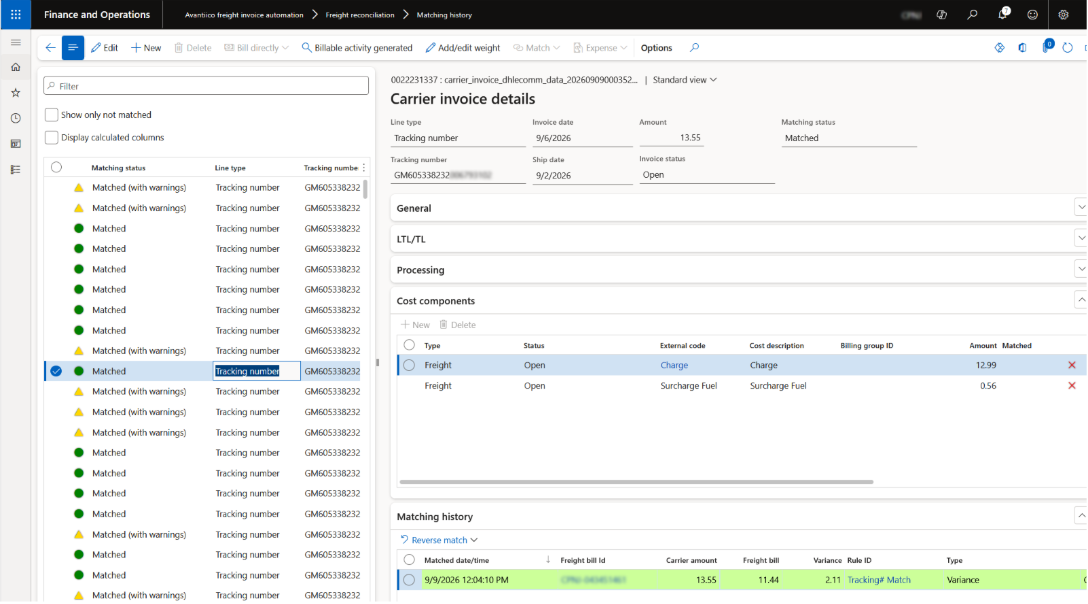
SCREENSHOT: Carrier invoice details showing matched line, $11.44 freight bill vs $13.55 carrier amount, $2.11 variance flagged
If you're responsible for freight spend and haven't looked closely at how much sits in unreconciled variance, it's worth a look, the numbers tend to be bigger than people expect.
See how it works
Freight Invoice Automation matches carrier invoices to delivery events automatically, so variances like this get caught instead of absorbed. Learn more: https://avantiico.com/solutions/avantiico-solutions/freight-invoice-aut…