Embedded Payments Are Redefining What's Possible in Dynamics 365
Finance teams running Dynamics 365—whether Business Central or Finance & Operations—face a persistent challenge in managing A/R and payments. While the ERP may be operating smoothly, separate A/R software and payment processor integrations leave finance teams to perform multiple reconciliations on transactions. This bottleneck increases manual work, data entry errors, late payments, and customer inquiries. Indirectly, it also effectively ruins many of the efficiency gains expected from the ERP and reduces the organization’s ability to address strategic priorities.
This fragmentation also leads to real pain in customer transactions. According to PYMNTS data, 11% of cross-border payments fail globally, with US companies experiencing 72% higher failure rates on international transactions than domestic ones. In 2023 alone, failed payments cost US merchants $3.8 billion in lost revenue.
For Dynamics customers managing global cash flow, these issues translate directly to cash leakage and compliance risk. Post-pandemic digital transformation has forced finance teams to reassess legacy tooling and plan for new regulatory and compliance requirements. Achieving a unified approach has become an urgent matter that they are looking to their Microsoft partners to help solve. To succeed, these organizations need a solution that delivers a single platform to handle A/R and payments end-to-end, integrated with the rest of their Dynamics investment and aligned with their process automation goals.
When A/R software, the payment processor, and customer portal are designed to work together with the core ERP, both in terms of technology and as part of end-to-end processes, organizations can benefit from straight-through processing with no manual handoffs. In this approach, companies gain a consolidated, unified reconciliation with one payment relationship and a modern customer experience enabled by a customer portal. For partners, supporting this approach creates repeatable and successful projects that streamline execution, deliver on expectations, and boost client satisfaction.
The Patchwork Approach to Payments Is Costing Your Customers
D365 users aren’t the only ones troubled by a patchwork approach. Microsoft implementation partners regularly confront the problems inherent to a bolted-on approach, helping customers solve challenges like hidden costs, slow payments, poor UX, and inconsistent experience for end customers.
For their part, partners often struggle to support multiple vendor relationships that emerge from a bolted-on approach. An astonishing 83% of finance teams cite the impact of poor integration between A/R, ERP, and payments on their clients.
Embedded Payments: The Architecture That Changes Everything for Dynamics ERP Users
When customers opt to bolt payments on to Dynamics 365, they are also committing to a future of ongoing complexity. By contrast, an embedded approach to payments working with Dynamics represents an architectural decision that changes how the entire system works.
Think for a moment about the differences between the two approaches. With the bolted-on experience:
- An invoice is generated in the A/R system.
- The customer then gets a link to a separate payment portal, paying via a processor.
- Data lands in the processor first
- A team member needs to reconcile it back to A/R.
- Then, someone needs to reconcile the A/R to ERP.
For finance teams, this means there are three separate views of the same transaction.
In the embedded experience, the first step is the same, but then the process diverges to ensure a single view and an automated process.
- The invoice is also generated in A/R.
- The customer portal is native and therefore seamless.
- The customer pays in the portal.
- When a payment lands in the processor, it is instantly reflected in A/R and in D365
These distinctions may seem architectural, but they matter a lot for teams of Dynamics users. With an embedded approach, companies switch to straight-through processing with Dynamics, the A/R system, and the processor unified into one flow with no manual bridge. A single vendor relationship replaces multiple support contracts; integration is pre-built rather than custom; and reconciliation becomes automated. Companies implementing this architecture report 70% reductions in reconciliation time and 6-week implementations instead of 12+ weeks of custom integration work.
Companies can easily miss the substantial hidden costs associated with settling for a bolted-on approach. In addition to paying for A/R software licensing, they pay payment processor transaction fees. Integration professional services are costly over projects lasting six to twelve (or more) weeks. For most companies, ongoing integration maintenance adds to costs together with multiple vendor support contracts and the costs of data duplication and cleanup.
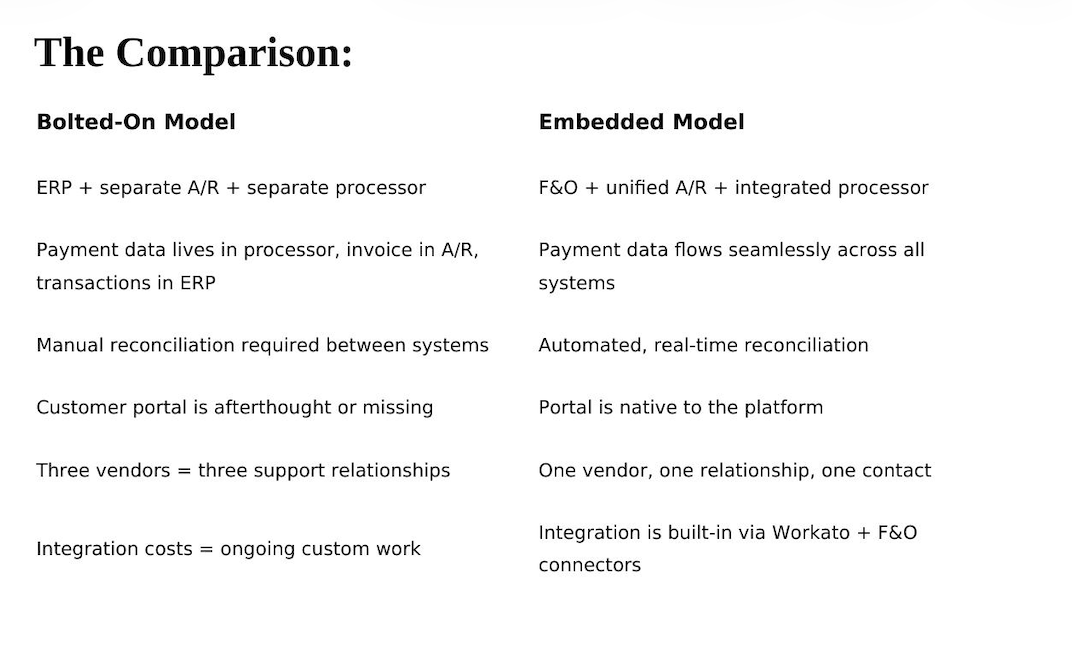
The differences are architectural, but so much more than that. Companies experience different implementation times, reconciliation flows in Dynamics, cost models, and customer experience. The processor relationship shifts in your advantage, while the partner support burden lessens as well.
Why Every Dynamics 365 Customer Needs Automated Reconciliation
It’s one thing to describe the benefits of an embedded approach. It’s another to conceptualize its impact for users within a team.
Business Central users know that out-of-the-box their ERP provides sophisticated transaction handling. However, it lacks modern A/R automation and global payments capabilities. D365FO users have a similar familiarity with its limitations, namely a lack of payment flexibility and support for customer portals.
Global expansion requires a global payments layer, not one that is bolted on. Compliance and security are simplified with a unified platform rather than scattered across vendors.
Multi-entity scenarios (especially common in F&O) demand unified reconciliation. The differences with an embedded approach are tangible. In the older bolted-together paradigm, payments land with the processor. The A/R system must match payments to invoices, either through manual inputs or a rule-based approach. Finance teams need to sync to A/R in their ERP for posting. Exceptions require manual investigation across three systems. The stunning end result is an average reconciliation time of more than 70 hours a month for a mid-market company.
Convenience isn’t the only consideration. Regulatory and compliance pressure favors consolidated architectures, especially for D365FO. For example, regulations like Sarbanes-Oxley require strict segregation-of-duties to prevent individual users from initiating or approving transactions. Parallel accounting structures in GAAP and IFRS, together with automated financial consolidation, and regulatory requirements for auditability through unalterable logs tracking user actions impose similar requirements. Companies must also wrestle with product and supply chain safety auditing, data privacy, batch tracking, indirect tax, and VAT or GST considerations.
One emerging pattern within the embedded payments approach is AI-powered reconciliation. Rather than rule-based matching of payments to invoices, solutions that embed machine learning into the A/R workflow can auto-match payments—including partial and multi-invoice payments—and surface only true exceptions for human review. The result: reconciliation times drop from 70+ hours per month to 20–30 hours, and finance teams focus on strategy instead of exception handling.
Flywire’s embedded approach followed the lead of finance teams that cite poor integration between A/R, ERP, and payments as a challenge. The end result is a solution that cuts reconciliation time for customers by as much as 70%, reducing the need for follow-up customer inquiries and delivering 60% faster settlement.
How Dynamics 365 Partners Win in the Embedded Payments Era
Embedded payments have become an expected option for CFOs and Controllers running Dynamics 365, both for BC and D365FO.
Offering embedded payments represents a substantial competitive advantage for Dynamics partners. It is a complete solutions spanning Dynamics, A/R, and payments, without the fragmentation that remains all too typical today.
A partner with embedded capabilities owns the relationship, from a single-vendor integration to enhanced simplicity for later management. A faster implementation, totaling six weeks versus 16 weeks or more, accelerates customer success and builds trust that leads to other results-driven conversations focused on customer business needs.
In a typical bolted-on timeline, A/R software procurement plus implementation can take 8 to 12 weeks. Subsequently, processor integration usually spans 4 to 8 weeks, followed by 2 to 4 weeks of data migration and cleanup, and finally additional 2 to 4 weeks of portal launch. In the end, the company may spend 16 to 28 weeks to reach full value.
With a bolted-on scenario, companies struggle with multiple processors for international payments. FX management is fragmented because the processor calculates, A/R records, and finance reconciles. There is no visibility into which payment methods are available, resulting in customer confusion on the best way to pay. The extra work, inefficiency, and unpredictability of the approach reflect on the perceived value of the Microsoft partner assisting in building and deploying this solution.
By contrast, with an embedded global solution, companies can tap into over 1,200 payment methods available globally in a single processor. They can also use 140 currencies with FX locked before payment. A single processor equals a single relationship, with better rates that follow. Companies are able to see all options in one portal, with 1,200 payment methods accessible to the finance team in one system.
Dynamics 365 partners need to consider how to empower themselves to meet demand. Above all, they need to ask themselves the question: how do I own the full stack and lock in our role as a trusted advisor?
Part of the answer comes down to technical capabilities, but for most partners understanding customer demands is even more critical. Dynamics partners can consider a few discovery questions for their customers to frame discussions.
- How many payment processors do you currently use?
- How much time does your team spend on manual reconciliation between Dynamics and your A/R system?
- Is your current solution giving you visibility into all payment methods?
These initial questions help to inform follow-on questions.
- How is your global payment experience in Dynamics?
- Are you planning multi-entity expansion, especially D365FO?
- Is your Dynamics investment being held back by weak A/R and payments?
Embedded Is the Future of Financial Management with Dynamics 365
The market is steadily moving toward a unified rather than a fragmented approach. Dynamics 365 customers, whether they run Finance or Business Central, expect to work with a vendor that can help them handle complex workflows with elegant solutions.
Dynamics partners that understand—and can deliver on—embedded, integrated systems will own the A/R and payments market segment. The trend in this direction has already begun. Dynamics users are tired of bolt-on A/R and payments capabilities. Dynamics partners must adapt to the change, re-positioning their solutions and deploying new capabilities.
Flywire is a seasoned solution provider specializing in overcoming the inherent limitations of ERPs like Business Central and D365 Finance. Our customers have on average 14 days of DSO reduction and spend 70% less time on reconciliation. By avoiding the pitfalls of bolted-on tools, Flywire customers receive 45% fewer inquiries from their own customers about payments, experience 60% faster settlement, and can leverage 1,200+ payment methods. Flywire supports over 140 currencies, with payment capabilities across 240 countries served, and more than $25 billion moved annually.