11 Features in AI Inventory Management Software
Running out of stock loses sales. Holding too much stock locks up cash. For years, businesses tried to fix this with spreadsheets and basic inventory management software. It never fully worked, because people cannot watch thousands of products, suppliers, and sales channels at the same time.
Top AI inventory management software like MetaWMS and GOIS solves this problem. It uses machine learning to predict demand, track stock in real time, and make decisions without waiting for a human. According to McKinsey research, AI-driven forecasting can cut demand-forecast errors by 20% to 50% compared with traditional methods, and this improvement leads to fewer lost sales from stockouts (Source: Svitla, 2026).
But not every tool that says "AI" on the box actually delivers. Some are just old inventory management systems with a chatbot added on top. This guide explains the 11 features that make AI powered inventory management software worth buying, whether you run an e-commerce store, a restaurant, a hospital, a school, or a fast-growing brand.
Confused Which AI WMS is Right for Your Business?
Schedule a Free Consulting with MetaOption Experts
How We Chose These Features (Selection Parameters)
Before writing about the features, we set clear rules for what counts as a "must-have." When you compare the best AI inventory management software in 2025 and 2026, use the same parameters:
- Real business impact. The feature must reduce stockouts, cut excess inventory, or save staff time. Nice-to-have dashboards did not make the list.
- True AI, not just automation. The feature must learn from data and improve over time. A simple "reorder when stock hits 10" rule is automation, not artificial intelligence in inventory management.
- Works across industries. We looked at needs in retail, e-commerce, restaurants, healthcare, education, and warehousing. A feature had to be useful in at least three of these.
- Integration depth. The feature should connect with ERP, POS, e-commerce, and shipping tools. Many experts now say clean data plus strong integration beats complex AI models on fragmented inputs (Source: Agile Soft Labs, 2026).
- Fits growing brands. The feature should work for a company with 500 SKUs and still work at 50,000 SKUs. This matters for the best AI inventory management software for growing brands.
- Measurable results. You should be able to track the feature's impact through metrics like forecast accuracy (MAPE), fill rate, inventory turns, and stockout rate.
Good Read: 10 Best AI Inventory Management Software
Now let's look at the 11 features:
1. AI Demand Forecasting
This is the heart of any inventory management AI software. Instead of guessing next month's sales from last month's numbers, AI demand forecasting looks at years of sales history, seasonality, promotions, weather, holidays, and even social media trends. It then predicts how much of each product you will sell.
Why it matters: Better forecasts mean less safety stock. If the software knows demand within a few percent, you do not need to keep a huge buffer "just in case." In one documented deployment of 5,000 SKUs across three warehouses, AI forecasting boosted inventory turns by 47% and cut stockouts by 75% (Source: Agile Soft Labs, 2026).
What to look for: Ask the vendor what MAPE (mean absolute percentage error) their customers typically reach. A MAPE below roughly 10–20% is generally considered workable, but the right number depends on your products and demand volatility.
2. Real-Time Analytics and Live Stock Visibility
Many buyers search for "ai inventory management software with real-time analytics" because this is the feature that changes daily work the most. Real-time analytics means the software updates stock levels the moment a sale happens, a shipment arrives, or an item is moved between warehouses.
Old systems updated once a day or once a week. That gap caused overselling, double-ordering, and angry customers. With real-time inventory intelligence AI, your dashboard shows on-hand, in-transit, on-order, and reserved stock at the same time. A system that tracks only on-hand inventory often generates extra purchase orders for stock that is already on the way, which is a common and expensive mistake (Source: Agile Soft Labs, 2026).
Is it AI inventory management software with real-time analytics? Check three things: (1) does stock update within seconds, not hours; (2) does it show every stock state, not just on-hand; (3) does the AI flag problems on its own, like "this SKU will run out in 4 days."
3. Automated Replenishment and Optimal Inventory Calculations
The next step after forecasting is action. Good AI inventory optimization tools calculate the optimal reorder point, reorder quantity, and safety stock for every product, then create purchase orders automatically.
If you have ever wondered how to automate optimal inventory calculations with AI, here is the simple version. The software uses classic supply-chain math (safety stock, reorder points, service-level targets) but runs it across thousands of SKUs and updates the numbers as new data arrives. A human planner would take days to do this; the AI does it every night.
What to look for: The ability to set rules by product category (for example, higher service levels for best-sellers), approval workflows for large orders, and clear explanations of why the AI suggested a quantity.
4. Multi-Channel and Multi-Location Sync
E-commerce brands sell on their own website, Amazon, Walmart, Shopify, and marketplaces at the same time. AI-powered inventory management for e-commerce keeps stock counts correct across all of these channels so you never sell the same unit twice.
The same feature helps retailers with many stores, restaurants with many locations, and healthcare networks with many clinics. The AI decides which location should hold which stock and can suggest moving inventory from a slow store to a fast one.
5. Order Fulfillment and Shipping Automation (FBM, Picking, Packing)
For sellers who ship their own orders (Fulfilled by Merchant, or FBM), the best AI software for inventory management order processing and shipping is one that connects inventory to the warehouse floor.
Look for:
- Smart picking routes that tell staff the shortest path through the warehouse.
- Packing suggestions that choose the right box size to cut shipping cost.
- Carrier selection that picks the cheapest carrier for each delivery promise.
- Order routing that sends each order to the warehouse closest to the customer.
The best AI software for order fulfillment, inventory management, and shipping automation should also handle returns, so returned items go back into available stock quickly. This is where AI in warehouse management and AI order management come together in one system.
6. Anomaly Detection and Smart Alerts
Instead of sending 200 alerts a day, AI based inventory management learns what "normal" looks like for each product and only warns you when something is really wrong. Examples:
- A product that usually sells 10 a day suddenly sells 80 (possible viral moment or a pricing mistake).
- Stock counts drop without matching sales (possible theft or data error).
- A supplier's delivery times slowly get longer (risk of future stockouts).
This turns the software from a reporting tool into a team member that watches your business 24/7.
7. Supplier and Lead-Time Intelligence
Demand is only half of the problem. Supply is the other half. Strong AI powered inventory management systems track each supplier's real performance: on-time rate, quality issues, price changes, and lead-time variance.
The AI then adjusts your reorder timing automatically. If a supplier that used to deliver in 10 days now takes 15, the system orders earlier without anyone noticing. Some tools also recommend backup suppliers when risk gets high.
8. Expiry, Batch, and Lot Tracking (Critical for Healthcare, Food, and Restaurants)
If you want to buy AI software for inventory management in healthcare, this feature is non-negotiable. Hospitals and pharmacies must track expiry dates, lot numbers, and recalls. The AI predicts which items will expire before they are used and suggests using or moving them first (first-expiry, first-out).
The same applies to restaurant inventory management software with AI. Restaurants deal with fresh ingredients that spoil in days. AI automation for restaurant inventory management forecasts ingredient use from menu sales, recipe data, and reservations, then orders the right amount to cut waste. Is it restaurant inventory management software with AI? Ask whether it links recipes to ingredient stock and predicts spoilage, not just counts cases in the walk-in.
Schools and universities have a similar need for lab supplies, cafeteria food, and IT equipment. If you plan to buy AI software for inventory management in education, look for asset tracking plus consumable forecasting in one tool.
9. Generative AI Assistant and Natural-Language Queries
This is the newest feature on the list, and it is spreading fast. Generative AI inventory management lets you type or speak questions like:
- "Which products will stock out in the next two weeks?"
- "Show me dead stock over $5,000 in value."
- "Why did we overorder SKU 4432 last month?"
The assistant reads your data and answers in plain English, sometimes with a chart. It also writes reports, drafts purchase orders, and explains its own forecasts. For small teams without a data analyst, this turns AI retail analytics into something anyone can use.
10. Integration with ERP, POS, Accounting, and E-Commerce Platforms
A great AI model on bad data still gives bad answers. The best AI inventory management software connects directly to your ERP (SAP, NetSuite, Dynamics), POS system, accounting software, and sales channels through APIs. Data flows in both directions with no manual uploads.
What to look for: Pre-built connectors for the tools you already use, a documented API for custom links, and clear data-mapping so that "Product A" in your POS is "Product A" in the AI system. If a vendor cannot show you the integration list, walk away.
11. Scalability, Security, and Custom AI Inventory Management Software Development
Growing brands need software that grows with them. Look for cloud hosting, role-based access, audit logs, and pricing that does not explode when you add SKUs or locations.
Some companies with unusual workflows choose AI inventory management software development instead of an off-the-shelf tool. Custom development makes sense when you have proprietary processes, strict compliance rules, or very high volume. For most businesses, though, a configurable off-the-shelf platform delivers results faster and cheaper.
Quick Comparison: What Each Industry Needs Most
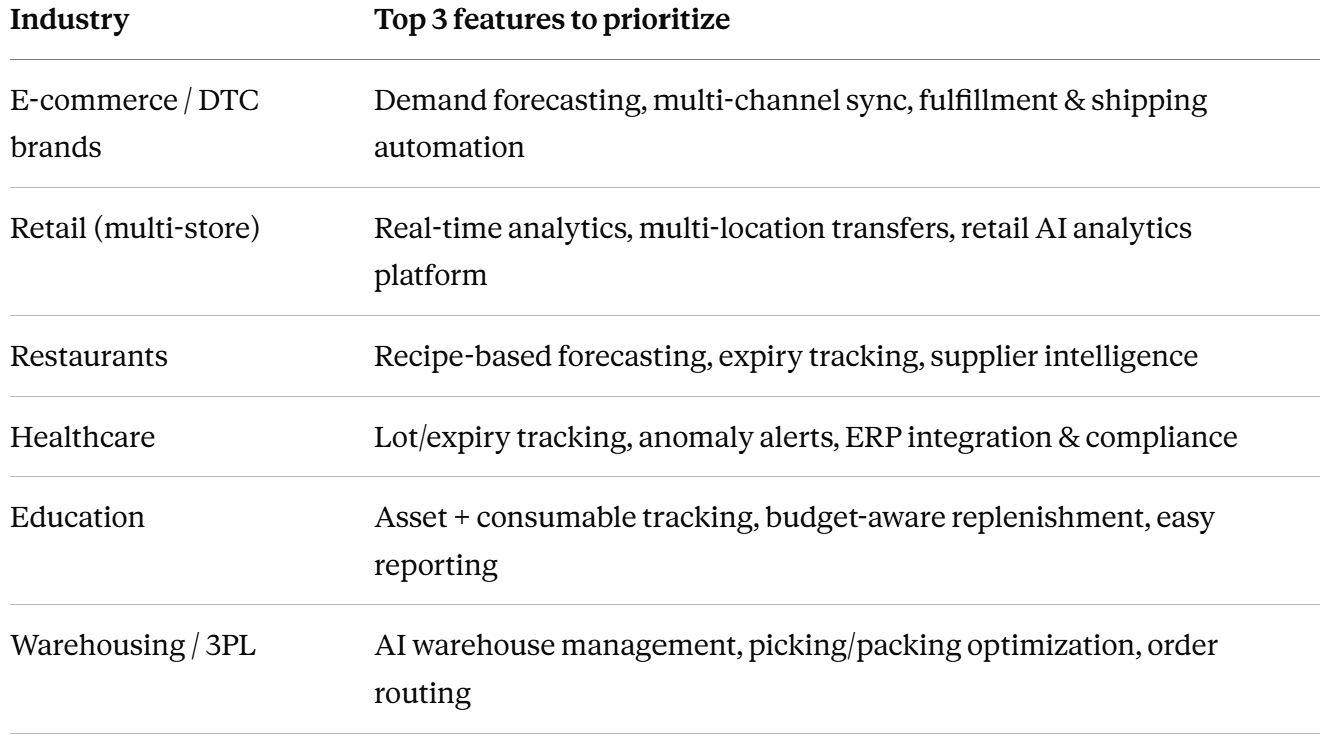
How Is AI Used in Inventory Management? A Simple Summary
If you take one thing from this article, remember this: AI in inventory management does three jobs. It predicts (demand, lead times, spoilage), it watches (real-time stock, anomalies, supplier risk), and it acts (reorders, transfers, routing, reports). The 11 features above are simply the tools that do those three jobs well.
Technology for inventory management will keep changing. AI now makes up a large share of supply chain digital spending, but a 2026 Gartner survey found many supply chain leaders are still unclear on the ROI of their AI investments (Source: Svitla, 2026). The way to avoid that problem is simple: choose software with the features that match your business, measure results with clear metrics, and start with clean data.
Frequently Asked Questions (FAQs)
1. What is AI inventory management software?
It is software that uses machine learning to forecast demand, track stock in real time, and automate ordering and fulfillment. Unlike basic inventory tools, it learns from your data and gets more accurate over time.
2. How is AI used in inventory management?
AI is used for demand forecasting, automatic replenishment, real-time stock tracking, anomaly detection, supplier performance tracking, warehouse picking and packing optimization, and natural-language reporting.
3. What is the best AI inventory management software in 2025 and 2026?
There is no single winner. The best AI inventory management software for growing brands is the one that fits your industry, integrates with your current systems, and delivers measurable improvements in forecast accuracy and stockout rates. Use the 11 features and the selection parameters in this guide to compare options.
4. Is there free AI inventory management software?
Some vendors offer free plans or free trials with limited SKUs and basic forecasting. Truly free AI inventory management software is rare because AI models need computing power and data storage. Free tiers are useful for testing, but most growing businesses will need a paid plan.
5. How do I know if it is really AI inventory management software with real-time analytics?
Ask for a live demo. Stock levels should update within seconds of a sale or shipment. The system should show on-hand, in-transit, on-order, and reserved stock, and the AI should raise alerts on its own rather than waiting for you to run a report.
6. Can AI inventory management software work for restaurants?
Yes. Restaurant inventory management software with AI links menu sales to recipes and ingredients, predicts spoilage, and orders the right amounts. It reduces food waste and keeps popular dishes available.
7. Is AI inventory software useful in healthcare and education?
Very much so. In healthcare, it tracks lot numbers, expiry dates, and recalls while forecasting usage of medicines and supplies. In education, it manages lab supplies, cafeteria food, and equipment across campuses with limited budgets.
8. How does AI automate optimal inventory calculations?
The software applies safety-stock and reorder-point formulas to every SKU, using forecasted demand and real supplier lead times. It recalculates these numbers automatically as new sales and delivery data come in, so your reorder points are always current.
9. Does AI inventory management software help with FBM order processing and shipping?
Yes. The best AI software for inventory management, order processing, picking, packing, and shipping (FBM) chooses the nearest warehouse, plans the fastest pick route, picks the right box size, and selects the cheapest carrier that meets the delivery promise.
10. Should I buy off-the-shelf software or choose AI inventory management software development?
Most businesses should start with a configurable off-the-shelf platform because it is faster and cheaper to deploy. Custom AI inventory management software development makes sense only if you have unique workflows, strict compliance needs, or very high volumes that standard tools cannot handle.