ERP Software Examples: Features, Benefits & Real-World Use Cases
Running a business today involves managing many different processes at the same time. From finance and inventory to sales, purchasing, customer service, and production, every department needs accurate information to work efficiently. When these processes are managed using separate software or spreadsheets, it often leads to duplicate data, manual errors, and delayed decision-making.
This is where Enterprise Resource Planning (ERP) software becomes valuable.
ERP software brings all your business operations together into one centralized system. Instead of switching between multiple applications, employees can access real-time information from a single platform. This improves collaboration, increases productivity, and helps businesses make faster and smarter decisions.
However, not all ERP systems are designed for the same type of business. A small business has different needs than a global enterprise, while a manufacturing company requires different capabilities than an eCommerce retailer.
In this guide, we'll explore some of the best ERP software examples, their key features, benefits, and the types of businesses they serve. Whether you're running a startup, a growing mid-sized company, or a multinational organization, this article will help you understand which ERP solution may be the right fit.
Need Right ERP Software for Your Unique Business Needs?
Get a Free Consultation from MetaOption Experts | Get Response in 4 Hours
What is ERP Software?
Enterprise Resource Planning (ERP) software is an integrated business management system that helps organizations manage their core operations from a single platform.
Instead of using separate applications for accounting, inventory, purchasing, sales, and customer management, ERP software connects these departments and stores all business data in one centralized database.
For example, when a sales order is created, the ERP system can automatically:
- Update inventory levels
- Generate an invoice
- Notify the warehouse team
- Schedule product shipment
- Record financial transactions
- Update customer information
This automation eliminates duplicate work, improves accuracy, and saves valuable time.
Today, most modern ERP systems are cloud-based, allowing businesses to securely access their data from anywhere while ensuring all departments work with the latest information.
In simple words
Think of an ERP system as the central nervous system of your business. It connects every department so information flows smoothly across the organization.
Why Businesses Need ERP Software
As businesses grow, managing operations manually becomes increasingly difficult. Different teams often use different software, making it hard to keep data accurate and up to date.
Without an ERP system, businesses commonly face challenges such as:
- Duplicate data entry
- Inventory inaccuracies
- Delayed financial reporting
- Poor visibility into business performance
- Slow order processing
- Lack of coordination between departments
- Difficulty forecasting demand
- Limited business insights
ERP software solves these problems by providing a single source of truth for all business data.
Some of the biggest benefits include:
- Improved operational efficiency
- Better inventory control
- Faster decision-making
- Automated workflows
- Real-time reporting
- Better customer service
- Improved compliance
- Higher employee productivity
Whether you're managing 10 employees or 10,000, an ERP system helps streamline business operations and supports long-term growth.
Key Features of ERP Software
Although every ERP solution is different, most modern systems include a common set of features that help businesses manage their daily operations more efficiently.
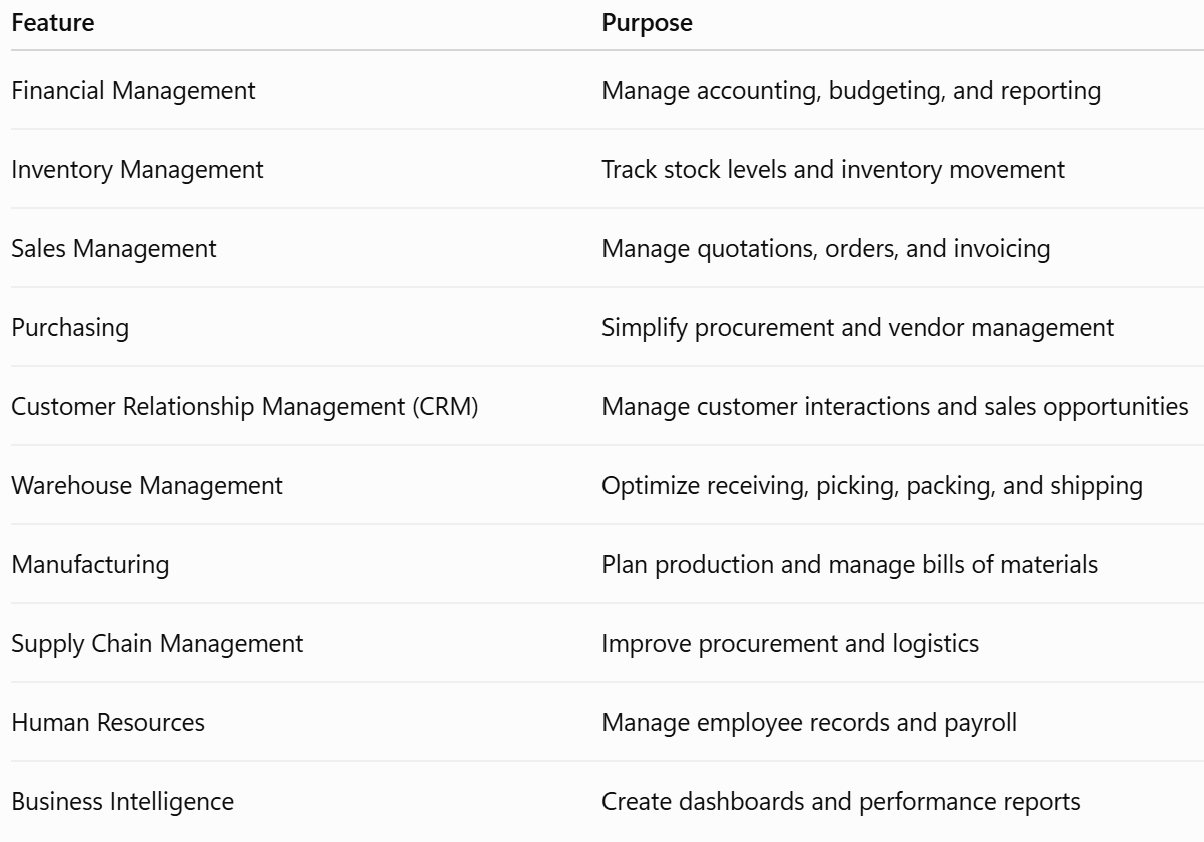
These features help businesses replace disconnected systems with one integrated platform, improving visibility and reducing manual work.
ERP Software Examples by Business Type
Every business has unique operational needs, which is why there is no single ERP solution that fits everyone. The right ERP depends on factors such as company size, industry, budget, and long-term growth plans.
Below are some of the best ERP software examples based on different business types.
ERP Software Examples for Small & Medium Businesses (SMBs)
Small and medium-sized businesses often look for ERP software that is affordable, easy to implement, and capable of supporting future growth. They typically need strong financial management, inventory control, sales management, and reporting without the complexity of enterprise-level systems.
Here are three popular ERP solutions for SMBs.
1. Microsoft Dynamics 365 Business Central
Best For: Growing small and medium-sized businesses, manufacturers, distributors, wholesalers, retailers, and service companies.
Microsoft Dynamics 365 Business Central is one of the most popular cloud ERP solutions for SMBs. Developed by Microsoft, it combines finance, sales, purchasing, inventory, project management, and customer service into one integrated platform.
MetaWMS (Warehouse Management Solution), MetaShip (Shipping Management Solution), and MetaDocs (Document Management Solutions) are the best examples fall in this category.
Its user-friendly interface and seamless integration with Microsoft 365, Teams, Power BI, and Power Automate make it an attractive choice for businesses already using Microsoft products.
Business Central also supports advanced warehouse management through solutions allowing businesses to improve inventory accuracy, barcode scanning, order picking, goods receipt, and warehouse operations as they grow.
Key Features
- Financial management
- Inventory management
- Sales and purchasing
- Supply chain management
- Project management
- Customer relationship management
- Business intelligence dashboards
- Multi-location inventory
- Cloud deployment
- Microsoft 365 integration
Advantages
✔ Easy to use
✔ Highly scalable
✔ Excellent reporting capabilities
✔ Strong Microsoft ecosystem
✔ Supports third-party business applications
Possible Limitations
- Advanced warehouse management may require additional WMS solutions.
- Customizations may require implementation expertise.
Why Choose Business Central?
Business Central is an excellent option for businesses that want enterprise-level functionality in an affordable cloud platform. It can grow alongside your business while keeping operations connected and efficient.
2. Odoo ERP
Best For: Startups, small businesses, and companies looking for flexible customization.
Odoo is an open-source ERP platform known for its modular design. Instead of purchasing one large software package, businesses can choose only the applications they need, such as CRM, accounting, inventory, manufacturing, or HR.
As business requirements grow, additional modules can be added without replacing the existing system.
This flexibility makes Odoo particularly attractive to startups and businesses with unique operational processes.
Key Features
- Modular architecture
- CRM
- Accounting
- Inventory
- Manufacturing
- Sales management
- eCommerce
- HR management
- Marketing automation
Advantages
✔ Highly customizable
✔ Large application marketplace
✔ Flexible deployment options
✔ Cost-effective for smaller businesses
Possible Limitations
- Some advanced features require paid modules.
- Extensive customization may increase implementation complexity.
Why Choose Odoo?
Odoo is a good choice for businesses that want flexibility and prefer building an ERP system around their specific business needs.
3. SAP Business One
Best For: Small businesses planning long-term growth.
SAP Business One is designed specifically for small and medium-sized businesses that want the reliability of SAP technology without implementing the larger SAP S/4HANA platform.
It offers integrated financial management, purchasing, inventory control, sales management, production planning, and reporting.
Businesses that expect to expand operations often consider SAP Business One because it provides many enterprise features within a simplified ERP environment.
Key Features
- Financial management
- Inventory control
- Purchasing
- Sales management
- Customer management
- Manufacturing
- Business analytics
Advantages
✔ Reliable SAP platform
✔ Strong inventory management
✔ Integrated financial reporting
✔ Good manufacturing capabilities
Possible Limitations
- Implementation can be more complex than some cloud-native ERP solutions.
- User interface may require training for new users.
Why Choose SAP Business One?
Businesses looking for a trusted ERP platform with strong financial and inventory capabilities often choose SAP Business One as a long-term investment.
ERP Software Examples for Mid-Market & E-commerce Businesses
As businesses expand, they often outgrow basic accounting software and entry-level ERP systems. Mid-market businesses need better automation, real-time reporting, multi-location inventory management, and seamless integration with eCommerce platforms.
Here are two popular ERP software examples for growing businesses.
4. Oracle NetSuite ERP
Best For: Mid-sized businesses, wholesalers, retailers, eCommerce companies, and fast-growing organizations.
Oracle NetSuite is one of the world's leading cloud ERP platforms. Since it is entirely cloud-based, businesses can access financial data, inventory, customer information, and business reports from anywhere.
NetSuite combines accounting, CRM, inventory management, purchasing, order management, warehouse management, and eCommerce into one unified system.
Key Features
- Financial management
- Inventory management
- CRM
- Order management
- Procurement
- Warehouse management
- Multi-company management
- Business intelligence dashboards
Advantages
✔ Completely cloud-based
✔ Highly scalable
✔ Excellent financial reporting
✔ Strong eCommerce capabilities
✔ Supports international businesses
Possible Limitations
- Higher licensing costs than many SMB ERP solutions
- Implementation may require experienced consultants
Why Choose Oracle NetSuite?
NetSuite is an excellent choice for businesses that are growing rapidly and need a scalable ERP platform capable of supporting multiple locations, currencies, and business entities.
5. Acumatica ERP
Best For: Mid-sized manufacturers, distributors, construction companies, and retailers.
Acumatica has become one of the fastest-growing cloud ERP platforms because of its flexible licensing model and industry-specific editions.
Instead of paying for every user, businesses can choose modules based on their operational requirements, making Acumatica an attractive option for organizations expecting steady growth.
Key Features
- Financial management
- Inventory management
- CRM
- Manufacturing
- Distribution
- Construction management
- Project accounting
- Business analytics
Advantages
✔ Flexible licensing
✔ Modern cloud platform
✔ Industry-specific solutions
✔ Excellent mobile accessibility
Possible Limitations
- Some advanced customizations require implementation partners.
- Additional modules may increase costs.
Why Choose Acumatica?
Acumatica is ideal for businesses that want flexibility, cloud deployment, and industry-specific functionality without investing in a large enterprise ERP system.
ERP Software Examples for Large Enterprises & Global Corporations
Large organizations often operate across multiple countries, warehouses, and business units. They require ERP platforms capable of managing global operations, regulatory compliance, advanced financial planning, and complex supply chains.
6. SAP S/4HANA
Best For: Large enterprises and multinational organizations.
SAP S/4HANA is considered one of the most powerful enterprise ERP solutions available today. Built on SAP's HANA in-memory database, it enables businesses to process large volumes of data quickly while supporting AI-driven automation and advanced analytics.
Key Features
- Enterprise financial management
- Manufacturing
- Supply chain management
- Procurement
- Asset management
- AI-powered analytics
- Global compliance
Advantages
✔ Extremely scalable
✔ Advanced automation
✔ Powerful analytics
✔ Supports global operations
Possible Limitations
- High implementation cost
- Longer deployment timeline
- Requires experienced implementation teams
Why Choose SAP S/4HANA?
Large enterprises with complex operations choose SAP S/4HANA because it offers extensive functionality and supports business growth on a global scale.
7. Oracle Cloud ERP
Best For: Large organizations requiring advanced financial planning and enterprise management.
Oracle Cloud ERP combines financial management, procurement, project management, enterprise performance management, and risk management into one cloud platform.
Key Features
- Financial management
- Enterprise planning
- Procurement
- Project management
- Risk management
- AI-powered insights
Advantages
✔ Strong financial capabilities
✔ Excellent planning tools
✔ Cloud-native platform
✔ Enterprise scalability
Possible Limitations
- Premium pricing
- May be more complex than required for smaller businesses
Why Choose Oracle Cloud ERP?
Organizations looking for advanced financial planning and enterprise reporting often consider Oracle Cloud ERP.
8. Workday ERP
Best For: Large organizations focused on finance and human resources.
Workday is widely recognized for its Human Capital Management (HCM) capabilities while also providing financial management and workforce planning.
Industries such as education, healthcare, and professional services commonly use Workday.
Key Features
- Human resources
- Payroll
- Financial management
- Workforce planning
- Reporting
- Analytics
Advantages
✔ Excellent HR capabilities
✔ Cloud-based
✔ Modern user interface
✔ Strong reporting
Possible Limitations
- Limited manufacturing functionality
- Better suited for service-oriented organizations
Why Choose Workday?
Businesses that prioritize workforce management alongside financial operations often choose Workday.
ERP Software Examples for Manufacturing & Industry-Specific Businesses
Some ERP systems are built specifically to address the needs of manufacturers and distributors. These solutions focus on production planning, inventory control, warehouse operations, and supply chain management.
9. Epicor Kinetic
Best For: Manufacturing and industrial businesses.
Epicor Kinetic is designed specifically for manufacturers that need better production planning, shop floor management, inventory control, and quality assurance.
Key Features
- Manufacturing execution
- Production planning
- Inventory management
- Supply chain management
- Quality control
- Scheduling
Advantages
✔ Strong manufacturing tools
✔ Industry-specific workflows
✔ Advanced production planning
Possible Limitations
- Primarily focused on manufacturing
- May not be the best fit for service businesses
Why Choose Epicor Kinetic?
Manufacturers needing deep production management capabilities often consider Epicor Kinetic.
10. SYSPRO ERP
Best For: Manufacturers and distributors.
SYSPRO specializes in manufacturing, inventory optimization, warehouse management, procurement, and supply chain operations.
It has been serving manufacturers for decades and continues to be a trusted ERP solution in the industrial sector.
Key Features
- Inventory management
- Manufacturing
- Warehouse management
- Procurement
- Supply chain
- Business intelligence
Advantages
✔ Excellent inventory management
✔ Strong manufacturing support
✔ Reliable reporting
✔ Industry-specific capabilities
Possible Limitations
- User interface may feel dated compared to newer cloud ERP platforms.
- Implementation requires planning and training.
Why Choose SYSPRO?
Businesses that rely heavily on manufacturing and inventory control appreciate SYSPRO's specialized functionality.