Dynamics 365 F&O vs. Business Central, SAP, NetSuite, Infor & Epicor
If you're evaluating Dynamics 365 Finance & Operations (D365 F&O), you're almost certainly holding it up against something else: Business Central, SAP S/4HANA, NetSuite, Infor CloudSuite, or Epicor Kinetic. That comparison is the actual decision most manufacturing buyers are trying to make, and generic "what is D365 F&O" content doesn't answer it.
This guide does three things: gives you a direct, criteria-by-criteria comparison of D365 F&O against the five systems manufacturers evaluate it against most often; explains where D365 F&O wins and where it genuinely doesn't; and covers what's actually new in Dynamics 365 Finance and Supply Chain Management across the last two Microsoft release waves, so you're evaluating the current product, not a two-year-old feature set.
Top 5 ERP comparisons with D365 F&O
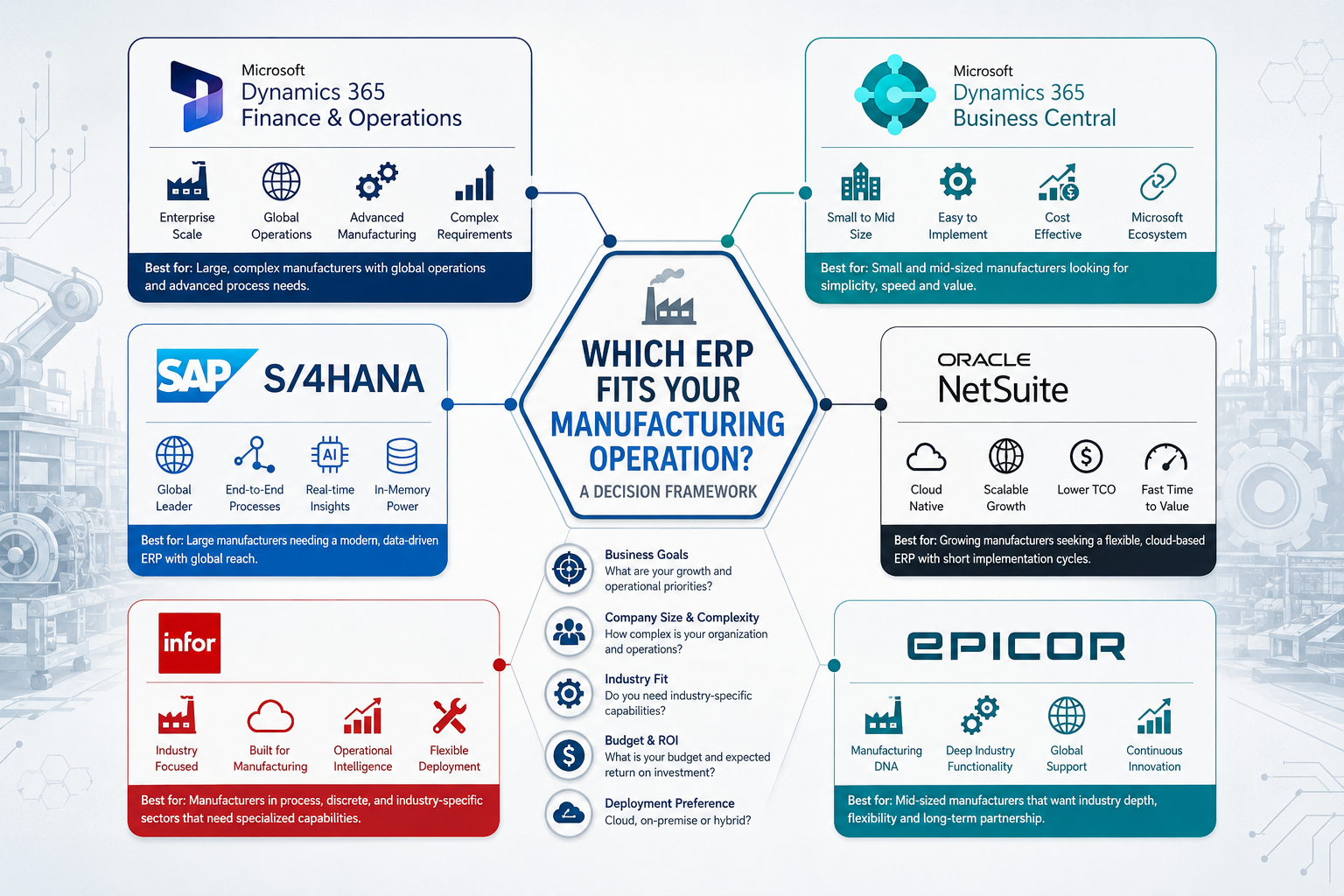
D365 F&O is built for organizations that have outgrown single-entity, single-country ERP. If you're running one legal entity in one currency with straightforward production, this article isn't really for you.
Read our comparison of Business Central with F&O, because Business Central will very likely serve you better at lower cost and lower implementation risk.
D365 F&O earns consideration when you have two or more of the following: multiple legal entities, multiple currencies, intercompany trade, multi-country tax and regulatory complexity, or manufacturing operations complex enough that standard MRP and basic production orders aren't enough. If that's your profile, the comparisons below are built for you.
Most comparison content stops at "it depends on your size." A more useful test is three questions, and if you answer yes to two or more, F&O (not Business Central, and not necessarily SAP) is very likely your right-sized platform: will you be consolidating financials across more than one legal entity within 24 months; does your production process require scheduling across multiple warehouses or plants rather than one site; and does any market you sell into require statutory or tax localization your current system doesn't natively support.
Revenue and headcount are lagging indicators of ERP fit. These three questions are leading indicators, and they'll tell you which direction to go before your finance team is stuck reconciling entities manually every close.
Dynamics 365 F&O vs. Business Central: Where the Line Actually Sits
This is the comparison Microsoft partners get wrong most often, because the honest answer isn't "F&O is just the bigger version of BC." They're architecturally different products with different ceilings.
Business Central is the right call for single-entity or lightly multi-entity mid-market manufacturers who need solid production orders, basic MRP, and standard costing without the configuration overhead of a Tier 1 ERP. It deploys faster, costs less to implement, and is easier to maintain with a smaller internal IT function.
D365 F&O becomes the right call once you need: advanced and multi-warehouse production scheduling, complex intercompany elimination and consolidation across currencies, deep regulatory and tax localization across multiple countries, or global inventory and finance visibility across a group structure that Business Central's architecture wasn't built to carry at scale.
The two products share the Dynamics 365 brand but almost nothing underneath it, which is the detail most comparison content skips and the one that should change how you plan for the long term. Business Central runs on the Dynamics NAV codebase in the AL language; F&O runs on the Dynamics AX codebase in X++. That means there is no clean upgrade path from BC to F&O: a manufacturer that outgrows Business Central faces a genuine re-implementation, not a version bump, typically running 9-18 months and $500K-$3M+ depending on complexity.
If your five-year plan involves plausibly outgrowing BC's ceiling, it's worth pricing that eventual re-implementation into your decision now rather than treating BC as a free trial run for F&O later.
The mistake we see most often is manufacturers choosing F&O by default because it's "more enterprise," then carrying implementation and support costs a Business Central deployment would never have required. If your growth plan doesn't involve multi-entity, multi-currency, or multi-country operations within 24 months, that F&O premium buys you very little.
A phased Business Central to Dynamics 365 F&O migration is also a legitimate path for manufacturers scaling into multi-entity operations. Some run Business Central in smaller subsidiaries while F&O runs the parent entity, though this requires deliberate integration architecture rather than an out-of-box connection between the two platforms.
Dynamics 365 F&O vs. SAP S/4HANA
SAP S/4HANA is the deepest, most configurable ERP available for complex discrete and process manufacturing. Regulated industries like pharmaceuticals and chemicals, in particular, lean on native Production Planning, Materials Management, Quality Management, and Plant Maintenance modules that go deeper than what F&O offers out of the box.
That depth comes at a cost. S/4HANA implementations run longer, cost meaningfully more in both licensing and services, and require a larger, more specialized internal team to administer. Microsoft partners and independent ERP analysts consistently frame the trade-off the same way: S/4HANA for maximum depth in the most complex regulated environments, D365 F&O for organizations with real multi-entity, multi-currency complexity that don't need SAP's full depth and want tighter, lower-friction integration with Microsoft 365, Teams, and Power BI.
For most mid-market manufacturers with $50M-$1B in revenue, the honest read is that F&O covers 80-90% of what S/4HANA offers at meaningfully lower total cost of ownership, with the remaining gap mattering only if your manufacturing complexity or regulatory burden is genuinely SAP-tier.
Manufacturers migrating from SAP to Dynamics 365 F&O should treat the move as a full implementation with a data-migration head start, not a lift-and-shift. Microsoft has invested in migration tooling, but legacy SAP configuration and custom ABAP logic still need to be re-architected rather than ported directly.
The AI and customization gap between the two platforms is also widening faster than most side-by-side feature checklists reflect. Microsoft Copilot is built directly into D365 Finance for invoice processing, cash flow forecasting, and financial close automation, and low-code extension runs through Power Platform and Dataverse, meaning a finance analyst, not just a developer, can build a workflow extension.
SAP's equivalent AI capability runs through SAP BTP or dedicated add-ons and generally requires more specialized setup, and deep customization still runs through ABAP, which requires SAP-certified consultants rather than in-house low-code talent. For manufacturers weighing total cost of ownership, that gap in who can maintain and extend the system (not just who can afford to buy it) deserves more weight than it typically gets in RFP scoring.
Dynamics 365 F&O vs. NetSuite
This comparison usually signals the buyer is still deciding how much ERP they actually need. NetSuite is cloud-native, deploys faster than F&O, and is a strong fit for companies under roughly 500 employees running lighter manufacturing complexity alongside strong e-commerce or subscription revenue models.
Manufacturing depth is where NetSuite falls short of F&O for anyone running real production complexity. Its native manufacturing functionality is thinner than F&O's, SAP's, or Epicor's, and manufacturers who choose NetSuite for cost or speed reasons often outgrow it within a few years if production complexity increases. If manufacturing execution (not finance or e-commerce) is your core operational complexity, F&O is the safer long-term choice even though NetSuite may look faster and cheaper today.
Dynamics 365 F&O vs. Infor CloudSuite
Infor's differentiator is vertical depth: CloudSuite ships with pre-built industry workflows for sectors like food and beverage, fashion, aerospace, and industrial manufacturing, which reduces the customization burden compared to a more horizontal platform like F&O.
The trade-off is ecosystem breadth. F&O's advantage is its native integration with the Microsoft stack, including Teams, Outlook, Excel, Power BI, and increasingly Copilot, which matters enormously for organizations already standardized on Microsoft 365, since it changes user adoption dynamics more than any feature comparison does. If your manufacturing vertical has strong Infor-specific tooling and you're not deeply invested in the Microsoft ecosystem, Infor deserves serious evaluation. If your organization already lives in Microsoft 365 daily, that adoption advantage for F&O is real and often underweighted in RFP scoring.
Dynamics 365 F&O vs. Epicor Kinetic
Epicor Kinetic is purpose-built for manufacturing in a way F&O isn't: decades of focus on job costing, shop floor control, production scheduling, and quality management show up in configuration depth that's hard for a more horizontal ERP to match natively.
For manufacturers where shop-floor execution and job costing precision are the primary pain point (not finance consolidation, multi-entity complexity, or global tax), Epicor's manufacturing-first design can outperform F&O's more configuration-heavy approach to the same problems. F&O regains the advantage when finance, multi-entity, and cross-functional Microsoft ecosystem integration matter as much as shop-floor depth. Few manufacturers need only one of those things, so the honest evaluation weighs both.
Comparison at a Glance
| Criteria | D365 F&O | Business Central | SAP S/4HANA | NetSuite | Infor CloudSuite | Epicor Kinetic |
|---|---|---|---|---|---|---|
| Best fit | Multi-entity, multi-currency mid-market to enterprise | Single-entity mid-market | Complex/regulated large enterprise | Cloud-native, lighter manufacturing | Vertical-specific manufacturing | Manufacturing-first, job costing depth |
| Manufacturing depth | Strong, configurable | Solid, standard | Deepest (regulated industries) | Lighter | Strong (vertical) | Deepest (shop floor/job costing) |
| Implementation time | 6-14 months | 3-6 months | 12-24+ months | 3-6 months | 6-12 months | 6-12 months |
| Microsoft ecosystem fit | Native | Native | Limited | Limited | Limited | Limited |
| Relative cost | Mid to Mid-high | Lower | Highest | Mid | Mid | Mid |
On raw licensing, Dynamics 365 F&O (Finance and Supply Chain Management combined) starts around $180 per user per month, which sits below typical SAP S/4HANA licensing and above Business Central's entry point. NetSuite's base license runs roughly $999 per month plus $99-149 per user, with total annual cost typically landing between $30K and $150K+ depending on modules and user count. That's useful context if you're comparing Dynamics 365 F&O pricing against NetSuite pricing directly. SAP S/4HANA and Epicor pricing are both more scope-dependent and generally require a direct quote rather than published tiers. Licensing is only one part of total cost: as covered above, services and change management typically outweigh license fees over the life of a manufacturing implementation.
What D365 F&O Implementation Actually Costs: Real Benchmarks
Most vendor content quotes a single number, which is exactly why it's unreliable. Published implementation benchmarks put full D365 F&O implementations between $500,000 and $3 million or more, with the spread driven almost entirely by functionality scope, integration count, and compliance requirements, not by licensing.
Two paths sit inside that range. An accelerated or "rapid" implementation using a pre-configured template typically starts around $250,000 and suits manufacturers willing to adapt their processes to the template rather than heavily customize the system. A traditional, fully configured implementation for a multi-entity manufacturer regularly exceeds $1 million, and industry-specific requirements alone can add 20-40% on top of a baseline scope.
The single biggest lever in either direction is customization discipline. Excessive customization is consistently identified as the number one cost escalator in F&O implementations, ahead of integration complexity and data migration, though both matter. A useful planning rule of thumb from implementation benchmarking: total implementation cost for enterprise-grade deployments often runs 3-5x the annual licensing cost, which gives you a rough sanity check on any vendor quote before you've even scoped the project in detail.
What's New in Dynamics 365 Finance and Supply Chain Management: 2025 Release Wave 2 and 2026 Release Wave 1
Evaluating F&O on old feature sets is a common and costly mistake. Microsoft ships two major release waves a year, and the direction of the last two waves matters more than any single feature for understanding where the platform is headed.
2025 release wave 2 (October 2025-March 2026) centered on agentic finance and deeper supply chain automation. On the finance side, agentic bank reconciliation now lets AI agents handle more of the transaction matching, with finance teams previewing results before posting and correcting exceptions without reversal entries, meaningfully reducing period-end manual effort. A new accounting rules engine centralizes posting account setup and enforces consistent general ledger posting rules across entities, and the journal framework was extended to support more account types for streamlined processing.
On the supply chain side, generative AI for demand planning now analyzes historical sales and forecast data to surface trends, seasonality, and ABC/XYZ classification automatically. Quality management gained sample management capabilities: sampling rules for production and batch orders, automated testing workflows, and full sample lifecycle tracking, which matters directly for regulated or quality-sensitive manufacturers. The Warehouse Management mobile app added wrist-mounted scanner support, and a new labor management integration framework connects the warehouse module to third-party labor systems for real-time productivity tracking.
2026 release wave 1 (April 2026-September 2026) pushes further into AI-driven planning and warehouse automation. The account reconciliation agent got a major autonomy upgrade, doing more of the reconciliation work without manual intervention. Perhaps more significant for manufacturers, unified pricing management now connects directly with demand planning, so pricing decisions and their demand impact are visible before changes go live, closing a gap that previously required manual cross-referencing between pricing and planning teams.
Supply chain enhancements continue the AI-forward trajectory: warehousing gains AI-powered picking, inventory rebalancing, and hands-free scanning; a new supplier engagement capability lets teams communicate with and track supplier performance directly inside Supply Chain Management; and AI-generated natural language summaries let planners ask questions about demand data rather than manually reviewing datasets. A new pricing API also exposes pricing and discount calculations to external applications, which is useful for manufacturers running e-commerce or partner portals that need real-time pricing without duplicating logic.
The pattern across both waves is consistent and worth taking seriously in your evaluation. Microsoft is investing heavily in agentic AI reducing manual finance and planning work, and in tighter integration between pricing, demand, and supply chain execution. If your evaluation criteria weight "how much manual reconciliation and planning work will this system eliminate in 18 months," F&O's roadmap trajectory is a genuine differentiator versus platforms investing less visibly in agentic automation.
Frequently Asked Questions
Is Dynamics 365 F&O better than Business Central for manufacturing?
It depends on entity structure and complexity, not manufacturing quality alone. F&O is better once you have multi-entity, multi-currency, or multi-country complexity; Business Central is often the better choice for single-entity mid-market manufacturers, at lower cost and implementation risk.
How does D365 F&O compare to SAP S/4HANA for regulated manufacturing?
S/4HANA offers deeper native functionality for highly regulated, complex manufacturing (pharma, chemicals). F&O covers most mid-market manufacturing needs at lower total cost, but organizations with SAP-tier regulatory or process complexity should weigh that depth gap carefully before choosing F&O on cost alone.
What's the biggest change in D365 F&O over the last year?
The clearest trend across the 2025 wave 2 and 2026 wave 1 releases is agentic AI taking over more manual finance work (bank reconciliation, account reconciliation) and deeper integration between pricing, demand planning, and supply chain execution.
Should we shortlist NetSuite or Infor instead of F&O?
If your primary complexity is e-commerce or subscription revenue with lighter manufacturing needs, NetSuite deserves a look. If your manufacturing vertical has strong Infor-specific tooling and you're not committed to the Microsoft ecosystem, Infor is a legitimate alternative. Both are worth shortlisting alongside F&O rather than assuming F&O is the default.
How much does a Dynamics 365 F&O implementation really cost?
Full implementations typically range from $500,000 to $3 million or more, with rapid/templated deployments starting around $250,000 and traditional multi-entity implementations regularly exceeding $1 million. Customization scope, not licensing, is the primary driver of where you land in that range.
Ready to Compare Your Options Properly?
Choosing between D365 F&O, Business Central, SAP, NetSuite, Infor, and Epicor isn't a features exercise. It's a fit exercise based on your entity structure, manufacturing complexity, and existing technology investment. Talk to Dynamics Square USA LLC about a structured ERP fit assessment for your manufacturing operation.