Job Costing Blind Spots: Why Service & Project-Based Businesses Don't Know Their Real Profitability Until It's Too Late
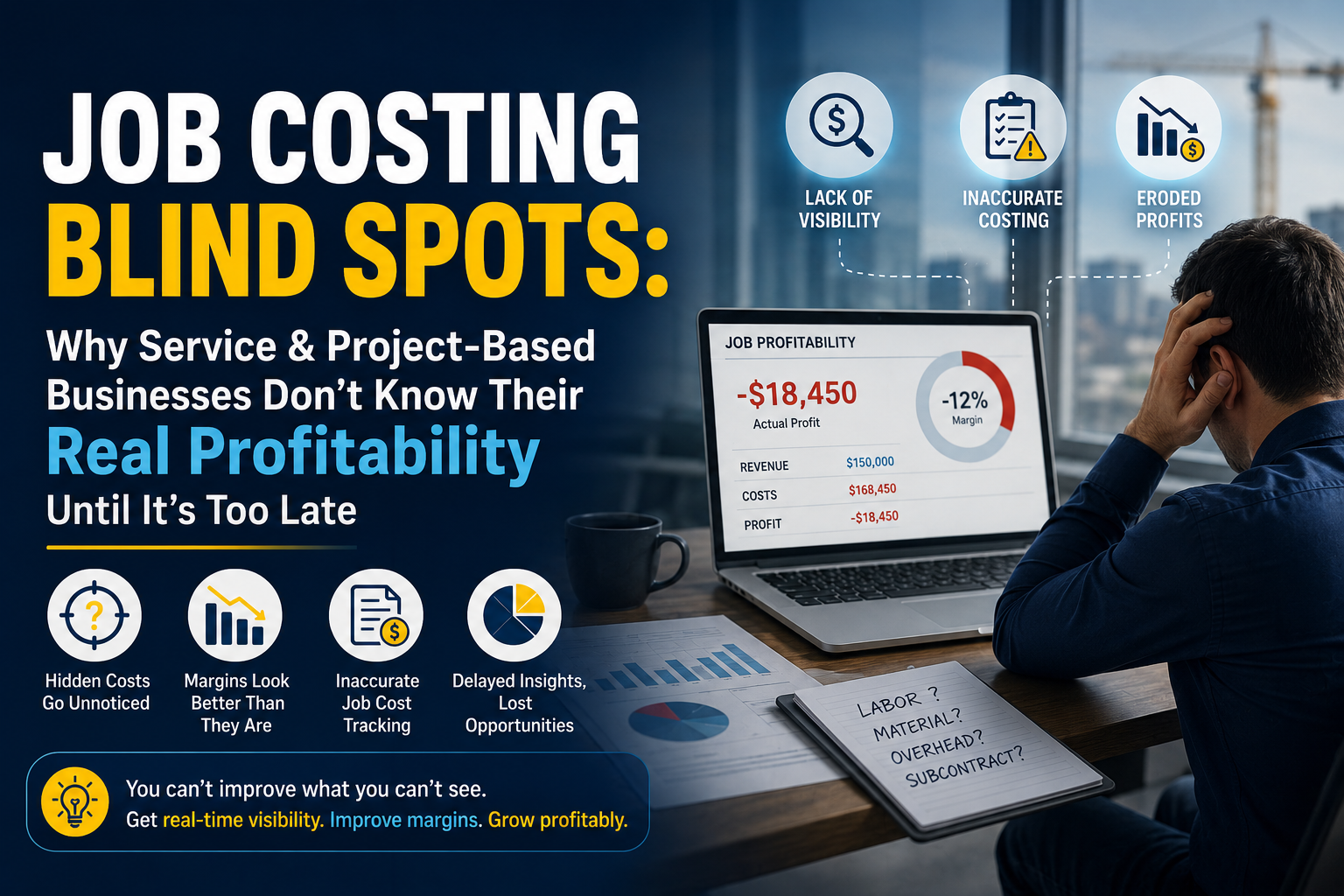
The Project That Looked Fine Until It Didn't
Every project-based business has a version of this story: the job wraps up, everyone's happy with the delivery, and then finance closes it out and finds out it barely broke even, or lost money outright. Nobody caught it while it was happening because nobody had a real-time view into it.
This isn't a rare event. It's closer to the default state for a lot of service and project-based US businesses, and it's one of the most expensive blind spots in the industry, precisely because it's invisible until the project is already done.
Why This Happens So Often
Project profitability looks simple from a distance: revenue minus cost equals margin. In practice, most service and project businesses are flying without real instrumentation on that calculation until it's far too late to act.
Budget overruns are closer to the rule than the exception. Industry data on professional services project performance puts the share of projects exceeding budget at over 45% before they even finish, meaning nearly half of all engagements are already trending unprofitable while still in progress, often without anyone noticing in real time.
Scope creep quietly erodes margin project after project. Research from the Project Management Institute finds that scope creep affects roughly 32% of projects. Individually, each "can you just add this one thing" request feels minor. Compounded across a project, it can turn a planned 55% margin into something closer to 30%, without a single line item ever looking alarming on its own.
Labor cost gets understated by default. A common and costly mistake in project costing is using base salary instead of fully loaded labor cost, a gap that typically runs 30-40% higher once benefits, payroll taxes, and overhead are properly included. A project can look profitable on paper simply because the true cost of the people delivering it was never fully captured.
Utilization gets tracked at the company level, not the project level. Industry benchmarking from the SPI Professional Services Maturity study puts average billable utilization at around 71%, with top-performing firms closer to 80%. But a healthy company-wide utilization number can hide individual projects where the wrong mix of senior and junior time was applied, a detail that only shows up if costing happens at the project level, not just the org level.
Budget-to-actual comparison happens too late to matter. In many service businesses, the moment someone actually compares budgeted hours to actual hours spent is at final billing, by which point there's no opportunity to correct course, only to explain the variance after the fact.
What This Actually Costs
The financial impact isn't abstract. One widely cited estimate puts the average annual loss from poor project profitability tracking at roughly $127,500 per firm, money lost specifically because projects that looked successful on delivery were quietly unprofitable underneath, and nobody found out until it was too late to change anything.
Beyond that headline number, the compounding effects show up in ways that are easy to underestimate:
Pricing decisions built on bad data. If you don't know which past projects were actually profitable, your next proposal is priced on a guess dressed up as a benchmark.
Client and project selection mistakes. Without project-level profitability data, it's nearly impossible to tell which clients or project types are quietly draining margin versus which ones are actually worth prioritizing.
Resourcing decisions made blind. Staffing the wrong mix of senior and junior talent on a project is one of the most common margin killers, and it's invisible without real-time cost tracking tied to who's actually doing the work.
Firm valuation impact. For firms considering a sale or investment down the road, inconsistent or unreliable project-level profitability data is a red flag during financial due diligence. Buyers want to see which service lines and project types are actually driving value.
How Business Central Closes the Gap
Microsoft Dynamics 365 Business Central includes job costing and project management functionality built specifically to give service and project-based businesses real-time visibility instead of a post-mortem.
Real-time budget-to-actual tracking. Business Central tracks hours, expenses, and costs against the project budget continuously, not just at invoicing, so a project trending toward an overrun shows up while there's still time to adjust scope, staffing, or client conversation.
True fully loaded costing. Labor costs in Business Central can be configured to reflect actual fully loaded cost, not just salary, so project margins reflect reality instead of an optimistic understatement.
Project-level profitability, not just company-level. Every job, task, and resource can be tracked individually, meaning you can see exactly which projects, service lines, and even which staffing mixes are actually profitable, and which ones only look that way in the aggregate.
Change order and scope tracking built in. When scope changes, Business Central lets you capture that as a trackable change to the budget rather than quietly absorbed, unbilled work, turning scope creep into a visible, billable, or at minimum trackable event instead of an invisible margin leak.
Resource allocation tied to real cost data. Because time and cost data flow together, staffing decisions can be made with visibility into how a given resource mix affects project margin, not just project timeline.
Reporting that supports pricing and go/no-go decisions. With historical, project-level profitability data actually available, proposal pricing and client/project selection can be based on what past work actually returned, not on instinct or an averaged company-wide number that hides the real picture.
What Changes When You Can See It in Real Time
The shift isn't just better reporting after the fact. It changes what's possible while a project is still running. A project manager can see a budget trending toward overrun at the halfway mark, not at close-out, and actually do something about it. Leadership can compare project types and clients on real margin data instead of gut feel when deciding what to pursue next. And when it's time to have a scope conversation with a client, there's an actual change-order trail to point to instead of an awkward, after-the-fact explanation of why the invoice ran over.
For growing US service and project-based businesses, consulting firms, engineering practices, IT service providers, and similar operations, this is often the difference between a firm that scales profitably and one that scales its revenue while quietly eroding its margins along the way.
Do You Actually Know Which of Your Projects Are Profitable?
If the honest answer is "we find out at close-out" or "we don't really break it down by project," that's a strong signal this blind spot is already costing you. You just haven't quantified it yet.
Dynamics Square works with US service and project-based businesses to assess how project costing currently works and where Business Central can close the gap between when a problem happens and when someone actually finds out about it.
Schedule a free project profitability assessment with Dynamics Square and find out what your current project reporting might be missing.
Dynamics Square is a certified Microsoft Solutions Partner helping US businesses implement and optimize Microsoft Dynamics 365 Business Central and Finance & Operations.