Why Real-Time Inventory Visibility Is No Longer Optional for Modern Warehouses?
In the past, many warehouses could survive with manual stock records, delayed updates, and periodic stock counts. That is no longer enough.
Today, customers expect faster delivery, fewer mistakes, and accurate order tracking. At the same time, warehouses handle more products, more orders, and more pressure than ever before. In this kind of environment, real-time inventory visibility is not just a nice feature. It has become a basic business need.
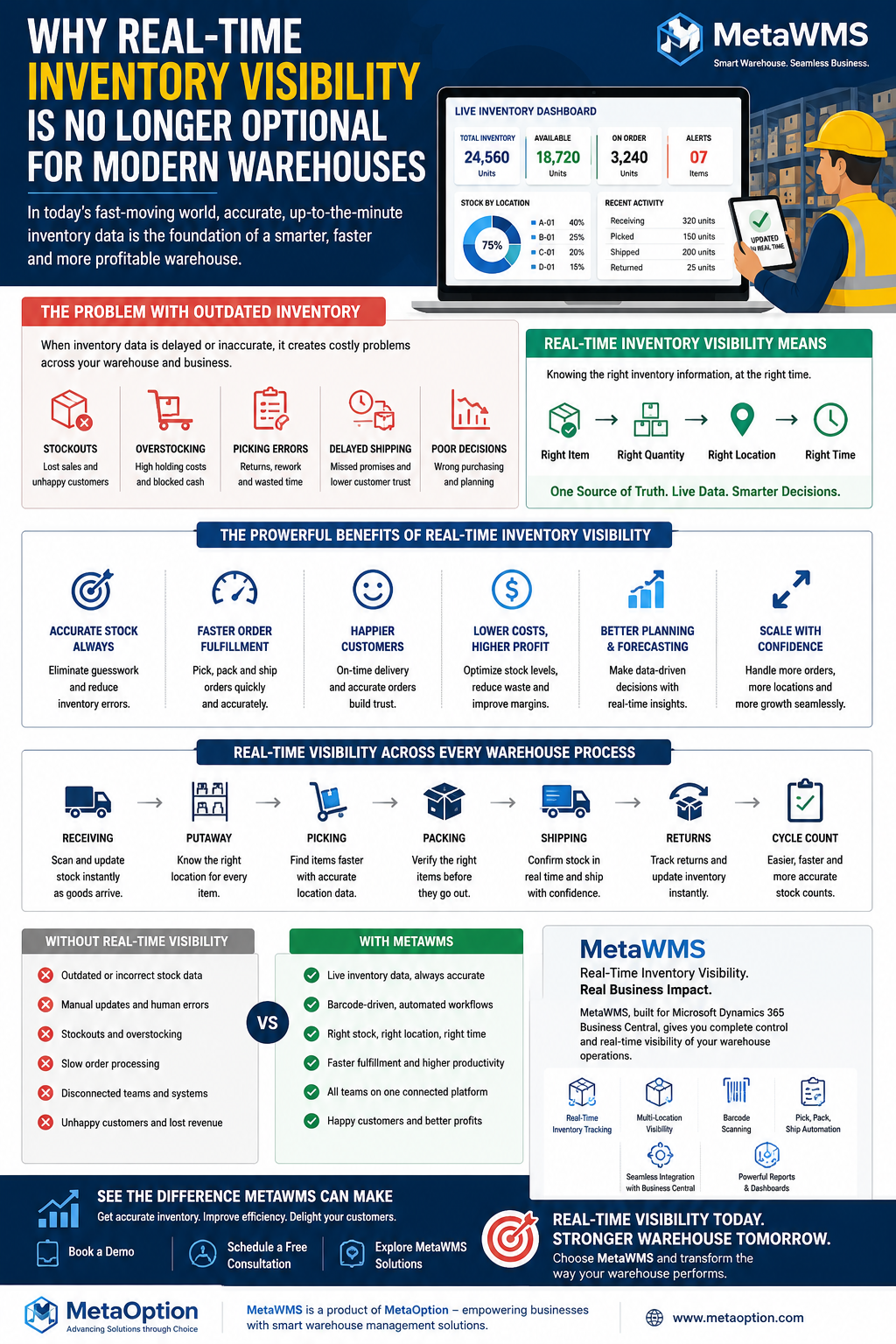
Real-time inventory visibility means knowing exactly what stock you have, where it is, and how much is available at any moment. It gives warehouse teams a live view of inventory movement, from receiving to storage to picking to shipping. Instead of waiting for end-of-day updates or manual reports, teams can make decisions using current information.
For modern warehouses, this matters a lot. Without real-time visibility, businesses face stock shortages, overstocking, shipping delays, unhappy customers, and wasted time. With real-time visibility, they can work faster, reduce errors, and serve customers better.
What Is Real-Time Inventory Visibility?
Real-time inventory visibility is the ability to track stock instantly as it moves through the warehouse.
For example, when goods arrive, the system updates stock right away. When an item is picked for an order, the available quantity changes immediately. When something is moved from one location to another, the system records it at once.
This gives warehouse teams a live picture of:
- What items are in stock
- Where each item is stored
- What has been received
- What has been picked
- What has been packed and shipped
- What is reserved for customer orders
- What is damaged, returned, or missing
In simple terms, it removes guesswork.
Why Old Inventory Methods Are Not Enough
Many warehouses still depend on spreadsheets, paper notes, delayed manual entries, or separate systems that do not talk to each other. These methods may work for a small operation, but they break down as the business grows.
Here is why:
1. Manual updates are slow
If staff update inventory later instead of instantly, the system becomes outdated very quickly. By the time someone checks stock, the numbers may already be wrong.
2. Human error increases
Typing errors, missed entries, and double counting are common in manual systems. Even a small mistake can lead to serious stock problems.
3. Multiple teams use different information
When sales, warehouse, and purchasing teams do not see the same stock data, they make decisions based on incomplete information. This causes confusion and poor planning.
4. Customer expectations are higher
Customers do not want excuses. They expect fast delivery and accurate order status. If a warehouse cannot confirm stock or delay happens because inventory was wrong, the customer experience suffers.
5. Operations are more complex
Modern warehouses handle more products, more channels, and more fulfillment routes. Manual systems cannot keep up with this speed and complexity.
The Real Cost of Poor Inventory Visibility
Not having real-time visibility is expensive. Sometimes the cost is visible right away. Other times, it appears slowly through lost time, wasted labor, and unhappy customers.
Stockouts
If the system shows stock that is not actually available, the warehouse may accept an order it cannot fulfill. This leads to delays, split shipments, or canceled orders.
Overstocking
When inventory data is unclear, businesses often buy more stock than needed just to stay safe. This locks money in unsold goods and increases storage costs.
Picking mistakes
If warehouse workers pick from the wrong location or use outdated stock information, order errors increase. That means more returns, more rework, and more time wasted.
Delayed shipping
When staff spend time searching for products, checking counts, or correcting records, shipping becomes slower. In fast-moving industries, even small delays matter.
Poor purchasing decisions
Purchasing teams rely on inventory data to reorder goods. If the data is old, they may order too early, too late, or in the wrong amount.
Frustrated customers
Nothing hurts trust faster than incorrect stock availability or late deliveries. Customers expect accuracy, and poor inventory control makes that difficult.
Why Real-Time Visibility Matters More Today
Modern warehouses do not operate the way they used to. The market has changed, and so have customer expectations.
Faster order fulfillment is now expected
Customers want next-day or even same-day delivery. To meet this demand, warehouses must know exactly what is available and where it is located.
More sales channels create more complexity
Many businesses now sell through retail stores, online shops, marketplaces, and wholesale channels at the same time. Inventory must be synced across all of them.
Labor costs are rising
Warehouses cannot afford wasted time. If staff spend too long looking for items or fixing inventory problems, the business loses money.
Supply chains are less predictable
Delays, shortages, and changing demand can happen quickly. A warehouse needs live inventory data to respond fast.
Warehouses must be more efficient
Companies want to do more with fewer resources. Real-time visibility helps teams work smarter, not harder.
Benefits of Real-Time Inventory Visibility
Real-time inventory visibility brings major benefits to warehouse operations.
1. Better accuracy
When stock updates happen instantly, the chances of errors drop. Teams can trust the numbers they see on screen.
2. Faster order fulfillment
Workers spend less time searching for products and more time shipping orders. This improves speed across the entire warehouse.
3. Improved customer satisfaction
When the warehouse has accurate data, customers receive correct orders on time. That builds trust and loyalty.
4. Smarter purchasing
Purchasing teams can see true stock levels and reorder at the right time. This helps avoid shortages and overbuying.
5. Better space management
When inventory is visible in real time, warehouse managers can use storage space more efficiently. They know what is moving, what is slow-moving, and where items should go.
6. Less waste
Fewer mistakes mean fewer returns, fewer adjustments, and less product damage. That saves money.
7. Stronger decision-making
Managers can use real-time data to understand trends, spot bottlenecks, and improve performance.
How Real-Time Visibility Improves Every Step of Warehouse Work
Real-time inventory visibility helps at every stage of the warehouse process.
Receiving
When goods arrive, they should be scanned and added to inventory right away. This makes stock available faster and avoids delays in order planning.
Putaway
Knowing the exact location of each item helps staff place stock in the right storage area. This makes future picking faster.
Picking
Workers can see where to find products quickly. This reduces walking time and lowers the chance of picking the wrong item.
Packing
Packing teams can verify that the right items are ready before shipping. This cuts down on packing mistakes.
Shipping
The warehouse can confirm inventory before shipping an order. This helps avoid shipment errors and last-minute surprises.
Returns
Returned goods can be tracked and added back into stock only after they are checked. This keeps inventory records accurate.
Cycle counting
Real-time systems make it easier to compare physical stock with recorded stock. If something is off, teams can fix the issue faster.
Common Problems That Real-Time Visibility Solves
Here are some of the most common warehouse problems that real-time visibility can help solve:
- “The system says we have stock, but we cannot find it.”
- “Sales promised a product that is actually out of stock.”
- “We discovered shortages only after an order was delayed.”
- “Staff are wasting time checking spreadsheets.”
- “We keep overordering because we do not trust the inventory numbers.”
- “The warehouse and purchasing team are not working from the same data.”
Real-time visibility reduces these issues by giving everyone one accurate source of truth.
What Happens When You Do Not Have It
Warehouses without real-time visibility often struggle in the same ways.
They may look busy but still underperform. Staff spend time correcting mistakes instead of moving orders. Managers make decisions based on old reports. Customers face delays. Inventory costs rise. And the business slowly loses efficiency.
At first, the problems may seem small. A few stock mismatches here, a late shipment there. But over time, these issues add up. They affect revenue, customer trust, and team morale.
Real-Time Visibility Is Not Just About Technology
Some people think real-time inventory visibility is only a software issue. It is not.
It is also about process. A warehouse needs good scanning habits, clear workflows, trained staff, and reliable data entry. Technology enables real-time visibility, but the warehouse must also use it properly.
A good system should help teams:
- Scan items quickly
- Update stock instantly
- Track locations clearly
- Reduce manual work
- Keep all teams aligned
- Support growth without confusion
When both process and technology work together, the warehouse becomes much stronger.
What a Modern Warehouse Needs
A modern warehouse should be able to answer these questions at any moment:
- How much stock do we have?
- Where is it located?
- Which orders is it reserved for?
- What came in today?
- What was shipped out?
- What is missing or damaged?
- Which items are running low?
- Which products move the fastest?
If a warehouse cannot answer these questions quickly, it is already falling behind.
Real-time inventory visibility makes those answers available instantly.
Why It Supports Growth
Businesses that want to grow cannot rely on old inventory methods. Growth adds more products, more orders, more staff, and more complexity. Without live inventory data, growth creates chaos.
Real-time visibility helps businesses scale by:
- Supporting higher order volume
- Improving accuracy during expansion
- Making multi-location operations easier
- Helping new staff work faster
- Reducing dependency on a few experienced employees
- Making the business more organized and predictable
In short, growth becomes easier when inventory is under control.
A Competitive Advantage, Not Just a Feature
Real-time inventory visibility is now a competitive advantage.
Businesses that have it can respond faster, ship more accurately, and manage stock with confidence. They waste less time and make fewer mistakes. They can serve customers better than competitors who still depend on old methods.
This is why real-time visibility is no longer optional. It is part of what separates a modern warehouse from an outdated one.
Final Thoughts
Warehouses today must be fast, accurate, and flexible. That is hard to do without real-time inventory visibility.
When inventory is visible instantly, teams work with confidence. They know what is in stock, where it is, and how to move it efficiently. This improves fulfillment, reduces errors, lowers costs, and keeps customers happy.
In a world where speed and accuracy matter more than ever, waiting for delayed inventory updates is a risk businesses can no longer afford.
Real-time inventory visibility is not just useful. It is essential.