Manhattan Warehouse Management System Vs MetaWMS: A Feature-by-Feature Comparison of WMS
Manhattan warehouse management system is often the first name that comes up when businesses are looking for a robust WMS. Though it's powerful, established, reliable and widely used, and trusted by large enterprises. But power alone can’t make a system that’s right for every warehouse.
If you’ve landed on this blog, you’re likely dealing with real operational pressure. Whether it be:
- Orders are increasing.
- Inventory accuracy is slipping.
- Your warehouse team is juggling many manual processes.
- And the current system, or lack of one, is slowing everything down.
Now you’re evaluating options, and the choice isn’t simple.
On one side, you have Manhattan, a well-known enterprise-grade solution with deep functionality. On the other side, you have MetaOption’s MetaWMS, a modern, intelligent, and configurable warehouse management system designed to simplify operations without adding complexity.
But what is so challenging here?
Most comparisons focus solely on individual features, screens, modules, and their capabilities, but that’s not how buying decisions are made.
What actually matters is this:
- How fast can you go live with the product?
- How easily can your team adopt the system?
- Will it reduce picking errors and inventory mismatches?
- How much will it cost - not just upfront, but long-term?
- And will the system be able to scale with your business growth?
This feature-by-feature comparison is built for businesses facing these exact questions, and by the end of this comparison guide between Manhattan WMS Vs MetaOption’s MetaWMS, you can drive an informed decision.
You’ll have a clear graph of where each system excels, where trade-offs exist, and which type of business each solution truly fits.
A Detailed Feature Comparison: Manhattan Warehouse Management System Vs MetaWMS
If you’re trying to choose a warehouse management system that aligns with your operational reality, not just your aim of WMS implementation, then this comparison will help you move forward with confidence.
Let’s compare the features of Manhattan Associates Warehouse Management with MetaWMS.
Feature 1: Implementation & Time to Go-Live
For most businesses, the first real test of choosing WMS is to evaluate the complexity or speed of implementing WMS. This is where expectations meet reality.
Manhattan Warehouse Management System is built to handle complex, enterprise-grade WMS scaling environments. To meet the highly complex needs of enterprises, it requires lots of customizations in the system, which results in delayed implementation.
With Manhattan WMS, businesses often deal with:
- Long deployment timelines due to extensive configuration
- Heavy reliance on certified implementation partners
- Detailed process mapping before any system setup begins
For large enterprises, working with an in-house dedicated IT team can really afford this depth of WMS. But for mid-sized or fast-growing businesses, it often translates into months of struggle before seeing any operational value.
In addition, changes happening during implementation can further slow down the progress. Even small workflow adjustments may require additional development and testing cycles, which quickly add up to the cost and time.
MetaOption’s MetaWMS approaches implementation with a different philosophy.
Instead of forcing warehouses to adapt to go live with a complex or rigid system logic, MetaWMS offers workflow configuration based on actual operations. This significantly reduces deployment time and work on real operational struggles.
Key advantages include:
- Faster onboarding with pre-configured warehouse flows
- Minimal dependency on external consultants
- Easier adjustments during implementation without disrupting timelines
Businesses looking for WMS solutions that can quickly help stabilize operations can trust MetaWMS. It delivers faster value without facing a prolonged phase of going live.
What does this mean for your business?
If your organization can afford long implementation cycles and has the resources to manage complexity, then choosing the Manhattan Warehouse Management System will be a worthy option.
But if speed, continuity, and faster ROI matter, MetaWMS reduces risk by getting your warehouse operational sooner, without compromising core functionality.
Feature 2: Inventory Visibility & Accuracy
Getting the big picture of your inventory with optimum accuracy is one of the core things that businesses expect from their WMS. Poor visibility leads to stockouts, overstocking, misplaced items, and emergency orders often kill margins and customer trust.
Manhattan Warehouse Management System is designed with the feature to deliver real-time, end-to-end inventory visibility across multi-located warehouses and sales channels. It tracks inventory from inbound receipt through put-away, movement, picking, and shipping, all on a single platform.
Operational impact of the Manhattan WMS system seen in industry reports:
- 72% of warehouses says that their real-time visibility feature helps directly improve agility and customer service performance.
- In addition, predictive analytics used in many Manhattan deployments helps businesses forecast demand and allocate stock proactively, reducing the risk of urgent restocking and stock discrepancies.
Real-World Use Case Example: A retailer using Manhattan’s inventory and store fulfillment solutions combined RFID capabilities to dramatically improve inventory visibility, increasing store inventory accuracy from around 70% to nearly 100%, enabling more reliable omnichannel fulfillment and fewer stockouts.
MetaWMS
MetaWMS focuses on real-time barcode scanning, centralized dashboards, and actionable stock visibility, which is directly linked to daily operations. Automated scans and cycle counts keep inventory levels fresh and matched to physical stock accurately.
Typical outcomes reported for MetaWMS-style deployments:
- Improved cycle counts and stock accuracy
- Faster identification of misplaced or miscounted SKUs
- Reduced overstocking and stockouts due to better demand alignment and visibility
Use case example: A mid-sized e-commerce distributor using MetaWMS maintains synchronized inventory between digital storefronts and warehouse stock and eliminates the risk of overselling during peak seasons.
Comparison: Bottom Line
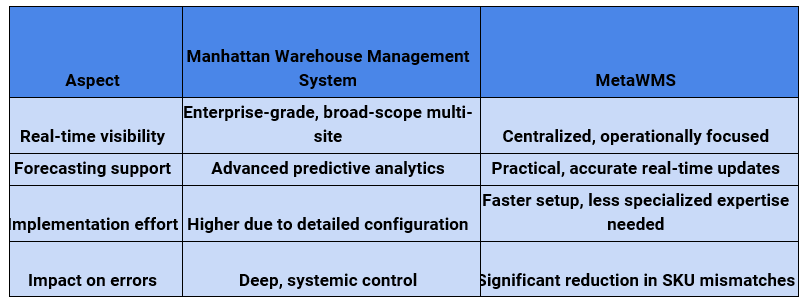
What does this mean for your warehouse?
If you operate complex networks with multi-site inventory, manhattan warehouse management system shines with enterprise visibility and forecasting. But if your priority is fast, accurate stock control that improves daily fulfillment, MetaWMS delivers measurable accuracy improvements with less complexity.
Feature 3: Picking, Packing & Order Fulfillment
When it comes to choosing the best WMS software for the business, it's important to evaluate the order fulfillment accuracy and speed. Also, the ultimate choice of the WMS depends upon the fact that how accurately and speedily it handles the order and improves bottom-line cost.
Manhattan warehouse management system combines advanced order fulfillment, slotting optimization, and automated task management. This means every picker and packer gets system-directed instructions that enable them pick an optimized route and handle order complexity efficiently.
What’s the Impact of Manhattan WMS's on the industry?
Warehouse executives reported that modern WMS solutions can push order accuracy to almost 99%. It's because Manhattan warehouse inventory management software offers advanced configurations, like wave picking, batch pick planning, and AI-informed slotting.
MetaWMS, on the other hand, is designed to offer simpler, faster order execution with built-in picking, packing, and shipping workflows that don’t need months of setup. With barcode-supported picking and dynamic task allocation, warehouse teams can process orders more accurately and consistently.
Operational impact:
- Optimized picker routes to ensure quick delivery
- Automated label printing and scanning minimize human error
- Warehouse floor staff spend less time on manual checks
Use case example: A logistics provider that is engaged in handling high-volume e-commerce parcels experiences fewer mis-picks and faster pack-to-ship times with MetaWMS. This deeply helps in improving daily throughput without extensive training.
In a nutshell: If your warehouse handling complex order fulfillment model, which includes mixed order types and sophisticated routing needs, then Manhattan warehouse management system will be your ultimate choicedelivers very precise control at a cost of complexity. If speed, accuracy, and ease of use matters you the most to manage your daily inventory, then MetaWMS gets you there faster with less operational overhead.
Feature 4: Learning Curve, User Experience & Workflow Adoption
No matter how fancy a Warehouse management system you adopted to streamline your warehouse inventory, it fails if your team finds it hard to access.
This is one of the most underestimated factors that businesses consider while choosing the best WMS. Businesses often focus on features and forget the people actually using the system every day.
Manhattan Warehouse Management System is designed for users with technical skills. As it supports complex workflows, advanced exception handling, and highly detailed operational controls, it requires dedicated in-house technical support.
For experienced teams, this depth is valuable. But here’s the operational reality many businesses face:
- Warehouse staff turnover can exceed around 30 - 40% annually in logistics-heavy industries
- Seasonal hiring introduces temporary workers with limited system exposure
- Training time directly impacts productivity and error rates
With the Manhattan warehouse management system, onboarding new users often requires:
- Structured training programs
- Role-based configuration
- Detailed SOP documentation to understand the functionality
In large enterprises, this is manageable if they have in-house dedicated tech teams, but in fast-moving warehouses, it can slow things down.
MetaWMS is built by keeping in mind the actual warehouse-floor usability as a core priority to ensure easy accessibility to the WMS and allow users to start with the system without using documentation or training. The interface focuses on:
- Clear task prompts
- Barcode-driven actions
- Minimal decision-making for operators
This reduces dependency on long training cycles. Businesses can clearly see these operational impacts:
- Faster onboarding of new warehouse staff
- Fewer picking and packing errors
- Higher task completion consistency across shifts
In a Nutshell, when comparing the learning curve, accessibility, and workflow adoption of Manhattan and MetaWMS, Manhattan relies on long-term staff involvement and has the capacity to manage structured training to have deeper operational control.
Whereas MetaWMS offers ease of adoption and reduces friction on the warehouse floor, where mistakes are most expensive.
Feature 5: Ease of Integration with Existing System or ERP
No matter how big or small a warehouse management system you have sorted for the business, it can't work alone. The right choice of WMS should sync effortlessly with ERP, order management, transportation, and finance systems. This is where many implementations struggle.
The Manhattan warehouse management system is crafted in a way to ensure seamless integration with large enterprise ecosystems. It supports:
- ERP integrations
- Order management systems
- Transportation platforms
- Automation and robotics layers
For enterprises running complex multi-system environments, this creates a powerful connected supply chain. However, integrations often involve:
- Custom connectors
- Middleware dependencies
- Longer testing and validation cycles
MetaWMS is designed to integrate quickly and cleanly with ERP, Financial, Procurement, and other systems, especially within Microsoft Dynamics and modern ERP environments.
Key benefits include:
- Faster system synchronization
- Reduced dependency on custom development
- Easier data flow between the warehouse and business systems
- Offering a connected data overview for real-time decision-making
In a Nutshell, here’s what supports, when…
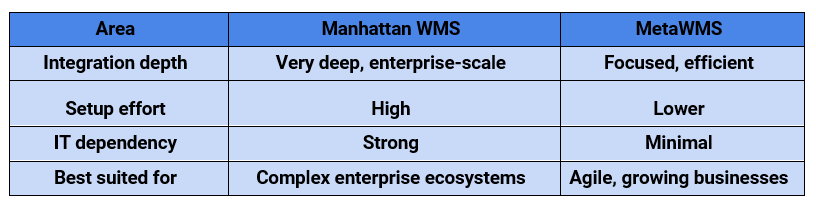
Feature 6: Scalability Without Operational Complexity
Scalability isn’t just about adding warehouses. It’s about scaling without breaking or disrupting the existing workflow.
Manhattan's warehouse management system is built to scale with the business expansion without breaking the workflow. It supports:
- Multi-warehouse networks
- Global operations
- High-volume transaction loads
Large retailers and manufacturers rely on Manhattan to manage growth across regions.
But scalability often comes with:
- Complex configuration need
- More governance overhead
- Need higher maintenance cost managing consistency across locations
MetaWMS scales by replicating proven workflows, not reinventing them.
This allows businesses to:
- Add new warehouses faster
- Maintain operational consistency
- Avoid over-engineering processes
The Practical Takeaway
If your roadmap includes global-scale expansion with advanced automation, then Manhattan WMS offers you unmatched depth.
If your growth is rapid but controlled, MetaWMS helps you scale without introducing unnecessary operational drag and complexity.
Feature 7: Upfront and Long-Term Cost of WMS Ownership
This is where many businesses pause while sorting and comparing the top WMS systems. The license cost is only one part of the story. What matters is what you need to keep paying year after year for the maintenance, and how quickly this system starts paying you back.
Manhattan’s WMS solution is positioned as a premium, enterprise-grade solution. And its premium pricing model reflects that.
Typical factors that influence it's cost are:
- Higher licensing fees
- Extended implementation costs
- Ongoing consulting and customization expenses
- Structured training program
For large enterprises, these premium pricing models are justified, but for mid-sized businesses, ROI can take longer to realize, and may be it's initial cost is too high to bear.
MetaWMS focuses on faster ROI and predictable costs. Businesses chosen to implement MetaWMS typically experience:
- Comparatively lower implementation costs
- Reduced the need for custom development
- Ensuring faster productivity gains after go-live
Because the system is easier to adopt, teams start using it effectively translating into quicker cost savings from reduced errors, better inventory control, and smoother fulfillment.
In a nutshell, if your organization can afford to pay higher upfront costs for long-term enterprise control, then Manhattan Warehouse Management System may fit your budget, but if ROI, speed, and cost clarity matter, then MetaWMS is easier to justify financially.
Feature 8: Support, Upgrades & Long-Term Ownership
A WMS is not a one-time project. As your business scales and deals with complex needs, you need a long-term operational partner to upgrade the system.
Manhattan warehouse management system benefits from a mature ecosystem:
- Global support structure
- Extensive documentation
- Certified partner network
However, this ecosystem can also mean:
- Dependency on partners for changes
- Longer turnaround times for enhancements
- Less flexibility for rapid operational tweaks
For enterprises with strong governance models, this structure works well. For agile businesses, it can feel a little rigid to adapt.
MetaWMS
MetaWMS emphasizes customer control and adaptability. The major support key advantages it offers:
- Faster response to change requests
- Easier configuration updates
- Less reliance on external consultants for routine adjustments
Final Decision Framework: Which WMS Is Right for You?
There is no universal “best -to-adopt rule” for choosing the warehouse management system. Maybe the system that seems best suited to your operations may not fit others. The ultimate decision depends upon understanding and evaluating your business's warehousing inventory management needs.
Choose the Manhattan Warehouse Management System If:
- When you operate at a large enterprise scale
- You are managing complex and multi-country warehouse networks
- Warehouse inventory management systems require deep customization and advanced automation
- You have a dedicated IT team that ensures constant support in adopting the system
- You’re all set for the heavy and long-term investments
Choose MetaOption’s MetaWMS If:
- You want faster implementation and quicker ROI
- Your warehouse teams need simplicity and usability
- You aim to reduce errors without heavy training cycles
- You’re scaling operations but want to stay agile
- You prefer predictable costs and operational flexibility
MetaWMS is built for businesses that want control without complexity and can fit to their budget.
Final Words
Hopefully, at the end of this blog, you can make a clear differentiation between Manhattan and MetaWMS and their features. Though the ultimate choice of not just about choosing the one best set of features alone. It's about how you want your system to run, what things you need to prioritize, and evaluating other operational efficiencies.
The right decision comes from understanding your pain points, your growth plans, and your team’s ability to adopt change. Make that choice clearly, and your warehouse becomes a competitive advantage, not a bottleneck.