Manufacturing Inventory Management System: A Complete Guide
Summary: A manufacturing inventory management system is software that tracks raw materials, work-in-progress (WIP), and finished goods in real time, links them to bills of materials and work orders, and tells you what to buy, what to build, and when. In 2026, the best inventory management systems for manufacturing like MetaWMS and GOIS come with barcode/RFID scanning, demand forecasting, and lot or serial traceability. Costs range from about $50 per user per month for small shops to $25,000–$100,000+ per year for a full ERP rollout.
Manufacturers hold three kinds of stock at once: the materials they bought, the parts they are still working on, and the products waiting to ship. Keeping all three accurate is hard. Surveys of manufacturers across discrete and process industries routinely find inventory accuracy between 60% and 80%, and it is often lower in maintenance storerooms. Every point of inaccuracy shows up somewhere: a rushed purchase order, a stopped production line, or a customer promise you cannot keep.
This guide explains, in simple English, what an inventory management system for manufacturing does, how it works on the shop floor, what it costs, which technologies matter in 2026, and how to pick the right one for your plant.
Not Sure Which Manufacturing Inventory Management System Is Right for You?
Get Expert Guidance from MetaOption. Schedule a Free ERP Consultation and discover the right solution for your manufacturing business.
What is a manufacturing inventory management system?
A manufacturing inventory management system is a software tool that records every movement of stock inside a factory, from the receiving dock to the shipping dock. Unlike a retail inventory tool, it understands that materials get transformed. Ten sheets of steel become forty brackets. A roll of fabric becomes two hundred shirts. The system has to know the recipe (the bill of materials, or BOM), the job that consumes it (the work order), and the result (finished goods).
In practice, an inventory management system for manufacturing does five core jobs:
- Tracks stock levels for raw materials, components, WIP, and finished goods across every location, bin, and warehouse.
- Consumes materials automatically when a work order is started or completed, so the numbers stay true without manual entry.
- Plans purchasing and production using reorder points, safety stock, and demand forecasts.
- Provides traceability by lot, batch, or serial number, which is required in food, pharma, aerospace, and medical devices.
- Reports on inventory value, turnover, dead stock, and shortages so managers can make decisions with real data.
Many people search for "inventory management system for manufacturers" and "inventory management system for manufacturing companies" as if these are different products. They are not. The difference is usually about size and complexity: a five-person cabinet shop and a 500-person automotive supplier both need the same core functions, but they need them at very different scales.
Why manufacturers need a dedicated system (not a spreadsheet)
Spreadsheets are still common. A 2023 survey found that 44% of inventory planning teams used spreadsheets as their main tool. That works until it does not. The moment two people update the same sheet, or a production run consumes material that nobody logged, the record drifts from reality.
The cost of that drift is real. According to 2026 supply chain benchmarks, top-performing companies reach 95% inventory accuracy while struggling ones sit near 65%, and that 30-point gap represents locked-up capital, phantom stock, and lost sales. Manufacturers below 95% accuracy face more unplanned downtime, more emergency purchases, and higher carrying costs than those with disciplined accuracy programs.
Other numbers worth knowing:
- Over 60% of manufacturers say inaccurate demand forecasts create more than 15% excess inventory every year.
- A commonly used carrying-cost assumption for SMBs in 2026 is about 25% of inventory value per year. On $2 million of stock, that is $500,000 a year in holding cost.
- Supply chain disruptions in 2023 produced an average stockout rate of 12.3% for manufacturers.
- 40% of companies with poor inventory management lose $500,000 or more annually on rush shipping.
An inventory management system for manufacturing industry use cases replaces guesswork with a single live record. That record is what makes everything else, from accurate costing to on-time delivery, possible.
Key features of an inventory management system for manufacturing
Not every feature matters to every plant. But the following list covers what a strong manufacturing inventory management system should include in 2026.
Multi-level bill of materials (BOM)
Your BOM defines what goes into each product, including sub-assemblies. A good system supports multiple BOM versions, phantom assemblies, and engineering changes. When you release a work order, the system reserves the components and flags shortages before production starts.
Work orders and backflushing
Backflushing means the system automatically deducts materials when a job is reported complete, based on the BOM. This is one of the biggest time-savers on the shop floor because operators do not have to scan every component. For high-value or regulated parts, you can turn backflushing off and require a scan instead.
Real-time stock tracking with barcodes and RFID
Barcode scanning is the baseline. RFID goes further by reading dozens of tags at once without line of sight. Barcode inventory management systems for manufacturing supply rooms are the most common starting point because scanners are cheap and labels are easy to print. RFID inventory management systems for manufacturing supply rooms make sense when you have high-volume, high-value, or fast-moving items and want counts without human effort.
Lot, batch, and serial traceability
If a supplier recalls a batch of raw material, you need to know every work order and every shipped unit that used it, in minutes, not days. Traceability is a legal requirement in food, pharma, and medical device manufacturing, and it is a customer requirement in aerospace and automotive.
Demand forecasting and MRP
Material requirements planning (MRP) looks at open sales orders, forecasts, current stock, and lead times to tell you what to buy and when. Newer systems add machine learning, which predicts demand with about 25% higher accuracy than rule-based methods.
Multi-location and multi-warehouse control
Stock lives in more than one place: the main warehouse, line-side bins, a supplier's consignment location, and maybe a second plant. The system should show all of it in one view and support transfers between locations.
Cycle counting
Instead of shutting down for an annual physical count, cycle counting lets you count a small slice of inventory every day. Systems that support ABC classification (counting high-value A items more often) keep accuracy high with less labor.
Integration with accounting, purchasing, and sales
Inventory that does not talk to accounting creates month-end reconciliation pain. The best software for manufacturing inventory management system needs will either be part of an ERP or integrate cleanly with one.
How a manufacturing inventory management system works: step by step
Here is the flow of a typical order through a modern inventory management system for manufacturing.
1. Purchase and receive. A purchase order is created (often automatically by MRP). When the material arrives, a receiver scans the PO and the items. The system records quantity, lot number, and location, and updates on-hand stock instantly.
2. Put away. The system suggests a bin location. The material is scanned into that bin.
3. Plan production. A sales order or forecast triggers a work order. The system checks the BOM, reserves available components, and creates purchase requests for anything short.
4. Issue to production. Materials are picked to the line. Depending on your setup, this is done by scanning or by backflushing at completion.
5. Report production. When the job finishes, finished goods are received into stock and components are consumed. Scrap and rework are recorded so costs stay accurate.
6. Ship. The finished goods are picked, packed, and scanned out. Inventory value moves from the balance sheet to cost of goods sold.
7. Count and correct. Daily cycle counts catch small errors before they grow. Variance reports show where and why mistakes happen.
Because every step is a scan or an automatic transaction, the system stays accurate with very little typing. That is the real difference between a manufacturing inventory management system and a spreadsheet.
Types of manufacturing inventory management systems
When people ask, "inventory management systems manufacturing companies which ones work best," the honest answer is that it depends on the type of system that matches your size. There are four broad categories.
Standalone inventory software
Tools like inFlow, Zoho Inventory, Sortly, or Brahmin Solutions focus on stock control with light manufacturing features (simple BOMs, assemblies). They are affordable and fast to deploy. They fit small shops doing under roughly $5 million in revenue.
Manufacturing-focused inventory platforms
Products like Katana, MRPeasy, Cin7 Core, and Fishbowl add proper work orders, MRP, and shop-floor tracking. They are the middle ground for growing manufacturers with $500K to $50M in revenue who need real BOMs, production scheduling, and lot traceability without a six-figure ERP project.
ERP systems with manufacturing modules
The best ERP systems for manufacturing inventory management, such as Microsoft Dynamics 365 Business Central, NetSuite, Acumatica, Epicor, Infor, and SAP Business One, tie inventory to finance, purchasing, sales, and production in one database. For manufacturers that need stock tied to bills of materials, work orders, and production scheduling, SAP, Epicor, Infor, and Dynamics 365 tend to lead. If you are searching "best ERP systems for manufacturing 2026 inventory management," these are the names you will keep seeing.
Warehouse management systems (WMS)
A WMS is deeper on warehouse tasks (wave picking, slotting, labor management) and is often layered on top of an ERP in large distribution-heavy plants.
Quick comparison
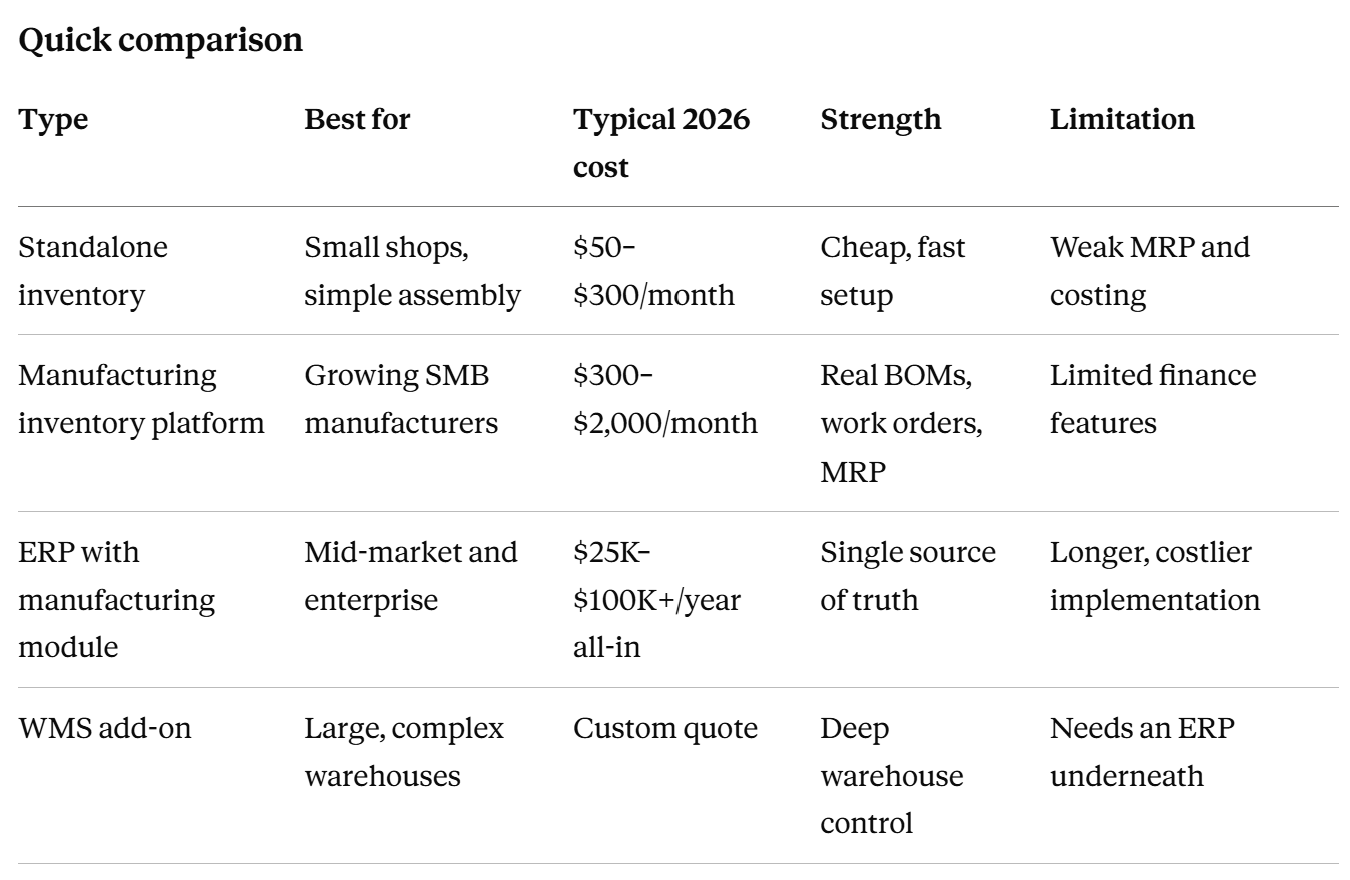
To compare leading manufacturing inventory management systems properly, score each one against the same checklist (see the buying section below) rather than relying on review-site rankings alone.
What does a manufacturing inventory management system cost in 2026?
Pricing is the number-one question buyers ask, and the range is wide. Here is a realistic picture based on 2026 published pricing and buyer guides.
Small business tools. Inventory management software costs most SMBs $50 to $300 per month in subscription fees, but the honest first-year figure, including onboarding, hardware, and integrations, usually lands around $7,000 to $8,500 for a typical five-person team. Zoho Inventory starts near $29/month; inFlow's summer 2026 plans run $129, $349, and $699 per month.
Mid-market platforms. A six-person warehouse team on Cin7 Core runs $649+ per month before onboarding, which typically adds another $1,000 to $5,000 in year one. Manufacturing modules, AI forecasting, and serial tracking often sit in a premium tier or cost an extra $100 to $200 per module per month.
Full ERP. Manufacturing ERP subscriptions typically run $50 to $300+ per user per month; a 40-user deployment at $150/user/month is roughly $72,000 a year in software alone, with implementation extra. ERP implementations for midsized companies cost $75,000 to $300,000 once you include software, services, training, and data migration, with 12 to 24 month payback periods.
Cost of inventory management system for clothing manufacturing
Apparel has special needs: size/color/style matrices, seasonal demand, and fast style changes. The cost of inventory management system for clothing manufacturing is usually higher than for a simple assembly shop because you need matrix inventory and often an apparel-specific ERP (such as Aptean Apparel ERP) or a strong add-on. Expect the mid-market tier at minimum, with apparel-specific configuration adding to implementation cost.
Inventory management system cost for garment manufacturers
Closely related, the inventory management system cost for garment manufacturers depends on whether you make to order or make to stock, how many fabric lots you track, and how many SKUs you carry. A small garment factory can start with a manufacturing inventory platform at a few hundred dollars per month. Larger garment manufacturers with multiple plants and export customers should budget for an ERP with lot traceability and multi-currency support.
Hidden costs to budget for
- Barcode scanners, label printers, and RFID readers
- Data cleanup and migration from spreadsheets or a legacy system
- Integrations with e-commerce, EDI, shipping, and accounting
- Training and change management
- Ongoing support or premium support tiers
A 2024 Capterra survey found that 49% of small businesses hit unexpected fees within the first six months of adopting new software, so ask vendors directly about every line item.
Technology trends shaping inventory management in 2026
AI-powered forecasting and optimization
If you are looking for the best AI-powered inventory management systems for manufacturing 2025 2026 buyers have been evaluating, the trend is clear: AI has moved from a marketing word to a measurable feature. Companies using AI-powered inventory optimization software report reducing inventory costs by 18% to 22% within 12 months. McKinsey research found AI forecasting can cut supply chain forecasting errors by 20% to 50% and reduce inventory levels by 20% to 30%. The best AI-powered inventory management systems for manufacturing 2025 2026 vendors are shipping now typically combine demand sensing, automatic reorder-point tuning, and anomaly alerts for unusual stock movements.
IoT-based inventory management systems for manufacturing
IoT-based inventory management systems for manufacturing use sensors, smart shelves, weight scales, and connected scanners to update stock without human input. Around 70% of warehouses now use IoT for real-time tracking. In a factory, an IoT scale under a bin of fasteners can trigger a reorder automatically when weight drops below a threshold. IoT-based inventory management systems for manufacturing are especially useful for consumables and small parts where scanning every pick is impractical.
Manufacturing inventory management systems for industrial vending machines
Industrial vending machines dispense gloves, cutting tools, PPE, and spare parts at the point of use. Manufacturing inventory management systems for industrial vending machines connect each machine to the central inventory record, so every item dispensed is tied to an employee, a job, and a cost center. This cuts shrinkage, reduces overuse, and gives purchasing exact consumption data. Manufacturing inventory management systems for industrial vending machines are a strong first step toward an automated supply room.
Automated inventory management systems manufacturing supply room setups
Beyond vending machines, automated inventory management systems manufacturing supply room designs include RFID cabinets, weight-based smart bins, and automated storage and retrieval systems (AS/RS). The goal of any automated inventory management systems manufacturing supply room project is the same: remove manual counting, capture usage automatically, and let the system reorder before anything runs out.
Cloud deployment and its challenges
Cloud is now the default for new deployments. It removes servers, delivers updates automatically, and makes multi-site visibility simple. Still, "cloud inventory management systems challenges manufacturers" is a common search for good reason. The main cloud inventory management systems challenges manufacturers report are: shop-floor connectivity (Wi-Fi dead zones near heavy machinery), data ownership and migration concerns, subscription costs that grow with users, and integration with older on-premise machines or PLCs. Good vendors address these with offline scanning modes, clear data export rights, and edge connectors.
Cloud-based manufacturing inventory management systems SMB Europe
Cloud-based manufacturing inventory management systems SMB Europe buyers choose must also handle VAT, Intrastat reporting, multi-currency, multi-language, and GDPR data residency. Dynamics 365 Business Central, Sage, Odoo, MRPeasy, and Katana are common choices in this segment. For cloud-based manufacturing inventory management systems SMB Europe manufacturers should confirm where data is hosted and whether the vendor has local implementation partners.
Industry-specific examples
An inventory management system for manufacturing industry segments behaves differently depending on what you make. Three examples show why.
Inventory management systems for cabinet manufacturers
Cabinet shops deal with sheet goods, hardware, finishes, and highly configurable products. Inventory management systems for cabinet manufacturers need to handle nested cutting (how many cabinet parts come from one sheet of plywood), remnant tracking, configurable BOMs by door style and finish, and job-based costing. Systems that integrate with cabinet design software (such as Cabinet Vision or Mozaik) reduce double entry. The most useful inventory management systems for cabinet manufacturers also track offcuts so usable remnants do not get thrown away or reordered.
Garment and clothing manufacturers
As covered in the cost section, garment makers need matrix inventory (style × size × color), fabric roll and lot tracking, and cut-plan integration. Seasonal demand makes forecasting accuracy critical.
Food, pharma, and process manufacturing
These industries need lot traceability, expiry control, recall reporting, and quality holds as standard. They favour ERPs like SAP, Infor CloudSuite, and Dynamics 365 with process-manufacturing add-ons. A manufacturing inventory management system in these industries must support first-expired-first-out (FEFO) picking, not just FIFO.
Manufacturing inventory management system best practices
Buying software is only half the job. These manufacturing inventory management system best practices are what separate plants that get value from those that end up with expensive shelfware.
- Clean your item master first. Duplicate part numbers, missing units of measure, and wrong lead times will break MRP no matter how good the software is.
- Set reorder points and safety stock with data, not gut feel. Start with lead time × average daily usage, add a buffer for variability, then let the system refine it.
- Use ABC classification. Count A items weekly, B items monthly, C items quarterly.
- Scan everything or backflush everything, but decide. Mixed methods on the same item create errors.
- Cycle count every day. Aim for 95%+ accuracy and track it as a KPI.
- Record scrap and rework honestly. Hidden scrap is the most common reason WIP numbers drift.
- Review dead stock quarterly. Slow movers tie up cash; sell, repurpose, or write them off.
- Train operators, not just office staff. Accuracy is created on the shop floor.
- Integrate with accounting. One record for quantity and value.
- Measure turnover. The average U.S. manufacturing inventory turnover ratio was 7.8 in 2023; know where you stand against your industry.
Following manufacturing inventory management system best practices like these often delivers more improvement than switching software.
How to choose the best inventory management system for manufacturing
Here is a practical checklist for choosing the best inventory management system for manufacturing needs at your plant. Score each vendor 1–5 on every line.
Fit
- Does it support multi-level BOMs and engineering changes?
- Does it handle your production mode (make-to-stock, make-to-order, engineer-to-order, batch)?
- Does it support lot, batch, and serial tracking at the level you need?
Shop floor
- Does it offer barcode and RFID scanning with offline mode?
- Can operators use it on rugged handhelds or tablets?
- Does it support backflushing and manual issue?
Planning
- Does it include MRP with lead times, safety stock, and forecast input?
- Does it have AI or statistical forecasting, and can you see how it works?
Integration
- Does it connect to your accounting or ERP, e-commerce, EDI, and shipping tools?
- Does it have an open API?
Cost and risk
- What is the all-in first-year cost including hardware, implementation, and training?
- What are the data export and exit terms?
- Who does the implementation, and do they know your industry?
The best software for manufacturing inventory management system requirements is the one that scores well on fit and shop-floor usability first. Fancy planning features are useless if operators refuse to scan.
When you compare leading manufacturing inventory management systems, also run a real scenario: give each vendor one of your actual BOMs and a sample work order, and watch them process it live in a demo. This single test reveals more than any feature matrix.
Implementation timeline and tips
- Small standalone tools: days to a few weeks; many vendors include onboarding, and some report average go-live in about three weeks.
- Mid-market platforms: typically 12 to 16 weeks for a mid-sized rollout.
- Full ERP: small manufacturers usually deploy in 3–6 months; larger operations need 9–18 months or more.
Tips that reduce risk:
- Run a pilot on one product line or one storeroom before going plant-wide.
- Do a full physical count right before go-live so the opening balances are true.
- Keep the old system read-only for 90 days, not running in parallel (parallel running doubles work and hides problems).
- Assign an internal owner for the item master and BOMs.
Conclusion
An inventory management system for manufacturing is not just a stock-counting tool. It is the connection between what you buy, what you build, and what you ship. Choosing a manufacturing inventory management system that fits your size and industry, then backing it with disciplined practices like daily cycle counts and a clean item master, will raise accuracy toward 95%, cut carrying costs, and stop the emergency purchases that eat margin.
Start by defining your must-have features, get an honest all-in cost from two or three vendors, and test each one with your real data. The right inventory management system for manufacturing companies pays for itself in months, not years.
Frequently Asked Questions (FAQs)
1. What is an inventory management system for manufacturing? It is software that tracks raw materials, work-in-progress, and finished goods in real time, links them to bills of materials and work orders, and plans purchasing and production. A manufacturing inventory management system differs from retail tools because it accounts for materials being transformed into new products.
2. What is the best inventory management system for manufacturing in 2026? There is no single winner, and if you are asking "inventory management systems manufacturing companies which ones work best," the answer depends on your size. For small shops, tools like inFlow, Katana, or MRPeasy work well. For mid-market and enterprise plants, the best ERP systems for manufacturing inventory management include Microsoft Dynamics 365 Business Central, NetSuite, Acumatica, Epicor, Infor, and SAP. Most lists of the best ERP systems for manufacturing 2026 inventory management buyers rely on feature these same names. Choose based on BOM depth, traceability needs, and integration.
3. How much does a manufacturing inventory management system cost? Standalone tools cost roughly $50–$300 per month. Manufacturing-focused platforms run a few hundred to $2,000 per month. Full ERP deployments typically cost $25,000–$100,000+ per year all-in, with $50–$300+ per user per month for software and $75,000–$300,000 for mid-market implementation.
4. What is the cost of inventory management system for clothing manufacturing? Clothing and garment manufacturers usually need matrix inventory (style, size, color) and lot tracking for fabric, which pushes them to mid-market platforms or apparel-specific ERPs. Budget from a few hundred dollars per month for a small factory up to an ERP-level investment for multi-plant operations.
5. What is the difference between an inventory management system and an ERP? An inventory management system focuses on stock control. An ERP includes inventory plus finance, purchasing, sales, production, and HR in one database. Many manufacturers start with inventory software and move to an ERP when reconciliation between systems becomes a burden.
6. Do I need RFID or are barcodes enough? Barcode inventory management systems for manufacturing supply rooms are enough for most plants and are the cheapest way to reach 95%+ accuracy. RFID inventory management systems for manufacturing supply rooms make sense for high-value tools, fast-moving consumables, or when you want automatic counts without scanning.
7. How do industrial vending machines work with inventory software? Manufacturing inventory management systems for industrial vending machines connect each machine to your central stock record. Every item dispensed is logged against an employee and job, which reduces shrinkage and gives purchasing exact usage data for reordering.
8. What are the main challenges of cloud inventory systems for manufacturers? The most common cloud inventory management systems challenges manufacturers face are shop-floor Wi-Fi coverage, data migration, subscription costs that scale with users, and integration with older machines. Offline scanning modes and clear data export terms solve most of these.
9. What are the top manufacturing inventory management system best practices? Clean your item master, set data-driven reorder points, use ABC classification, cycle count daily, record scrap honestly, review dead stock quarterly, train shop-floor staff, and integrate inventory with accounting. These manufacturing inventory management system best practices matter as much as the software itself.
10. Are AI-powered and IoT-based inventory systems worth it for small manufacturers? Increasingly, yes. AI forecasting is now built into many mid-market tools and can cut inventory costs by 18–22% within a year. IoT-based inventory management systems for manufacturing (smart bins, connected scales) are affordable for consumables and small parts. Start with one storeroom or product line, measure the result, then expand.