11 Key Features List of A Warehouse Management System
A warehouse management system plays a big role in how smoothly a warehouse runs. It helps teams manage stock, reduce mistakes, and move goods in the right direction without unnecessary delay. In a busy warehouse, even a small error can affect order accuracy, customer satisfaction, and daily productivity. That is why businesses look closely at the key features of warehouse management system before they choose one.
A good system does much more than track items. It supports the full flow of warehouse work, from receiving goods to storing inventory, picking orders, packing shipments, and handling returns. It also gives managers better control over inventory and better visibility into what is happening on the floor.

In simple terms, the right warehouse management system features help a business work faster, stay organized, and grow with less confusion. Below is a clear and practical warehouse management system features list that explains the most important functions in a way that is easy to understand.
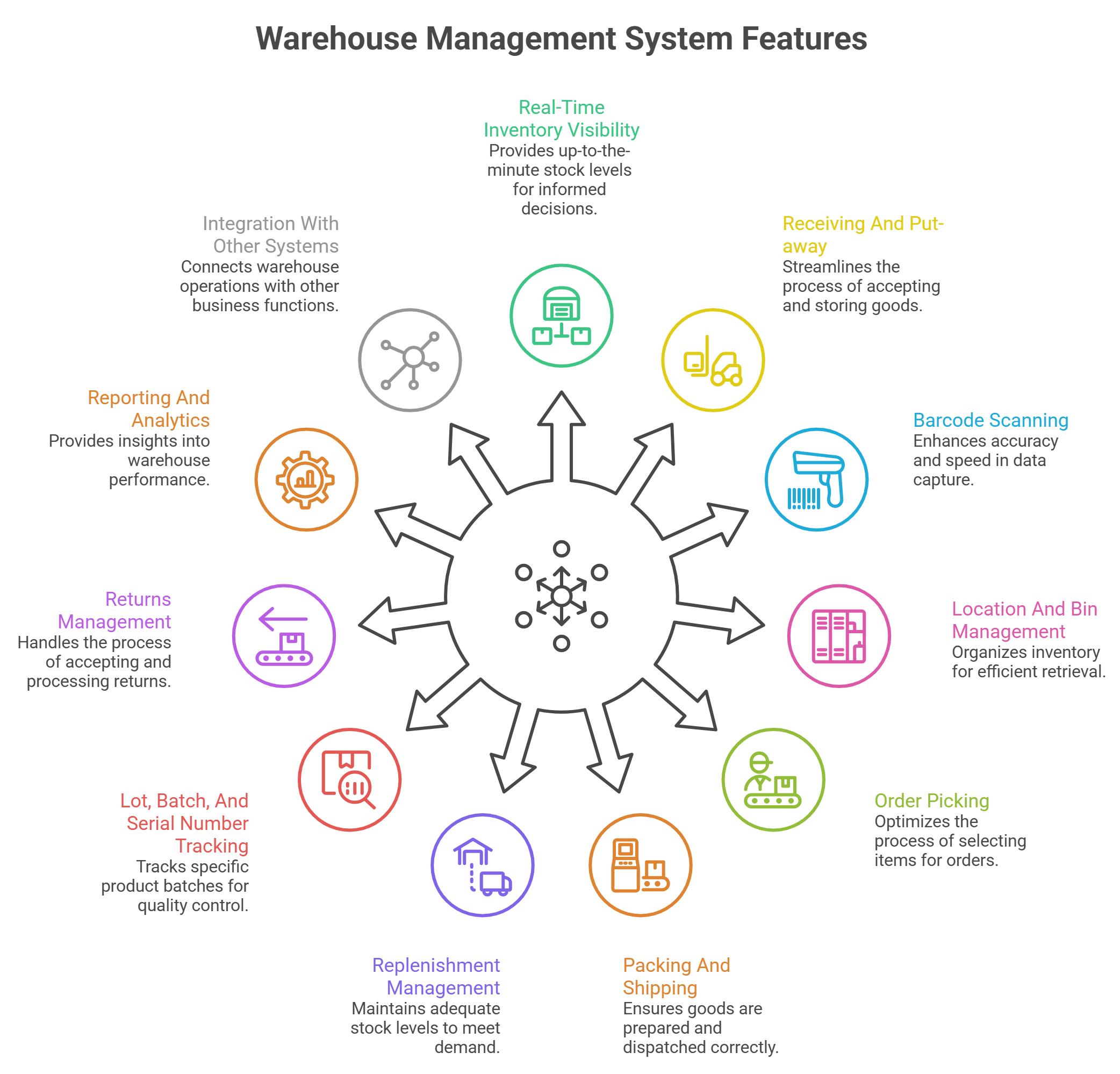
Best Key Features List of A Warehouse Management System
1. Real-Time Inventory Visibility
One of the most important features of warehouse management system is real-time inventory visibility. This means the system always shows the latest stock position without delay.
In a busy warehouse, inventory is constantly moving. Products are received, stored, picked, packed, and shipped throughout the day. Without accurate tracking, teams may rely on outdated information, which leads to errors.
With a WMS, every movement is recorded instantly. This ensures accurate stock levels, better control, and faster decision-making.
How It Helps In Daily Work
- Prevents stock mismatches
- Avoids overselling and stockouts
- Improves inventory planning
- Reduces manual checks
- Supports faster operations
For businesses evaluating the key features of a warehouse management system WMS, this is the foundation feature.
Good Read: 11 Best Warehouse Inventory Management System
2. Receiving And Put-away Management
Receiving and put-away are the starting points of warehouse operations. If these steps are not handled properly, errors can spread throughout the system.
A WMS ensures that incoming goods are verified against orders and stored in the correct location. It creates a structured process that improves both speed and accuracy.
This is one of the most essential warehouse management system features because it sets the base for clean inventory data.
Why This Feature Matters
- Verifies incoming shipments accurately
- Detects damaged or missing goods early
- Guides proper storage placement
- Reduces misplaced inventory
- Improves warehouse organization
A strong receiving process leads to a more reliable warehouse overall.
3. Barcode Scanning And Data Capture
Barcode scanning is one of the most practical features of warehouse management system. It replaces manual data entry with quick and accurate scanning.
Instead of typing product details, workers can scan items, locations, or labels. This reduces human error and speeds up operations.
What Makes It Valuable
- Improves speed and accuracy
- Reduces manual entry errors
- Enhances product traceability
- Simplifies warehouse workflows
- Supports real-time updates
This feature is widely used because it directly improves operational efficiency and reduces mistakes.
4. Location And Bin Management
Warehouses are divided into zones, aisles, racks, shelves, and bins. Managing these properly is one of the key features of warehouse management system.
This feature ensures that every product has a defined location. Workers can quickly find items without wasting time searching.
A WMS may also suggest storage locations based on product size, movement frequency, or handling requirements.
Benefits Of Good Location Control
- Faster product retrieval
- Better space utilization
- Reduced search time
- Improved warehouse organization
- Fewer misplaced items
This feature plays a major role in improving warehouse efficiency.
5. Order Picking Management
Order picking is one of the most critical warehouse activities. It directly impacts delivery speed and customer satisfaction.
A WMS improves picking by guiding workers with clear instructions. It also supports different picking methods such as batch picking, zone picking, and wave picking.
This is one of the most impactful warehouse management system features because it affects both speed and accuracy.
How It Improves Picking
- Reduces walking time
- Minimizes picking errors
- Improves worker productivity
- Speeds up order fulfillment
- Optimizes picking routes
Efficient picking leads to faster deliveries and better customer experience.
6. Packing And Shipping Support
Packing and shipping are the final steps before the product reaches the customer. Errors at this stage can damage the entire experience.
A WMS ensures correct packing, proper labeling, and accurate shipping. It may also verify items before dispatch to avoid mistakes.
This is one of the key features of warehouse management system that directly impacts customer satisfaction.
What This Feature Includes
- Order verification before packing
- Packing list generation
- Shipping label creation
- Carrier selection support
- Real-time shipment updates
A smooth shipping process builds customer trust and reduces returns.
7. Replenishment Management
Replenishment ensures that picking locations always have enough stock. When inventory runs low, the system triggers restocking tasks.
Without this feature, workers may face empty shelves, which slows down operations.
As part of warehouse management system features, replenishment supports continuous workflow.
Why It Is Important
- Prevents stock shortages
- Maintains picking efficiency
- Reduces operational delays
- Supports smooth workflow
- Improves warehouse productivity
This feature works quietly in the background but has a big impact on performance.
8. Lot, Batch, And Serial Number Tracking
This feature allows businesses to track products at a detailed level using lot numbers, batch numbers, or serial numbers.
It is especially important for industries that require traceability and compliance, such as food, healthcare, and electronics.
Key Advantages
- Supports product traceability
- Enables quick recalls
- Improves quality control
- Ensures compliance
- Tracks product history
Among the key features of a warehouse management system WMS, this one is critical for risk management and product tracking.
9. Returns Management
Returns are a normal part of modern business. A WMS helps handle them in a structured and efficient way.
It records returned items, identifies reasons, and directs products to the correct next step.
What It Helps With
- Faster return processing
- Accurate inventory updates
- Better product sorting
- Reduced confusion
- Improved customer experience
Efficient returns management helps maintain inventory accuracy and recover value from returned goods.
10. Reporting And Analytics
Reporting and analytics help businesses understand warehouse performance. This feature turns data into useful insights.
Managers can track productivity, identify delays, and improve operations based on real information.
This is a key part of warehouse management system features because it supports data-driven decision-making.
Common Reports May Include
- Inventory reports
- Order accuracy reports
- Productivity analysis
- Shipping performance
- Warehouse utilization
These insights help improve efficiency, planning, and overall performance.
11. Integration With Other Business Systems
A warehouse is connected to many business functions. Integration allows the WMS to work with systems like ERP, eCommerce platforms, and accounting tools.
This ensures smooth data flow and reduces manual work.
Benefits Of Integration
- Eliminates duplicate data entry
- Improves data accuracy
- Speeds up order processing
- Enhances coordination across teams
- Supports business scalability
Integration is one of the most important features of warehouse management system for growing businesses.
Good Read: Top Warehouse Management Systems
How These Features Work Together
The real strength of a WMS comes from how all features connect. From receiving goods to final delivery, every step is linked.
Inventory is updated in real time, orders are processed efficiently, and reports provide clear insights. This creates a smooth and reliable workflow.
This is why the key features of warehouse management system are not just individual tools. They work together to create a fully connected warehouse ecosystem.
Final Thoughts
Understanding the warehouse management system features list helps businesses choose the right solution. A good WMS improves accuracy, speed, and overall efficiency.
To summarize, the most important features of warehouse management system include:
- Real-Time Inventory Visibility
- Receiving And Put-away Management
- Barcode Scanning And Data Capture
- Location And Bin Management
- Order Picking Management
- Packing And Shipping Support
- Replenishment Management
- Lot, Batch, And Serial Number Tracking
- Returns Management
- Reporting And Analytics
- Integration With Other Business Systems
These are the key features of a warehouse management system WMS that help businesses run warehouses more efficiently. When used properly, they reduce errors, improve workflow, and support long-term growth.