Why E-commerce Businesses Using QuickBooks Need MetaWMS
Running an e-commerce business is exciting, but it also comes with growing operational challenges. As order volumes increase, managing inventory, warehouses, returns, and shipping becomes more complex. Many online retailers rely on QuickBooks to manage their accounting and basic inventory, but they soon realize that accounting software alone cannot efficiently run warehouse operations.
This is where MetaWMS makes a significant difference.
While QuickBooks helps businesses keep track of finances, invoices, and basic inventory records, MetaWMS is designed specifically to optimize warehouse operations. It enables faster order fulfillment, accurate inventory tracking, barcode-enabled workflows, and complete warehouse visibility.
In this guide, we'll explain why e-commerce businesses using QuickBooks need MetaWMS, how it solves common warehouse challenges, and why investing in a dedicated warehouse management system can improve customer satisfaction while supporting business growth.
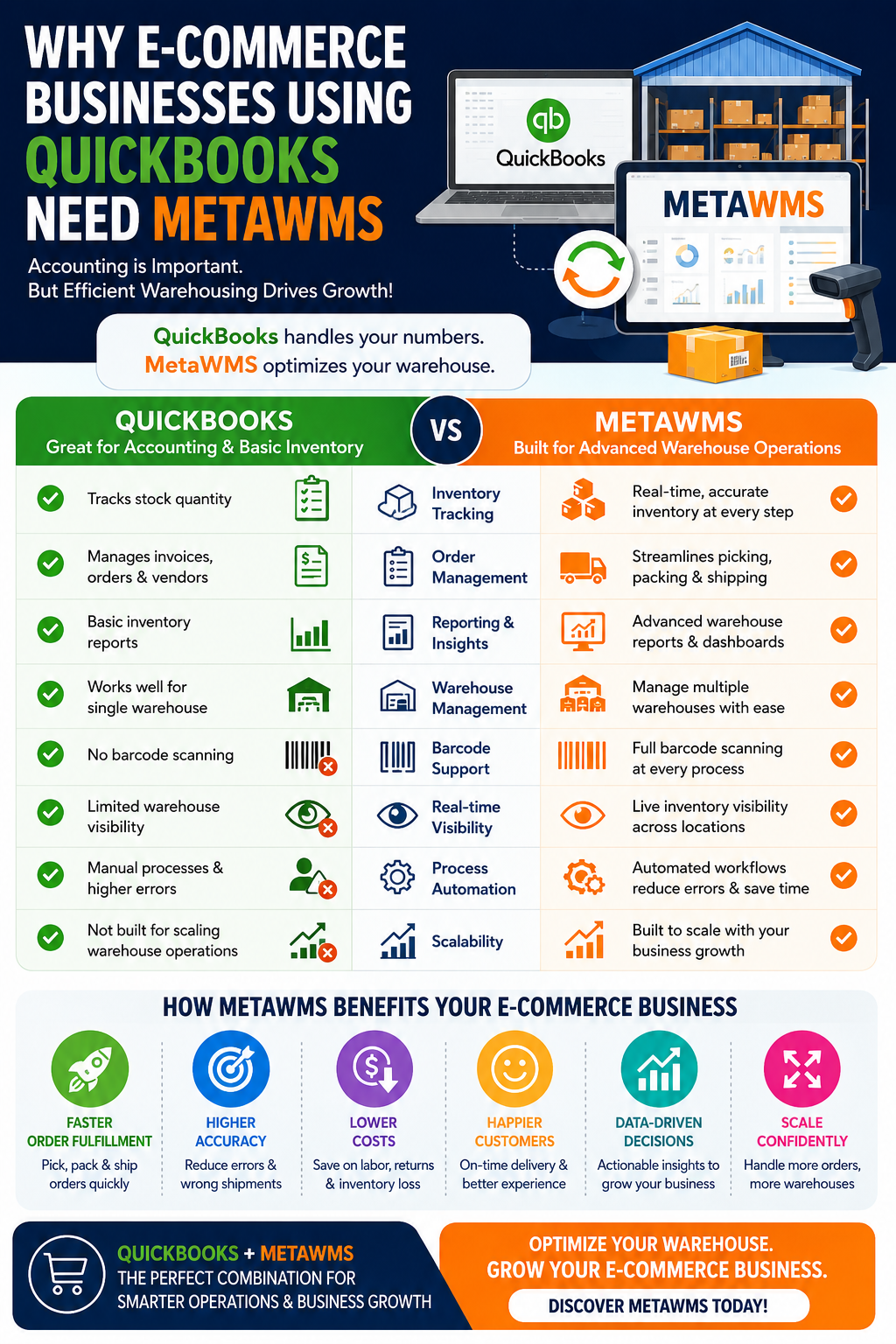
QuickBooks Is Excellent for Accounting, But Warehouse Operations Are Different
QuickBooks is one of the world's most popular accounting solutions for small and medium-sized businesses. It simplifies financial management by helping companies manage:
- Sales
- Invoices
- Purchase orders
- Expenses
- Vendor payments
- Basic inventory quantities
- Financial reporting
These capabilities are essential for running a business.
However, warehouse management requires much more than knowing how many products are available.
Modern e-commerce warehouses need to manage thousands of SKUs, multiple storage locations, barcode scanning, order picking, packing, shipping, inventory transfers, returns, and real-time stock updates. These operational processes require specialized warehouse software.
This is why many growing online businesses combine QuickBooks with a dedicated warehouse management solution like MetaWMS.
Common Warehouse Challenges Faced by E-commerce Businesses
As an online business grows, warehouse operations become increasingly demanding.
Some of the most common challenges include:
Inventory Inaccuracies
Without real-time warehouse visibility, inventory records often become inaccurate. Products may appear available in QuickBooks even though they have already been picked or shipped.
This results in:
- Overselling
- Stock shortages
- Customer complaints
- Order cancellations
Slow Order Fulfillment
Customers expect same-day or next-day shipping.
Manual picking and paper-based warehouse processes slow down fulfillment, increasing the risk of shipping delays.
Human Errors
Warehouse staff manually selecting products often pick the wrong SKU, incorrect quantity, or wrong customer order.
Even small mistakes can lead to costly returns and dissatisfied customers.
Poor Warehouse Visibility
Business owners often struggle to answer questions like:
- Which warehouse has available stock?
- Where exactly is a product stored?
- Which products are moving slowly?
- Which inventory requires replenishment?
Without warehouse intelligence, decision-making becomes difficult.
Difficulty Managing Multiple Warehouses
Many e-commerce businesses eventually expand into multiple warehouses.
Managing inventory across several locations manually is both time-consuming and error-prone.
Why Basic Inventory Management Is Not Enough
Basic inventory management records stock quantities.
Warehouse management controls how inventory moves throughout the warehouse.
There is a major difference.
Inventory management answers:
- How much inventory do I have?
- What products need reordering?
Warehouse management answers:
- Where is every product located?
- Which employee should pick the order?
- Which route minimizes walking time?
- Which carrier should ship this package?
- How can warehouse productivity improve?
MetaWMS focuses on operational efficiency, while QuickBooks focuses on accounting accuracy.
Together, they create a complete business management solution.
What Is MetaWMS?
MetaWMS is an advanced Warehouse Management System designed to simplify warehouse operations for manufacturers, distributors, wholesalers, and e-commerce businesses.
It helps businesses automate warehouse processes from receiving inventory to final shipment.
MetaWMS enables companies to improve warehouse accuracy, reduce manual work, and fulfill orders faster using barcode-driven workflows and real-time inventory visibility.
Why E-commerce Businesses Using QuickBooks Need MetaWMS
1. Real-Time Inventory Accuracy
One of the biggest advantages of MetaWMS is real-time inventory visibility.
Every warehouse transaction updates inventory immediately.
Whether inventory is:
- Received
- Picked
- Packed
- Transferred
- Returned
- Shipped
the system records the movement instantly.
This helps eliminate stock discrepancies and prevents overselling.
Customers receive accurate stock information, resulting in fewer cancelled orders.
2. Barcode-Based Warehouse Operations
Manual inventory handling often leads to mistakes.
MetaWMS supports barcode scanning throughout warehouse operations.
Warehouse staff can scan products during:
- Receiving
- Put-away
- Picking
- Packing
- Shipping
- Cycle counting
Barcode validation significantly reduces human errors while improving speed.
3. Faster Order Picking
Order picking is one of the most time-consuming warehouse activities.
MetaWMS helps warehouse teams locate products quickly by providing precise storage locations.
Employees no longer waste time searching shelves.
This improves:
- Picking speed
- Labor productivity
- Order accuracy
Faster picking leads to faster deliveries.
4. Better Warehouse Organization
As inventory grows, warehouse organization becomes increasingly important.
MetaWMS allows businesses to manage:
- Warehouse zones
- Bin locations
- Shelves
- Storage racks
Every item has a designated location, making inventory easier to locate and manage.
5. Multi-Warehouse Management
Many successful online retailers operate warehouses in different cities or regions.
MetaWMS enables businesses to manage inventory across multiple warehouse locations from a single platform.
Businesses can:
- Transfer inventory
- Monitor warehouse stock
- View location-specific inventory
- Balance inventory between warehouses
This simplifies inventory planning while reducing shipping costs.
6. Improved Order Accuracy
Incorrect shipments damage customer trust.
MetaWMS validates every step using barcode scanning and warehouse workflows.
Warehouse teams are guided throughout the fulfillment process, ensuring customers receive the correct products every time.
Higher accuracy means:
- Fewer returns
- Lower replacement costs
- Better customer reviews
7. Efficient Returns Management
Returns are a normal part of e-commerce.
Managing returns manually often creates inventory confusion.
MetaWMS streamlines reverse logistics by allowing warehouse teams to inspect returned products, update inventory status, and return eligible items back into stock quickly.
This improves inventory availability while reducing losses.
8. Warehouse Productivity Reporting
Growing businesses need data to improve operations.
MetaWMS provides detailed warehouse reports covering:
- Inventory movement
- Picking performance
- Warehouse productivity
- Stock aging
- Order fulfillment
- Inventory turnover
These insights help managers make informed operational decisions.
9. Reduced Operational Costs
Warehouse inefficiencies increase operating expenses.
Manual processes require more labor while generating more errors.
MetaWMS helps reduce costs by:
- Automating workflows
- Minimizing manual work
- Improving picking efficiency
- Reducing inventory losses
- Lowering return rates
The result is a more profitable warehouse operation.
10. Scalable Growth
Every e-commerce business wants to grow.
However, growth becomes difficult when warehouse operations remain manual.
MetaWMS scales alongside your business by supporting:
- Higher order volumes
- Additional warehouses
- More employees
- Larger product catalogs
- Business expansion
This allows businesses to grow without sacrificing efficiency.
How MetaWMS Complements QuickBooks
QuickBooks and MetaWMS perform different but complementary roles.
QuickBooks serves as the financial backbone of your business by handling accounting, invoicing, expenses, payroll (where applicable), tax reporting, and financial statements.
MetaWMS manages the physical movement of inventory within your warehouse. It tracks where products are stored, directs warehouse staff through receiving, put-away, picking, packing, shipping, and returns, and provides real-time operational visibility.
Instead of replacing QuickBooks, MetaWMS enhances your overall business operations by adding warehouse intelligence and automation.
This combination gives businesses the best of both worlds: accurate financial management and efficient warehouse execution.
Signs Your Business Has Outgrown QuickBooks Inventory
You should consider implementing MetaWMS if:
- Your warehouse ships more than 100 orders daily.
- Inventory mistakes are becoming frequent.
- Customers receive incorrect products.
- Employees rely on paper picking lists.
- Finding products takes too long.
- You operate multiple warehouses.
- Returns are difficult to manage.
- Stock counts consume excessive time.
- Warehouse labor costs continue to rise.
- Customer complaints about delayed shipments are increasing.
If several of these challenges sound familiar, a dedicated warehouse management system can deliver immediate operational improvements.
Benefits of MetaWMS for Different E-commerce Businesses
Online Retailers
MetaWMS helps retailers fulfill orders faster, maintain accurate inventory, and improve customer satisfaction.
Wholesale Distributors
Distributors benefit from bulk inventory handling, organized warehouse locations, and efficient order processing.
Manufacturers Selling Online
Manufacturers can synchronize production inventory with warehouse operations while maintaining accurate stock visibility.
Multi-Channel Sellers
Businesses selling through multiple online marketplaces gain better inventory control and avoid overselling by managing warehouse operations from one centralized system.
Best Practices for Implementing MetaWMS
To maximize the value of MetaWMS:
- Clean and organize your inventory data before implementation.
- Label all storage locations with clear barcode identifiers.
- Standardize warehouse receiving and shipping processes.
- Train warehouse staff on barcode scanning workflows.
- Conduct regular cycle counts to maintain inventory accuracy.
- Monitor warehouse performance using reports and dashboards.
- Review operational metrics regularly to identify opportunities for continuous improvement.
Following these practices helps businesses achieve faster adoption and long-term operational success.
Why MetaWMS Is a Smart Investment
Many businesses hesitate to adopt a warehouse management system because they view it as an additional expense.
In reality, the cost of warehouse inefficiency is often much higher.
Incorrect shipments, lost inventory, manual errors, delayed deliveries, excess labor, and customer dissatisfaction all impact profitability.
MetaWMS helps reduce these hidden costs while improving warehouse efficiency, inventory accuracy, and order fulfillment speed. Over time, the operational savings and improved customer experience can outweigh the investment.
Frequently Asked Questions
Can QuickBooks be used as a Warehouse Management System?
No. QuickBooks offers inventory management features, but it is not a full Warehouse Management System. It does not provide advanced warehouse capabilities such as directed picking, barcode-driven workflows, warehouse slotting, or real-time warehouse execution.
Why should e-commerce businesses use MetaWMS with QuickBooks?
QuickBooks manages your financial records, while MetaWMS manages warehouse operations. Together, they provide a complete solution for accounting, inventory visibility, and efficient order fulfillment.
Is MetaWMS suitable for small and growing businesses?
Yes. MetaWMS is designed to support businesses as they grow, making it suitable for companies that are expanding their product catalog, warehouse operations, or order volume.
Does MetaWMS support barcode scanning?
Yes. Barcode scanning is a core feature of MetaWMS and helps improve inventory accuracy, speed up warehouse processes, and reduce manual errors.
Can MetaWMS help manage multiple warehouses?
Yes. MetaWMS provides centralized visibility and control over inventory across multiple warehouse locations, making it easier to transfer stock, monitor inventory levels, and optimize fulfillment.
Conclusion
QuickBooks remains an excellent solution for accounting and basic inventory tracking, but modern e-commerce businesses require much more to run efficient warehouse operations. As order volumes increase and customer expectations continue to rise, manual warehouse processes become a barrier to growth.
MetaWMS fills this gap by providing real-time inventory visibility, barcode-enabled workflows, organized warehouse locations, faster picking and packing, efficient returns management, and detailed operational reporting. Rather than replacing QuickBooks, it extends its capabilities, allowing businesses to combine strong financial management with advanced warehouse execution.
For e-commerce companies looking to improve fulfillment accuracy, reduce operational costs, and scale confidently, adopting MetaWMS alongside QuickBooks is a practical step toward building a more efficient and customer-focused operation. This combination helps businesses deliver faster, operate smarter, and stay competitive in an increasingly demanding e-commerce landscape.