Manhattan WMS: All You Need to Know
Manhattan WMS (Warehouse Management System) is a flagship solution of Manhattan Associates for managing warehouse and distribution centre operations. Manhattan WMS (now delivered as Manhattan Active Warehouse Management) provides end-to-end inventory visibility, automated order fulfilment, labour and slotting optimization, and real-time execution control. In short, it digitises and orchestrates everything from receiving and put-away to picking, packing and shipping.
At its core, Manhattan WMS tracks and controls all warehouse processes. The system manages inventory in real time (across bins, racks, storage areas and yard) and automates workflows for order processing (picking, packing, shipping). It also includes labour management (assigning tasks, tracking performance) and slotting optimization (dynamically locating goods to minimise travel).
As one analyst review notes, “Manhattan Active Warehouse Management… facilitates inventory control, order fulfilment, labour management, and slotting optimization”, enabling visibility into inbound/outbound shipments and stock levels. Because it is delivered via a cloud-native, API-first architecture, the software scales automatically and is regularly updated with new features.
What Are The Top Alternatives of Manhattan WMS (Best Value-for-Money)
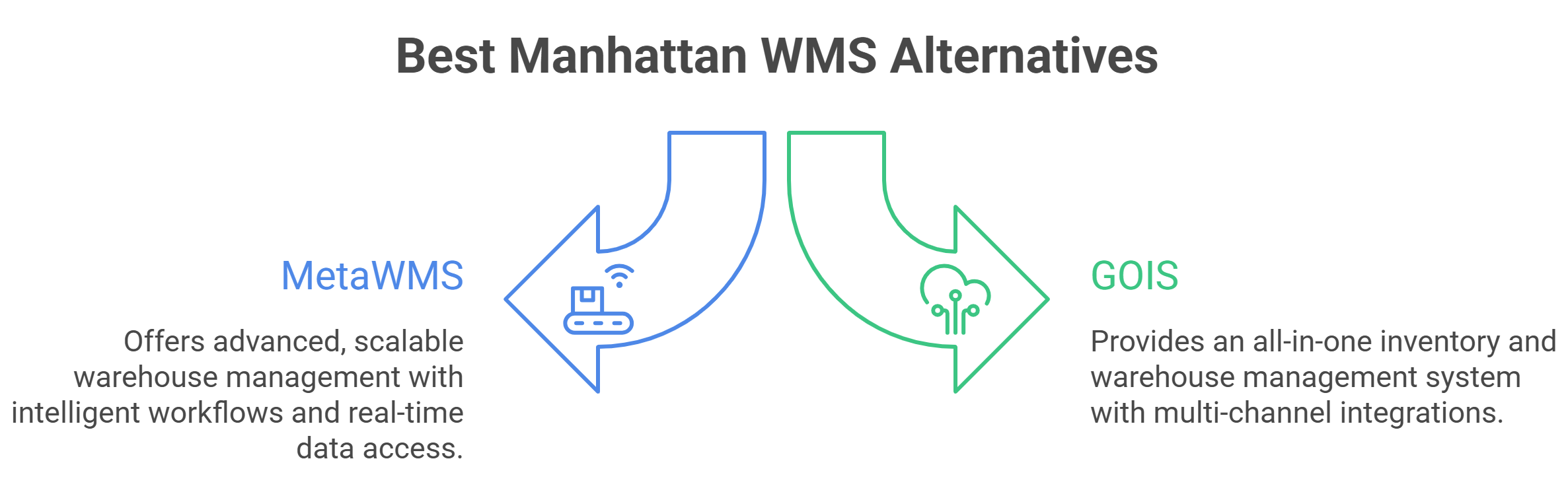
Two strong alternatives of Manhattan WMS are MetaWMS and GOIS (Goods Order Inventory System): both offering modern capabilities tailored to evolving warehouse and inventory management needs.
MetaWMS – Intelligent, Scalable Warehouse Management
MetaWMS is an advanced, next-generation warehouse management solution designed to eliminate inefficiencies, reduce errors, and bring complete operational visibility across warehouse environments. Built on Microsoft Dynamics 365 Business Central, MetaWMS combines enterprise-grade capabilities with flexibility and ease of use.
What sets MetaWMS apart is its ability to transform complex warehouse operations into a streamlined, automated, and highly controlled ecosystem. From inbound logistics to outbound fulfillment, every process is optimized through intelligent workflows and real-time data access.
With MetaWMS, businesses can gain:
- Complete visibility into inventory across multiple locations with real-time tracking
- Automated warehouse workflows that reduce manual errors and improve efficiency
- Optimized picking, packing, and shipping processes for faster fulfillment
- Seamless integration with ERP systems, shipping carriers, and barcode technologies
Beyond core operations, MetaWMS offers deep functionality such as batch and serial tracking, expiry management (FIFO/FEFO), cross-docking, cycle counting, and intelligent putaway recommendations. Its built-in dashboards and KPI tracking enable warehouse managers to make faster, data-driven decisions.
GOIS – All-in-One Goods Order Inventory System
GOIS (Goods Order Inventory System) is a modern, cloud-based inventory and warehouse management platform designed to unify inventory, order management, POS, and fulfillment into a single, easy-to-use system.
Unlike traditional warehouse systems that focus only on backend operations, GOIS takes a holistic approach, connecting everything from warehouse inventory to sales channels and checkout systems. This makes it particularly valuable for businesses operating in multi-channel and global environments.
GOIS is built to support end-to-end operations, including:
- Order and purchase management with real-time tracking of shipments and payments
- Multi-warehouse inventory control with seamless stock transfers and movement tracking
- Barcode and QR code scanning for faster and more accurate inventory updates
- Multi-channel integrations with platforms like Shopify, Amazon, and WooCommerce
- Connectivity with accounting tools (QuickBooks, Xero), ERPs (SAP, NetSuite), and shipping carriers (FedEx, DHL, UPS)
One of GOIS’s biggest advantages is its strong focus on automation and efficiency. Businesses using GOIS report significant improvements in operational performance, including reduced manual work, faster audits, and better inventory control. Features like automated order tracking, real-time alerts, and advanced inventory tracking (batch, serial, expiry-based) make it highly effective for industries dealing with high inventory movement.
What is Manhattan Active Warehouse Management (Cloud-Native WMS)?
Manhattan’s latest WMS offering – Manhattan Active Warehouse Management – is designed as a 100% cloud-native, microservices solution. It is actually “the world’s first cloud-native enterprise-class WMS capable of unifying every aspect of distribution”, meaning no more painful software upgrade projects. Instead, new capabilities arrive continuously (Manhattan delivers quarterly automatic updates) and the system is “visionless”.
Built entirely from microservices, Manhattan Active WM automatically scales to any business need and uses AI-driven insights for real-time decision-making. In practice this means a single, centrally managed platform – the Manhattan Active® Platform – connects all your warehouse facilities, yard, and transportation processes. Users log in to one unified application for inventory, orders, labor, slotting and automation across their entire network, without having to hop between siloed systems.
What Are the Key Features of Manhattan WMS?
Manhattan WMS offers a comprehensive set of features for modern warehouses:
- Global Inventory Visibility: It provides a single view of inventory across sites and operations. Managers see all stock from inbound to reserve storage, active pick zones and automated areas, through to outbound shipments. Real-time dashboards and digital twins let supervisors visualize people, equipment and goods in the warehouse for quick decision-making.
- Adaptive Order Planning: The system ingests incoming orders and uses Order Streaming (an AI-driven planning engine) to continuously optimise task assignments. As orders arrive or situations change (e.g. a robot fails or a rush order comes in), Manhattan WMS recalculates and re-prioritises tasks on-the-fly. This execution-driven planning ensures orders meet promised ship dates with high efficiency.
- Unified Workflow Execution: Unlike legacy WMS that separate tasks by order type, Manhattan’s WMS orchestrates all activities together. Dynamic workflows let put-away, picking, slotting and sorting run simultaneously and adapt in real time. Staff see an intuitive, mobile-friendly interface with actionable instructions (including images and prompts) that guide each task. Meanwhile, the built-in Warehouse Execution System (WES) tightly synchronizes material-handling equipment and robotics with human pickers. In effect, robots and conveyors operate as part of the WMS, not as an afterthought.
- Advanced Optimization: The system continually optimises layout and labor. For example, slotting optimization automatically relocates inventory to the best pick face, shortening travel times and speeding throughput. Labor management is embedded too – not a separate module – so the system can balance workloads, apply gamification and track performance in real time. A single app now handles both task execution and labor metrics, giving supervisors full visibility and control.
- Robotics & Automation: Manhattan WMS is “robot-ready”. Through the Manhattan Automation Network, it integrates with a wide range of automation technologies (AS/RS, conveyors, AMRs, sorters, etc). Robots and humans work in sync, with AI optimizing throughput across all assets. For example, Manhattan’s WMS can send pick instructions to an autonomous picking robot at the same time as directing a person to another task, maximising total throughput.
These capabilities are delivered via Manhattan’s cloud platform – so the WMS is also highly secure and flexible. A Manhattan blog notes that a cloud-native structure means “no version lock-in, automatic quarterly upgrades, reduced IT overhead, and faster scalability”. In practice, customers say they can “experiment with anything… deploy on Friday and decide… whether to roll back or move forward” quickly on this platform.
What Are the Integration and Ecosystem of Manhattan WMS?
Manhattan WMS does not operate in isolation. It links to the broader supply chain landscape via APIs. Out of the box, Manhattan integrates with ERP, order management, transportation (TMS) and yard management systems to create a unified supply chain platform. For example, inventory changes in the WMS update in real time in the ERP, and vice versa. Similarly, dock-door schedules (from a yard management system) and carrier appointments (via TMS) can be fully coordinated with warehouse tasks, eliminating the handoff delays that plague disjointed systems.
The Manhattan platform covers all execution domains. In addition to WMS, Manhattan also offers Active Yard Management and Active Transportation Management. They share the same data backbone and user interface, so truck arrivals, dock assignments, and warehouse labor can be managed seamlessly together. This tight integration is a key differentiator – as one whitepaper puts it, traditional WMS/TMS/YMS “move data back and forth, but each still plans and optimizes within its own silo.” Manhattan replaces that with a single decision environment for all domains.
Customer feedback confirms the integration strength. Reviewers note that Manhattan WMS’s modern, container-based infrastructure “enabl[es] us to use more modern CI/CD workflows” and is “flexible to meet our needs”. On the other hand, some warn that leveraging this power requires good planning: the system can feel static in places and needs thorough design work up front. In other words, Manhattan’s WMS is highly capable, but companies should allow time for configuration, integration and staff training.
What Are the Industry Recognition of Manhattan WMS?
Manhattan’s WMS leadership is well recognized by analysts. It has been named a Leader in Gartner’s Magic Quadrant for WMS for 17 years running. In the latest 2025 report, Gartner again positioned Manhattan as a Visionary/Leader, and in their Critical Capabilities for WMS Manhattan Active Warehousing earned the highest scores for the most complex warehouse scenarios. In short, Gartner highlights Manhattan’s cloud-native, microservices approach as a top solution for sophisticated, high-volume operations.
Other analyst sources echo this. Nucleus Research notes that a majority of Manhattan customers achieve positive ROI within a few years of go-live, thanks to productivity gains and cost savings. Industry blogs also cite Manhattan WMS’s slotting algorithms and AI features as state-of-the-art. (By comparison, competitors like SAP EWM integrate deeply into SAP’s ecosystem but often lack Manhattan’s level of built-in automation and AI-driven slotting.)
What Are the Customer Success Stories of Manhattan WMS?
ALSPEC, an Australian aluminum systems distributor, upgraded to Manhattan WMS to support its growth. After deploying the Manhattan WMS across eight DCs, ALSPEC achieved greater inventory visibility and efficiency. According to the case study, stock visibility improved, picking and packing became faster, and cross-docked items could be tracked more accurately. The flexible WMS even worked seamlessly with ALSPEC’s new ERP, demonstrating the solution’s integration capabilities.
Customer success with Manhattan WMS is broad. For example, DHL – one of the world’s largest logistics companies – chose Manhattan Active Warehouse Management as part of a cloud-first strategy. DHL’s CIO Markus Voss praised the switch to Manhattan’s versionless, cloud solution, noting that “going versionless is a big promise… We have upgraded many times and that is always a painful exercise”. In Manhattan’s own video case study, DHL reports that the new WMS integrates smoothly with their operations and ensures DHL always has the latest functionality for its warehouses. (This is important for DHL, which runs hundreds of facilities globally.)
Manhattan WMS customer DHL highlights the platform’s cloud-native agility. Markus Voss, Global CIO of DHL Supply Chain, emphasizes the benefit of a “versionless” WMS – upgraded in real time via the cloud – helping DHL avoid the pain of traditional upgrade projects.
One of the most dramatic examples comes from South Africa. Waltons (a 52-store retailer) replaced a legacy, paper-based system with Manhattan WMS and automation. Within months, Waltons saw productivity jump 166% and warehouse staff drop by 52%. Inventory accuracy improved from ~87% to 97% and shipping accuracy hit 100%. Pick rates soared (from ~30 to 80 lines per hour) and cycle-counts that took days were done in hours. These gains translated to millions in savings and the project paid for itself in about six months. Manhattan has published an ROI analysis showing Waltons’ annual savings in the millions (USD) from labor, inventory and overhead reductions.
Other public case studies and customer reviews tell a similar story of efficiency gains, whether the industry is retail, grocery, 3PL or manufacturing. According to Manhattan’s site, customers have reported “improved inventory accuracy, enhanced picking efficiency and on-time shipping performance” after going live with Manhattan WMS. In Peer Insights surveys, users praise the system’s flexibility and comprehensive feature set – one reviewer notes they got “what we paid for” and found the product “very predictable”. Of course, no system is without critics: some users mention a steep learning curve and the need for detailed initial configuration. But the consensus is that Manhattan WMS delivers robust capabilities for complex operations.
What Are the Implementation and Deployment Considerations of Manhattan WMS?
Deploying Manhattan WMS is a major project. Manhattan’s documentation advises that implementations typically take six to nine months to prepare for go-live. This timeline can vary based on scope, customisations and the need to integrate third-party automation. Early phases involve detailed planning of hardware, network, and conversion steps, followed by configuration and user training.
Because of its depth, Manhattan WMS often requires strong project management and executive support. Companies should budget for experienced analysts or consultants to map their processes to the system’s workflows. Training is crucial: one analyst notes that Manhattan’s WMS “supports complex workflows… requiring dedicated in-house technical support” and structured training for warehouse staff. In practice, firms often roll out Manhattan WMS module by module or facility by facility to manage this complexity. Ongoing support (often via Manhattan or certified partners) is also important to troubleshoot issues and tune performance.
Integration is another key challenge. While Manhattan provides many standard connectors, large customers often build custom links between WMS and their ERP, order management and automation equipment. Implementation partners typically handle middleware and API development. As the comparison guide notes, Manhattan WMS can demand “custom connectors, middleware dependencies, [and] longer testing and validation cycles” when tying into legacy systems. Factoring this into the project plan is essential.
On the plus side, Manhattan provides tools to smooth deployment. Its cloud-native architecture means there is no on-site software to install, and updates are managed by Manhattan. Also, because all facilities run on the same cloud platform, configuration changes (like new pick rules or updated reporting) can be propagated instantly to every warehouse without an IT upgrade. Users highlight that the platform’s predictability – knowing exactly how workflows will operate – helps in planning and change management.
Finally, cost and ROI: Manhattan WMS is typically sold via subscription (SaaS) or license plus support. Pricing depends on factors like number of users, sites and modules. Exact figures are often confidential, but one report suggests a per-warehouse subscription in the low thousands of dollars per month. That said, given the productivity and accuracy gains described above, customers often see a rapid payback. The Waltons case, for instance, achieved break-even in under one year. A longstanding study by Nucleus found that two-thirds of Manhattan users saw a positive ROI within ~2.5 years.
Conclusion
Manhattan WMS (now Manhattan Active Warehouse Management) is one of the industry’s most advanced warehouse execution platforms. It is designed for complex, high-volume operations where real-time optimization and integration are critical. Its cloud-native microservices architecture, continuous upgrade model and AI-enhanced automation set it apart from traditional on-premise systems. Major retailers, manufacturers and logistics firms use Manhattan WMS to gain end-to-end visibility and improve throughput. Independent analysts consistently rank Manhattan at the top of the WMS market.
That said, Manhattan’s power comes with complexity. Successful deployments require careful change management, adequate training, and often a phased rollout. Companies must be prepared for the implementation effort. But for businesses needing a future-ready, flexible warehouse management system, the benefits can be substantial: higher accuracy, faster order cycles, better labour productivity and seamless connectivity across the supply chain.
Sources: Authoritative Manhattan Associates documentation and whitepapers; industry analysis and blogs; and customer case studies and reviews. Each point above is backed by these references.