The Future of CRM Is Visual-First, And Most Businesses Aren't Ready
We have spent over two decades inside the Microsoft Dynamics 365 CRM ecosystem, working with sales teams, service operations, and CRM administrators across industries, geographies, and company sizes. In that time, we have seen CRM platforms evolve from basic contact databases to AI-powered business intelligence engines.
But there is one thing that has not changed nearly enough.
The way most people work inside their CRM looks almost identical to how it looked in 2005.
A grid. A list of rows. Columns of data. Click to open. Update. Save. Go back.
And it is quietly costing businesses more than they realise.
The Adoption Problem Nobody Wants to Talk About
Here is a set of numbers that should concern every CRM decision-maker in 2026.
Up to 70% of CRM projects fail to meet their objectives, not because of the technology, but because of poor user adoption.
The average CRM adoption rate across business sectors sits at just 26%.
32% of sales reps spend over an hour every single day on manual data entry instead of selling. And 76% of CRM users report that less than half of their organisation's CRM data is accurate and complete.
These are not technology failures. They are interface failures.
At Inogic, we have seen this pattern repeat itself across hundreds of Dynamics 365 implementations.
The CRM gets deployed. The data model is solid. The workflows are configured. And then, six months later, adoption is low, records are stale, and leadership is questioning the ROI.
The reason, almost universally, is friction. The interface asks too much of the user. Updating a record requires too many steps. The cognitive load of working in a grid, scanning rows, opening records, navigating fields, saving, and returning, accumulates across every working hour of every working day. People find workarounds. Spreadsheets. Whiteapp notes. Memory.
The CRM becomes a system of record in name only.
What Twenty Years of Implementation Experience Teaches You
When you have delivered CRM solutions across as many industries and team structures as we have at Inogic, patterns become unmistakable.
The teams with the highest CRM adoption are not the ones with the most complex implementations. They are the ones where the interface makes the next action obvious. Where updating a record feels like a natural extension of the work, not an interruption to it.
The human brain processes visual information 60,000 times faster than text. This is not a UX opinion. It is a cognitive reality that has direct implications for how enterprise software should be designed and how CRM users should be expected to interact with their data.
A pipeline that lives in a grid requires a sales rep to mentally construct the visual picture of where their deals stand. A pipeline that lives in a Kanban board in Dynamics 365 CRM shows them that picture instantly. Lane by lane. Card by card. Stage by stage.
The difference in cognitive load between those two experiences is the difference between a CRM your team uses and a CRM your team tolerates.
Why Visual-First Is Not a Trend, It Is the Direction
We built a Kanban Board for Dynamics 365 because we kept solving the same problem for clients who deserved a permanent fix, not a workaround.
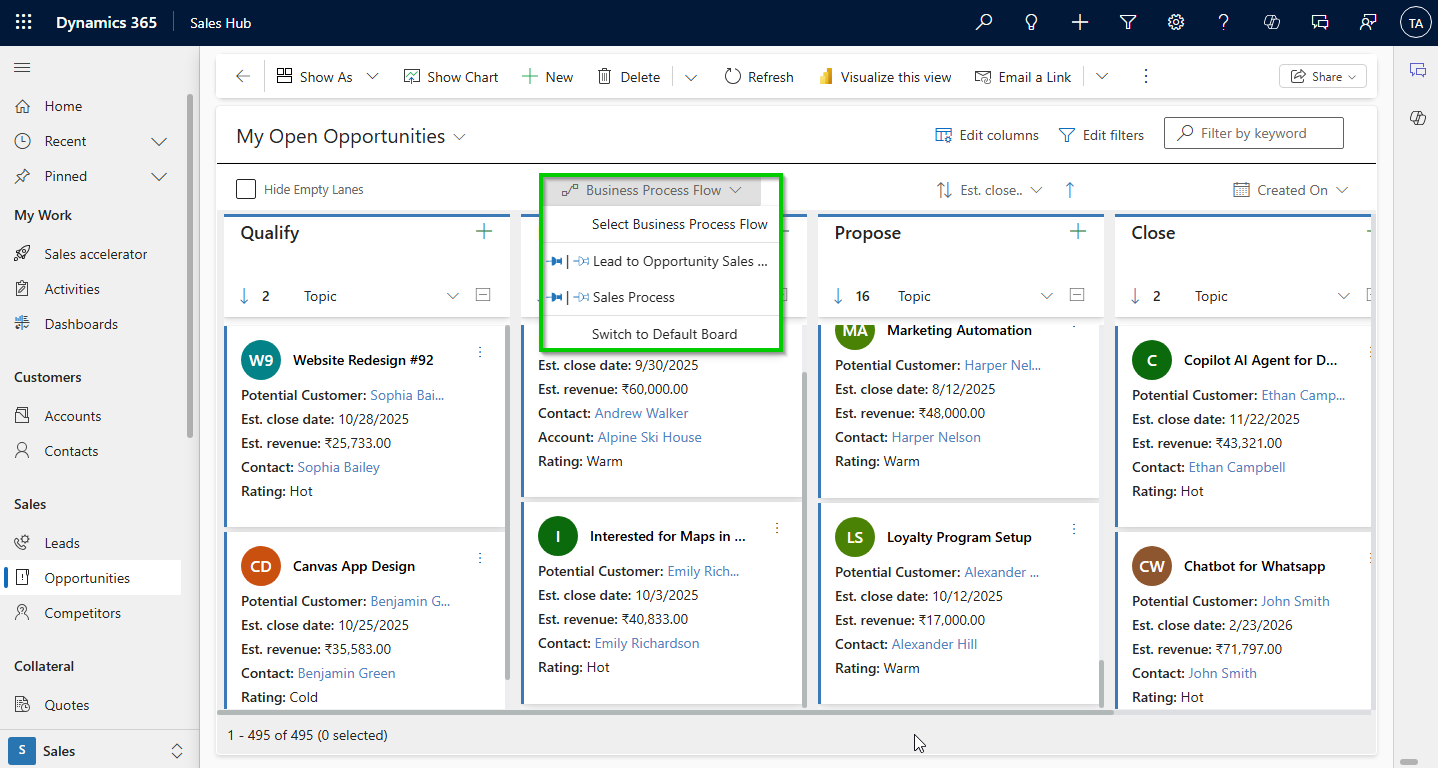
The Kanban view in Dynamics 365 CRM, which we designed, gives every record a visual identity. Every deal, every case, every custom entity becomes a card in a lane. Moving it forward takes one drag. Dynamics 365 updates instantly. No forms. No navigation. No friction.
The Kanban lane dynamics 365 structure maps directly to your Business Process Flow stages, your status fields, your organisational logic, whatever your team actually works by. And swim lanes let managers see workload distribution across owners or priority tiers at a glance, without running a single report.
This is not a cosmetic upgrade to Dynamics 365. It is a fundamental rethinking of how CRM users interact with their data, and consequently, how consistently and accurately that data gets maintained.
We have seen this shift produce real, measurable outcomes. Support teams are cutting standup time by a third because the board shows what a 30-minute meeting used to explain. Sales managers can identify stalled deals in seconds instead of running weekly pipeline reviews. Service leads rebalancing agent workloads in real time instead of discovering overload after an SLA breach.
These outcomes do not come from adding features. They come from removing friction.
The Copilot Era Makes This Urgent
Here is what makes visual-first CRM more strategically important in 2026 than it has ever been.
Microsoft Copilot in Dynamics 365 reads your CRM data to generate summaries, forecasts, and next-best-action recommendations. Its output quality is directly proportional to your data quality. Stale records produce weak AI. Consistently updated records, the kind that Kanban card dynamics 365 drag-and-drop interaction naturally produces, give Copilot the clean, structured, real-time signals it needs to perform.
The organisations that will get the most from Copilot are not the ones that invest most in AI configuration. They are the ones whose teams actually use their CRM, whose records reflect reality because the interface made that easy.
Visual-first is not just better UX. In a Copilot-first world, it is better AI infrastructure.
What We Believe And What We Have Seen Prove It
At Inogic, our conviction after 20+ years is this: the CRM adoption problem has never been a training problem or a change management problem at its root. It has been a design problem.
People do not resist CRM. They resist CRM, which makes their job harder.
The future of Dynamics 365 CRM is visual-first. Boards over grids. Cards over rows. Drag over click. Clarity over complexity.
Most businesses are not ready for that shift yet.
The ones who make it first will build the kind of CRM discipline that drives adoption, data quality, and ultimately, AI performance, that their competitors will spend years trying to close the gap on.
The Kanban view in Dynamics 365 is not where this journey ends. But for most organisations, it is exactly where it should start.
For more details, the Kanban Board by Inogic is available for a 15-day free trial on the Inogic website or directly on the Microsoft Marketplace.