10 Top Shipping Management Software Features to Watch out in 2027
Did you know that shipping management software can turn every package you send into either a repeat customer or a refund request? One delayed delivery can cost you a customer, one wrong carrier choice can wipe out your margin, and one blind spot in tracking can leave your support team scrambling for answers.
January 2027 is just around the corner. New carrier rates will go live overnight; your inbox might hold 140. "Where is my order?" tickets, and someone is still copying addresses from your ERP into a carrier portal. That's not a shipping problem. It's a software problem.
So here are the 10 features to demand when you're choosing shipping management software solutions…
Quick answer: The best shipping management software compares carrier rates in real time, automates labels, tracks every parcel with branded alerts, syncs with your ERP, handles returns and customs, audits invoices, predicts delays with AI, and scales in the cloud.
Looking for the best shipping management software for Business Central? Book a free MetaShip demo and see it working on your own orders.
10 Shipping Management Software Features to Watch in 2027
Each feature starts with the pain it solves, then what to check in a demo.
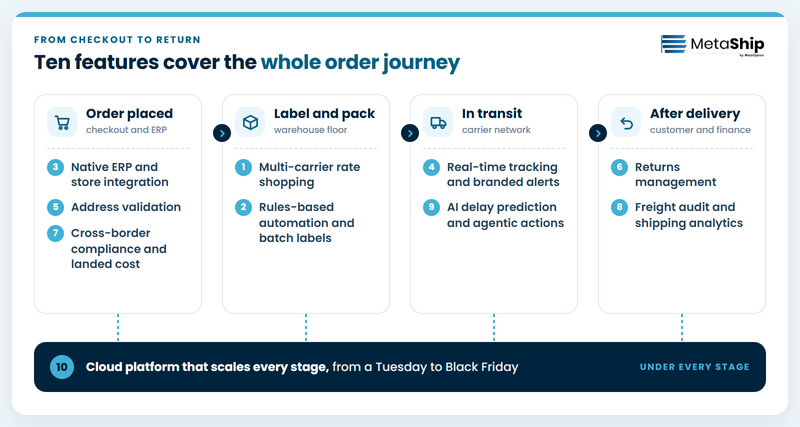
Every order stage has a feature that removes manual work, and the cloud platform carries them all.
1. Multi-Carrier Rate Shopping: Stop Overpaying on Every Label
The pain: Your team defaults to one carrier out of habit. The top shipping software compares live, negotiated rates across national, regional, and postal carriers, then picks the cheapest service that meets the delivery promise.
Look for: Your own contract rates, delivery-date rules and dimensional weight checks before the label prints.
2. Rules-Based Automation: Kill the Copy-Paste
The pain: Staff pick boxes, services and insurance by hand. Shipping automation software turns those choices into rules, such as "insure orders over $200," and prints hundreds of labels in one batch.
Look for: Rules on weight, value, SKU and destination, plus scan-to-verify packing.
3. Native ERP Integration: If It Doesn't Talk to Dynamics 365, It's a Silo
The pain: Finance reconciles ERP orders against carrier portals by hand. Shipping software solutions should pull sales orders from Dynamics 365 Business Central or Supply Chain Management and write tracking numbers and freight costs back automatically.
Look for: Two-way sync, Shopify and Amazon connectors, and open APIs.
4. Real-Time Tracking and Branded Alerts: Silence "Where Is My Order?"
The pain: Half your support queue asks one question. Proactive email and SMS alerts answer it first.
Look for: One feed for every carrier, branded pages and automatic delay notices.
5. Address Validation: One Wrong Digit, One Lost Parcel
The pain: A bad apartment number means a failed delivery and a fee. Address validation catches typos before you buy a label, and exception alerts flag stalled parcels before customers call.
Look for: Residential versus commercial checks and a live exceptions queue.
6. Returns Management: Turn a Margin Leak Into Loyalty
The pain: Returns arrive by email and get approved by hand. A self-service portal lets customers print a label or QR code in a minute, while rules decide refunds. The NRF says 9% of returns are fraudulent.
Look for: Exchange-first flows and returns synced to your ERP as credit memos.
7. Cross-Border Compliance: Sell Globally Without the Paperwork
The pain: Parcels stall at customs over a wrong HS code. From January 18, 2027, FedEx charges $25 for paper trade documents, so electronic customs filing now pays for itself.
Look for: Auto-generated commercial invoices, HS code lookup and landed-cost estimates at checkout.
8. Freight Audit and Analytics: See Every Surcharge Before It Hits Your P&L
The pain: Carrier invoices get paid unchecked. Auditing flags wrong weights and duplicate charges, and analytics spot savings, such as FedEx Express Saver rising only 3.09% in 2027.
Look for: Cost-per-parcel dashboards, invoice audits and surcharge breakdowns.
9. AI and Agentic Automation: Predict the Delay Before Your Customer Does
The pain: You learn a parcel is late from the customer. The newest shipping software companies use AI to predict delays and alert buyers automatically. Easyship now lets AI assistants create labels through plain-language requests.
Look for: Predicted delivery dates at checkout and AI carrier selection you can override.
10. Cloud Scalability: Built for Black Friday, Priced for a Tuesday
The pain: on-premise tools crawl in peak season. Cloud based shipping software scales on demand and already holds 52% of the market. The best shipping software for small business adds monthly plans and clear per-label pricing.
Look for: Proven peak uptime, SOC 2 security and no hidden fees.
How to Compare Shipping Software Vendors in 4 Steps
- Map your profile: Pull 90 days of carriers, zones, weights and surcharges.
- Shortlist by fit: Small business tools such as ShipStation and Shippo, or enterprise platforms such as Descartes and nShift.
- Run a rate test with 200 of your real orders.
- Test the Dynamics 365 integration live, and check contracts for per-label and overage fees.
How MetaShip Fits Into This: Shipping Management Software Built Inside Dynamics 365
Most shipping software vendors make you choose: a powerful shipping tool, or a clean connection to your ERP. MetaShip gives you both, because it isn’t bolted onto Business Central. It lives inside it.
Built for Microsoft Dynamics 365 Business Central, MetaShip turns your sales orders into packed, labeled, tracked shipments without your team ever leaving the screen they already know. Here’s how it lines up with the features above:
- Multi-carrier rate shopping- Compare live rates from FedEx, UPS, USPS and DHL and pick the best option before the label prints.
- Rules-based automation- Create packing lists, print package labels and scan items straight into packages, with multiple packing stations running at once.
- Native ERP integration- No sync gaps and no copy-paste. Order, address and product data come straight from Business Central, so tracking and shipment details stay in one system.
- Real-time tracking- Follow every shipment from one place instead of jumping between carrier portals.
- Fewer address and picking errors- Because shipping data is pulled directly from your ERP, wrong addresses and wrong products are caught at the source.
- Cloud scalability- As a cloud based shipping software, MetaShip grows with your order volume and works with both Business Central Essentials and Premium.
The result? Fewer clicks per order, fewer shipping mistakes, and freight costs your finance team can actually see.
Final words
Carrier rates are rising, customers expect Amazon-level tracking and every surprise fee costs a checkout. The right shipping management software turns each threat into a number you control.
Start with rate shopping, Dynamics 365 integration and proactive tracking, then add returns, customs, audit and AI as you grow. Score every vendor against these 10 features, and insist on a demo with your own orders.
Your next step: pull last quarter's carrier invoices and count the surcharges you can't explain. That's your business case.
Frequently Asked Questions
What is shipping management software?
A platform that connects your orders to your carriers. It compares rates, prints labels, tracks parcels and manages returns and customs from one dashboard.
What is the best shipping software for small business?
One with multi-carrier rates, simple automation, a direct store integration and monthly pricing, plus room to connect to an ERP like Dynamics 365 Business Central.
Is cloud based shipping software better than on-premise?
For most businesses, yes. It scales for peak season, updates carrier rules automatically and runs from anywhere.
Does shipping software integrate with Dynamics 365?
Many tools connect to Business Central and Supply Chain Management, syncing orders in and sending tracking numbers and freight costs back.
How does shipping automation software reduce costs?
It picks the cheapest carrier that meets the delivery promise, flags billing errors on carrier invoices and cuts support costs with proactive tracking alerts that prevent where-is-my-order contacts.